A low-profile pallet truck solves one specific problem: entering pallets, skids, machine bases, or export platforms whose underside sits too close to the floor for a conventional truck. To choose correctly, you need to measure the entry opening, compare the truck’s full geometry with your floor and aisles, and test the loaded unit before purchase.
Key takeaways
- Measure pallet entry height before ordering a low profile pallet truck.
- Compare fork width, length, lowered height and load capacity.
- Use low-profile trucks for compatible skids, pallets and machine bases.
- Choose powered equipment when travel distance, gradients or load weight demand it.
What makes a pallet truck low profile, and which dimensions matter?
A low-profile pallet truck has a lowered fork height, or fork-tip entry height, that lets the forks pass beneath a reduced-clearance load. Common low profile pallet truck uses include entering low-deck pallets, skids, machine bases, and export platforms.
“Low profile” is not a uniform industry dimension: models advertised this way often enter at roughly 50–65 mm, while conventional hand pallet trucks commonly measure about 75–85 mm.
Compare these dimensions before choosing a truck:
| Dimension | What to check | Why it matters |
|---|---|---|
| Minimum fork height | Fork-tip entry height when lowered | Must clear the lowest pallet member |
| Maximum lift height | Raised fork height | Determines whether the load clears boards or transitions |
| Fork length | Usable length | Prevents an unsupported or unstable load |
| Fork width | Width of each fork | Must fit the pallet openings |
| Outside fork width | Distance across both forks | Must match runner spacing and aisle access |
| Turning radius | Truck’s required turning space | Determines manoeuvrability near racks and docks |
| Ground clearance | Clearance under tips, rollers, chassis, and linkage | Predicts contact with debris and dock plates |
| Rated capacity | Capacity at the stated load centre | Prevents comparing unlike ratings |
| Specified load centre | Often 600 mm on 2,000–2,500 kg trucks | Defines where the load’s centre of gravity may sit |
Lower entry height also leaves less clearance beneath the truck. A long or forward-set load increases bending moment, so a 2,000 kg rating at 600 mm cannot be compared with the same rating at another load centre. Check the load-centre figure, not capacity alone.
How do you measure the pallet and confirm fork compatibility?
Measure the pallet’s smallest underside opening, not the average clearance. This is the critical check for low profile pallet truck applications, because a fork tip that enters easily can still strike the deck when you pump the load.
- Place the pallet on the actual floor and measure from the floor to the lowest deck member at several points along both entry sides.
- Record nails, warped boards, runners, stretch wrap, broken timber, and other obstructions; use the smallest measurement.
- Compare that minimum opening with the truck’s fork-tip entry height, not only its published lowered fork height.
- Confirm that both forks enter fully and that the fork length supports the load without moving its centre beyond the truck’s rated load centre.
- Check that fork spacing matches the pallet runners and does not place a fork against a board edge.
| Pallet base | Compatibility check | Main risk |
|---|---|---|
| Block pallet | Forks must pass between blocks or through the designed openings | A bottom board close to the floor can stop entry |
| Stringer pallet | Confirm the forks fit beside or through the stringers | Narrow openings can prevent full entry |
| Skid | Measure every underside rail and cross-member | Low rails leave little lifting clearance |
| Export platform | Check its custom base, wrap, and bracing | Protruding timber can catch fork tips |
| Machine base | Verify structural strength and load-centre position | Uneven weight can overload one fork |
Entry alone is insufficient. The forks must lift clear of pallet boards, dock plates, conveyor transfers, and floor transitions without striking the underside. Damaged pallets are risk cases: reject them if boards flex, split, or shift during the first lift.
Where do low-profile pallet trucks work reliably?
A low profile pallet truck for warehouses in Vadodara works reliably in receiving areas, production floors, staging zones, and loading docks when loads travel short distances across flat, sound concrete at floor level.
Low profile pallet truck uses become risky at broken expansion joints, thresholds, dock-leveller gaps, steep dock-plate edges, ramps, wet monsoon surfaces, dust, loose debris, and confined aisles.
Roller or wheel choice changes the limit:
| Option | Advantage | Limitation |
|---|---|---|
| Small load rollers | Lower entry height | Stop or shock-load on broken concrete, leveller gaps, and steep plate edges |
| Larger load rollers | Better travel over rough floors | Increase the minimum entry height |
| Polyurethane rollers | Quieter and less likely to mark finished floors | Do not overcome broken or obstructed flooring |
| Nylon rollers | Roll more easily under heavy loads and tolerate moisture | Transmit more noise and impact |
A ramp requires controlled pulling or pushing, not a hope that low entry height will protect the truck. Wet concrete also demands traction, clean rollers, and attention to dust that becomes paste under load.
Run this four-part check with the intended pallet and load:
- Confirm both forks enter fully without scraping the underside.
- Pump initially and verify stable steering.
- Withdraw cleanly without fork-tip impact on boards, plates, or thresholds.
- Turn without contacting racks, dock edges, or adjacent pallets.
When is a standard truck, powered truck, or forklift the better choice?
Choose a standard hand pallet truck when pallets have normal entry height and you need more clearance beneath the chassis. A low profile pallet truck is a low-lift, manually propelled device for floor-level movement, not a stacker.
| Option | Better choice when | Why low profile is the wrong priority |
|---|---|---|
| Standard hand pallet truck | Pallets have normal entry height and travel is short on sound floors | More clearance protects the forks, rollers, and linkage at joints, debris, and dock plates |
| Powered pallet truck | Movement is heavy and repetitive, distances are long, trailers are loaded frequently, or ramps are involved | Manual pumping and propulsion increase fatigue and reduce control |
| Forklift or reach truck | Loads must be stacked, placed in racking, or lifted high enough to clear damaged boards, dock plates, conveyors, or floor transitions | Low lift height leaves too little margin to extract the load safely |
Treat steep ramps, uneven floors, frequent outdoor travel, and repeated heavy loads as warning signs. These conditions punish small rollers and low ground clearance, especially where broken concrete, plate edges, or loose debris interrupt the route.
Operators must not drag forks over debris, reverse carelessly across dock plates, side-load the forks, or use them as a pry bar. Low geometry leaves less protection for fork tips, rollers, and pump linkage.
For low profile pallet truck applications, choose it only when the route is clear and the job remains horizontal, controlled, and close to floor level.
How should you test and specify a low-profile truck in Vadodara?
Approve a low-profile truck only after a physical demonstration with your actual pallet or skid, intended load, real floor joints, turning space, and load-centre position. A catalogue photograph cannot reveal a tight entry, damaged boards, slow steering, or a fork that strikes a joint.
1. Load the truck as it will operate, then check full fork entry, stable steering during pumping, clean withdrawal, and turning without touching racks, dock edges, or adjacent pallets. Repeat the test at the actual load-centre position, not only with a centred sample load.
2. Specify service conditions, not just capacity. Record dust exposure, monsoon water at loading docks, indoor and outdoor travel, sealed pump components, corrosion-resistant fork finishes, protected or drainable wheel bearings, and wheel compounds suited to wet concrete.
These details can matter more than a small nominal-capacity difference for a low profile pallet truck for warehouses in Vadodara.
3. Ask the low profile pallet truck supplier in Vadodara for written parts availability covering pump seals, lowering valves, load rollers, and handle assemblies. During the demonstration, inspect for hydraulic leakage, slow lowering, bent fork tips, seized rollers, and steering-wheel wear.
4. Compare local suppliers on demonstration quality, technician response time, service coverage, and replacement-part lead times. Aguatech Engineers Pvt.ltd. belongs in that comparison only after it completes the same loaded acceptance test and specification review as every alternative. Keep the signed test record with the purchase order.
Related product
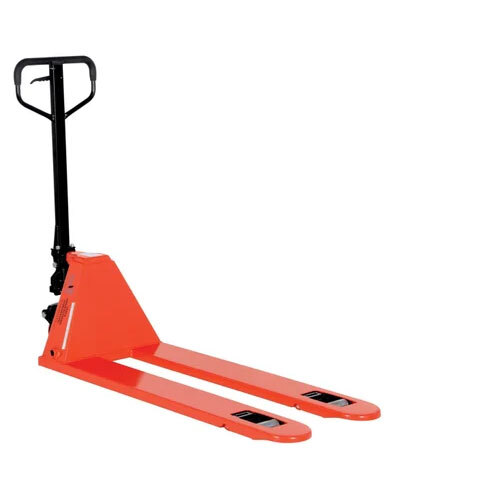 | Pallet Trucks A pallet truck (also known as a pump truck or pallet jack) is a wheeled trolley designed to lift and transport pallets. View product → |
Frequently asked questions
What makes a pallet truck low profile?
Its forks lower to a reduced entry height, allowing them to pass beneath low-clearance pallets, skids, machine bases and export platforms.
How do you confirm pallet compatibility?
Measure the pallet’s entry opening, deck height, fork-pocket width, pocket length and underside obstructions, then compare those measurements with the truck’s fork dimensions.
Where do low-profile pallet trucks work reliably?
They work reliably on smooth, level warehouse floors when the pallet or skid provides enough fork clearance and the load remains within the truck’s rated capacity.
When is a standard truck, powered truck or forklift better?
Choose a standard truck when ordinary pallet clearance is available, powered equipment for frequent or long-distance movement, and a forklift for stacking, high lifting or loads outside pallet-truck limits.