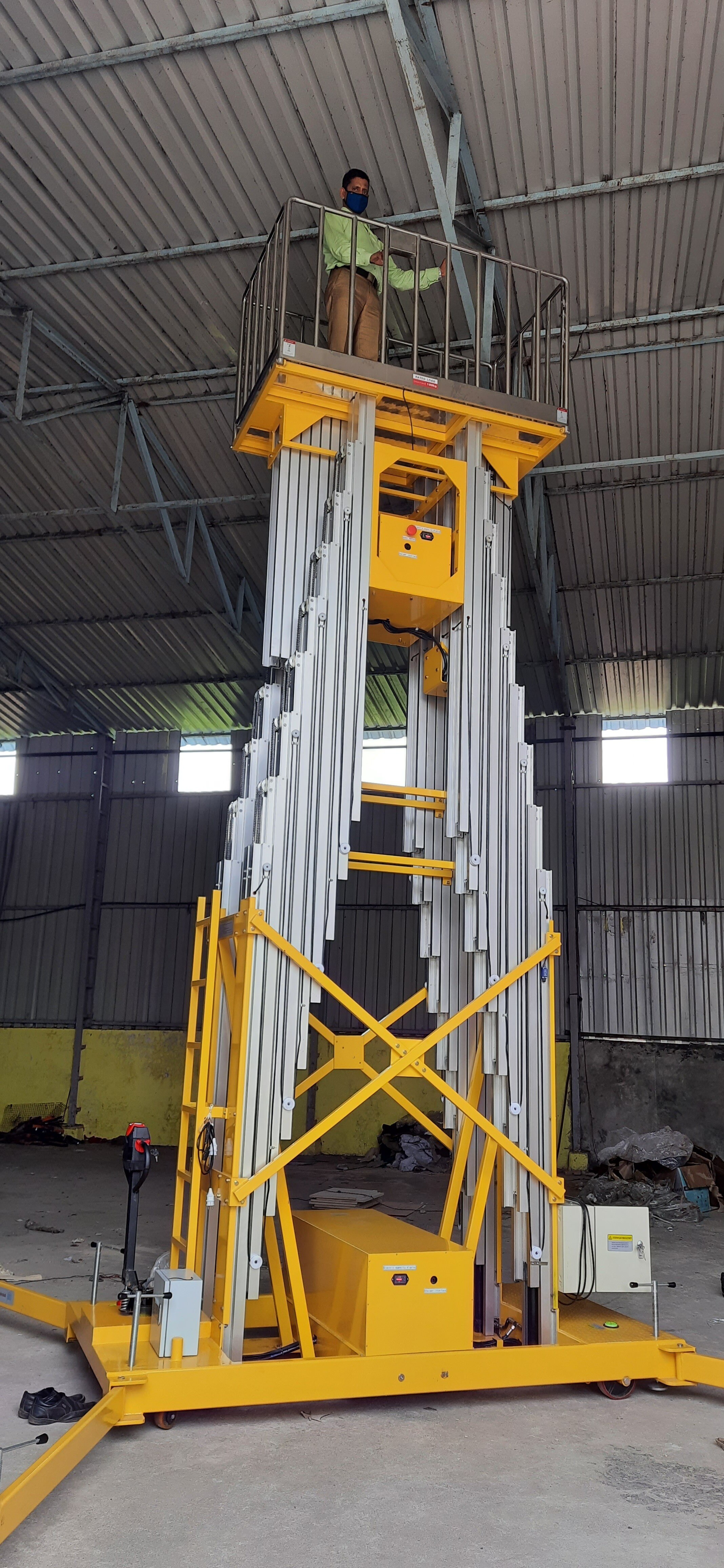
Choose the machine from the work envelope, travel route, floor condition and operating environment—not from maximum height alone. By the end, you will have a practical specification for comparing machines, checking factory fit and evaluating suppliers before placing an order.
Key takeaways
- Measure platform height, operator reach and the highest service point.
- Trace the machine route through doors, aisles, floors and work zones.
- Specify battery charging, emergency lowering and interlock requirements.
- Make the quotation include drawings, tests, training and warranty terms.
Turn the maintenance task into a measurable AWP specification
Specify the machine from the work envelope, not its headline height. Measure from the floor level to the platform position, the operator’s safe reach, and the highest point requiring service.
Record platform height and required working height separately: maximum platform height is not usable working height when pipe racks, sprinklers, cable trays, cranes, ducting or roof structures occupy the space above it.
| Specification item | What to record | Buying check |
|---|---|---|
| Floor and access point | Floor level and exact work position | Confirm the machine works directly above one floor position |
| Platform height | Height needed for the deck | Compare with the machine’s platform-height rating |
| Working height | Highest service point plus safe operator reach | Check clear overhead height, not nominal maximum height |
| Platform load | Occupants, tools, fixtures, parts and consumables | Total must remain below the rated platform load |
| Edge loading | Load location near the guardrail or centre | Ask whether the permitted rating changes at the edge |
For a double mast AWP for manufacturing facilities in Vadodara, complete these task records before requesting prices:
- Number of occupants, including one-worker jobs
- Task duration and relocations per shift
- Minimum platform width, usable length and gate position
- Required working height and platform height
- Total load in kilograms, with the heaviest item identified
- Whether work requires fixed positioning directly above the floor location
The resulting specification stops a brochure’s maximum height or capacity from deciding the purchase. It also exposes when the platform is too narrow, the load is concentrated at the guardrail, or overhead clearance makes the advertised height unusable.
Check the complete route through the Vadodara facility
A dimensional fit is not a safe fit. Measure the double mast aerial work platform in Vadodara in its overall width, overall length, collapsed height, turning radius and ground clearance, then compare each figure with the narrowest doorway, aisle, production bay, mezzanine access, goods lift, loading area and storage space.
Measure doors fully open, including thresholds, dock plates and protective bollards.
Ask the supplier for:
- Wheel loads, stabiliser or outrigger reactions, allowable slope, gradeability and minimum floor condition.
- Permitted wind speed, rain restrictions, surface requirements and rules for working near open edges.
- Confirmation that the machine is rated for outdoor use; do not move an indoor-only machine into an exposed yard during Vadodara monsoon conditions.
- Confirmation of whether travel is permitted while elevated, and whether edge protection or a spotter is required near docks, mezzanines and floor openings.
Inspect every route for cracks, expansion joints, ramps, drains, grating, pits, wet areas and suspended slabs. Check whether the route obstructs forklift crossings, fire exits or emergency access.
| Route area | Measure or inspect | Control before purchase |
|---|---|---|
| Doorways and aisles | Clear width, turning space, bollards | Mark the complete swept path |
| Floors and ramps | Cracks, joints, slope, drainage, wheel loads | Obtain slab approval |
| Docks and openings | Edges, plates, gaps, traffic | Use barriers and a spotter |
| Storage and lift | Collapsed height, length, capacity | Verify lift and storage limits |
Specify power, charging and machine safeguards before the quotation
1. Before the quotation, identify the battery chemistry: lead-acid, lithium-ion or another type. State charger input voltage, charging time, opportunity-charging limits, battery replacement method and the spare-battery plan for multi-shift work.
2. Mark a dedicated charging location away from process contamination, ignition sources, forklift routes and blocked escape paths. For lead-acid batteries, specify hydrogen ventilation, eye protection and spill controls; for lithium-ion batteries, specify the charger, thermal-event response and required separation from heat sources.
3. Confirm the offered AWP’s restrictions near furnaces, welding areas, washdown zones, chemicals, live electrical equipment and overhead conductors. Electric drive does not make the machine suitable for every environment.
4. Require these limits in writing: platform load and occupant count, maximum wind speed, maximum slope, travel-while-elevated rule, outdoor-use restriction and emergency-rescue method. Prohibit crane use, tying the platform to a structure, climbing guardrails, and using ladders or boxes on the platform.
5. During acceptance, test independent upper and lower controls, both emergency stops, emergency lowering, brakes, alarms, tilt or slope warnings, load-sensing protection, platform gates, guardrails, guarded mast sections and unauthorised-use prevention. Record each result.
6. Request the exact model and configuration’s declaration or certificate, serial-number traceability, test records and stated design standard. Check ISO 16368 for mobile elevating work-platform design calculations, safety requirements and test methods. Obtain the operator manual, rescue procedure, inspection checklist and maintenance schedule; “CE quality” is not a substitute for model-specific documents or acceptance testing.
Compare the double mast option with the task, not with a brochure
Two masts earn their place when the job is mainly vertical, the platform must carry two people or a substantial tool load, and repeated relocation is faster than erecting access equipment. The advantage must appear in the work cycle, platform size or rated load—not merely because one worker carries tools.
| Option | Reach and footprint | Setup, movement and cost trade-off | Best fit |
|---|---|---|---|
| Single mast AWP | Vertical access; smallest footprint | Fast relocation, lower charging and training burden | One worker, limited tools and a compact floor position |
| Double mast AWP | Vertical access; larger platform and capacity | More floor loading, charging demand and training than a single mast | Two occupants, larger tools or repeated vertical work |
| Scissor lift | Vertical access; larger deck and footprint | Higher wheel loads and more space required | Broad work areas needing several workers |
| Boom lift | Sideways and overhead reach; larger footprint | Greater setup demands and exclusion zones | Obstacles or positions not directly below |
| Scaffold tower | Fixed vertical access | Assembly, inspection and movement take time | Long-duration work at one location |
| Ladder | Minimal footprint and purchase cost | Limited hands-free security and tool capacity | Brief, light tasks |
| Fixed platform | Best at one repeated access point | Cannot follow changing work positions | Permanent maintenance stations |
Compare horizontal reach, footprint, operator capacity, floor loading, setup time, relocation time, charging downtime and training cost before choosing an AWP for factories in Vadodara.
A double mast machine is a poor substitute for a forklift, crane or permanent structure when the task needs repeated horizontal travel, suspended loads, significant side loading, rescue from elsewhere or continuous access at one fixed point. Consider task-cycle timing, not just maximum height.
Use the supplier quotation and acceptance test to control buying risk
A low quotation does not control buying risk; a measurable specification and signed acceptance test do. Before you buy double mast AWP in Vadodara, make the purchase order the controlling document, not the brochure.
1. State platform height, required working height, rated load, occupant count, dimensions, turning radius, floor-load limits, indoor or outdoor classification, wind limit, permitted slope, battery chemistry, charger input and charging time, travel-at-height rules, emergency lowering and every included accessory.
2. Require the aerial work platform supplier in Vadodara to name the exact model and configuration covered by the operator, inspection and maintenance manuals, ISO 16368 documentation, test records and serial-number traceability.
Obtain delivery training, operator and inspector records, preventive-maintenance intervals, spare-parts availability, battery and charger support, warranty and after-warranty coverage, technician competence and a written response time for safety-critical faults.
3. At acceptance, measure the machine, drive the intended route, verify charging, test upper and lower controls, emergency stops, emergency lowering, brakes, alarms, slope warnings, load protection and gates, then inspect the platform, masts, guardrails, fasteners, tyres and welds. Record defects and withhold payment until the agreed correction is documented.
Keep a pre-use checklist and require competent-person inspections after damage or unusual events. Schedule checks of mast sections, chains where fitted, fasteners, gates, brakes, tyres, batteries, alarms and structural welds; adjust frequency for shifts, dust, oil and chemicals. Aguatech Engineers Pvt.ltd.
belongs in the comparison when its quotation supplies this evidence, demonstrates the machine on your route and states post-delivery response commitments.
Related product
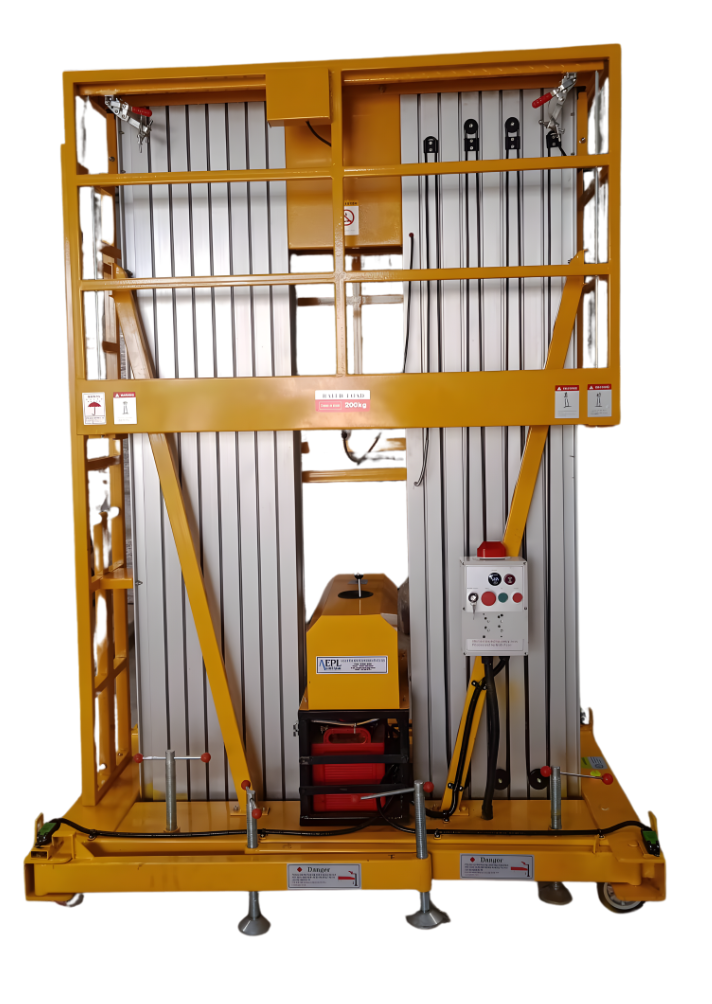 | Aerial Work Platform – Double Mast Aerial Work Platform – Double Mast A double mast aerial work platform is a high-stability, vertical lifting device utilizing two parallel aluminum or steel masts to elevate personnel... View product → |
Frequently asked questions
How do you specify a double mast AWP for a manufacturing facility?
Measure the floor-to-platform height, operator safe reach and highest service point, then record platform load, platform dimensions, duty cycle and working location.
What route checks matter before buying an AWP for a factory?
Measure doorways, aisle widths, floor transitions, lift dimensions, overhead obstructions, slopes and the turning space needed to reach each work area.
What power and safety details should the quotation include?
State the battery type and capacity, charger input, charging location, operating duty cycle, emergency lowering method, overload protection, guardrails, platform interlocks and travel controls.
How can you compare a double mast AWP with other access equipment?
Compare each option against the task height, reach, indoor route, platform load, setup time, frequency of movement, floor conditions and the level of positioning control required.
What should you verify during delivery and acceptance?
Check dimensions, serial numbers, manuals, safety labels, controls, brakes, emergency stop, emergency lowering, interlocks, alarms, battery charging and a practical work-height demonstration.