The right lift depends on more than the maximum weight you want to raise. Your floor layout, loading equipment, duty cycle, pit and headroom, monsoon exposure, and rules on people riding the platform all affect the specification. By the end, you will be able to define the lift configuration, calculate usable capacity, check installation space, and compare supplier quotations without relying on capacity alone.
Key takeaways
- Map pallet routes, landing doors, floor openings and turning space before choosing.
- Calculate capacity using the pallet, trolley, load and operator together.
- Confirm shaft dimensions, pit, headroom, power supply and landing interfaces.
- Demand drawings, safety details and operating limits in the quotation.
Start with the building layout and loading route
Choose the lift around the route your pallet, drum, bin or trolley actually takes, not around the available motor size. Map each loading point, floor opening, landing door and turning area before selecting an electro hydraulic goods lift for factory in surat.
| Building condition | Suitable configuration | Check before choosing |
|---|---|---|
| One guide line and compact loads | Single-column | Platform sway, side loading and the support structure |
| Frequent pallet-truck loading through aligned landings | Two-column guided lift | Clear width, door alignment and anchoring space |
| Short travel with a low pit or no shaft | Scissor lift | Folded mechanism, platform stability and access clearance |
| Multiple floors with controlled vertical travel | Guided-platform lift | Guide rails, landing gates and travel protection |
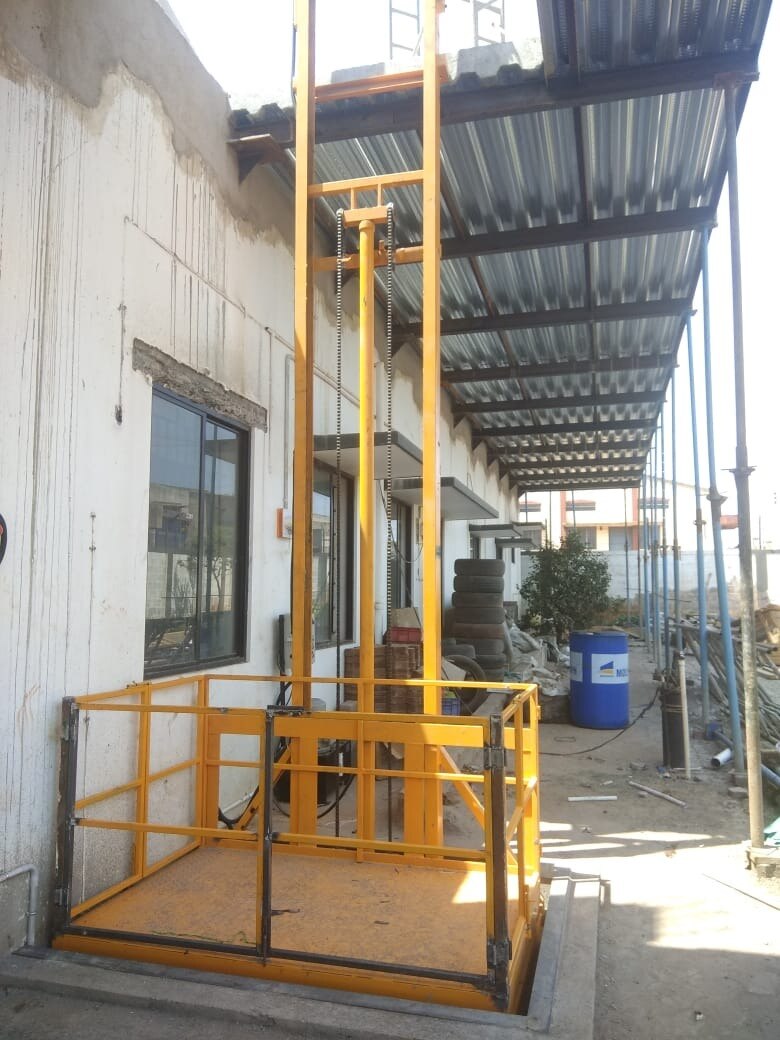
A single-column unit saves space but gives less tolerance for uneven loads. A two-column or guided platform suits pallets moving repeatedly between fixed floors. A scissor arrangement works where the route is short and the mechanism can remain below or beside the platform; it becomes awkward when several landings need doors.
Specify loading direction and whether a pallet truck or forklift enters the platform. A lift that accepts a pallet but cannot provide turning clearance will slow every cycle. Require landing doors and the platform gate to interlock, so the lift cannot run open and no landing door opens away from the correct floor.
Direct hydraulic lifting needs a suitable pit and cylinder arrangement. An indirect, roped or chained system suits a site where a full-travel cylinder cannot fit below the platform. Compare these electro hydraulic goods lift options against the route, not just the quoted capacity.
Calculate usable capacity from the complete loading unit
Specify the lift against the heaviest complete loading unit, not the product alone. Industrial goods lift capacity must cover the product plus its pallet, cage, drum trolley, stillage or attachment; otherwise a permitted load can overload the platform before production starts.
Record the loading unit that produces the worst case:
- Product weight, including loose material placed on the unit
- Pallet, bin, cage, trolley or stillage weight
- Number of wheels, wheel loads and axle loads
- Centre-of-load position and allowable eccentricity
- Forklift or pallet-truck entry, including threshold impact
- Expected production growth and the heaviest planned future unit
Use the greatest complete-unit weight as the starting point, then require the supplier to account for loading impact and uneven distribution in the design. A uniformly distributed load rating does not prove that the platform can take concentrated forklift wheels or a load placed near one edge.
Ask for separate limits for uniformly distributed load, point load, axle load and ramp or threshold loading.
For a goods lift for factory in Surat, state whether loading is manual, by pallet truck or by forklift. Specify the platform clear size and loading direction with the capacity, because a lift rated for a heavy pallet is unusable if that pallet cannot enter safely.
Keep the equipment goods-only: a higher rated load does not permit people to ride unless the lift is designed, certified and approved for passenger carriage.
Compare the specifications that determine daily usability and safety
Compare electro hydraulic goods lift options by the complete operating specification, not by industrial goods lift capacity alone. A quotation should show how the platform behaves during loading, travel, stopping and unloading.
| Specification | What to compare | Why it affects daily use |
|---|---|---|
| Rated load and platform size | Load rating, clear length and width, usable height | A narrow platform can reject the pallet or force unsafe overhang |
| Landing opening and stops | Clear door width, number of stops and loading direction | A lift that fits the shaft can still block pallet movement at the landing |
| Travel and speed | Vertical travel, rated lifting speed and stop accuracy | Slow travel reduces output; poor levelling creates trolley and trip hazards |
| Loading method | Pallet truck or forklift use, wheel loads, point loads and eccentricity | Forklift impact and off-centre loads can exceed the platform design |
| Hydraulic arrangement | Direct ram or indirect roped or chained lifting | Direct systems need suitable pit space; indirect systems suit restricted cylinder depth |
| Guides and structure | Single or paired guide arrangement, platform support and deflection limits | Inadequate guidance causes sway, noisy travel and uneven door alignment |
| Controls and doors | Hold-to-run or automatic controls, landing interlocks and platform gate | The lift must not run with an open access point or open a landing door between floors |
Specify a goods-only lift and prohibit passenger riding unless the equipment is separately designed and approved for people. Require protection against unintended platform movement, overload indication, emergency stop, and a documented emergency-release procedure. Ask for hydraulic, electrical and safety-device test records at commissioning.
Check the civil interface, power unit and Surat operating conditions
A shallow pit or blocked maintenance route can make a suitable lift unreliable. Before ordering an electro hydraulic goods lift for factory in Surat, confirm that the building can accept its pit or sump, cylinder arrangement, landing supports, headroom, shaft tolerances and power-unit location.
Request a supplier’s marked-up civil drawing, not a generic catalogue page. Check these items on site:
- Pit depth, sump construction and drainage or oil-leak containment
- Overhead clearance, shaft dimensions and landing sill alignment
- Reaction loads at each landing and the strength of beams, slabs and guide supports
- Access space for removing the motor, pump, filter, seals and hydraulic hoses
- Electrical supply, isolator location, earthing and protection against voltage fluctuations
- Door, gate and platform clearances at every loading floor
Surat’s heat, dust and monsoon water change the maintenance burden. Put the power unit in a ventilated enclosure away from direct sun, flood-prone areas and airborne process dust; protect hoses and fittings from vehicle impact. Hot oil loses viscosity control, while contaminated oil damages pumps and seals.
Specify an oil-condition schedule covering level, leakage, contamination, filters, seals and hose ageing. If the lift will run at high duty cycles, travel taller buildings or require fast repeated service, compare traction equipment before choosing hydraulic equipment.
Finally, identify the Indian lift, electrical and factory-safety approvals required by your local authority. A manufacturer’s test certificate does not approve the building installation. A credible goods lift for factory in Surat supplier will provide calculations, drawings, commissioning records and documented safety testing.
Make the quotation prove that the lift fits your operation
A capacity-only quotation proves almost nothing. Require a drawing and calculation package showing the platform clear size, guide arrangement, support reactions, landing openings, hydraulic circuit, cylinder selection, structural attachments, electrical controls and safety devices. The documents must match your actual floor openings and loading route.
Ask the goods lift manufacturer in Surat to attach these items to the quotation:
- Rated load, platform dimensions, clear landing-door opening, number of stops, vertical travel, rated speed, duty cycle, loading direction and pallet-truck or forklift loading limits.
- Structural calculations for the platform, guide rails, brackets, shaft or tower supports, pit and overhead loads.
- Hydraulic schematics naming the pump, relief valve, hoses, fittings, oil containment, heat ventilation and protection from dust, impact and flooding.
- Landing-door and platform-gate interlocks, unintended-movement protection, emergency stop, overload protection and the exact emergency-release procedure.
- General-arrangement and electrical drawings, followed by documented factory testing, site testing, commissioning records and operator training.
- A written schedule identifying the lift, electrical and factory-safety approvals required by the local authority in Gujarat. A manufacturer’s test certificate does not approve your building installation.
- Warranty limits, response time, preventive-maintenance intervals, spare-parts availability and inspection of oil, filters, seals and hose ageing.
For a goods lift for factory in Surat, state that people must not ride the platform unless the equipment is designed and approved for passenger carriage. Aguatech Engineers Pvt.ltd. should be assessed on whether its quotation supplies this evidence, not simply on its lifting capacity.
Related products
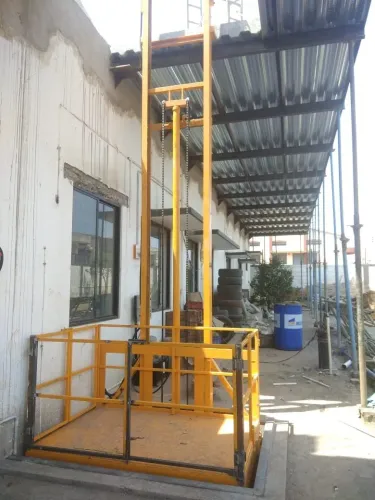
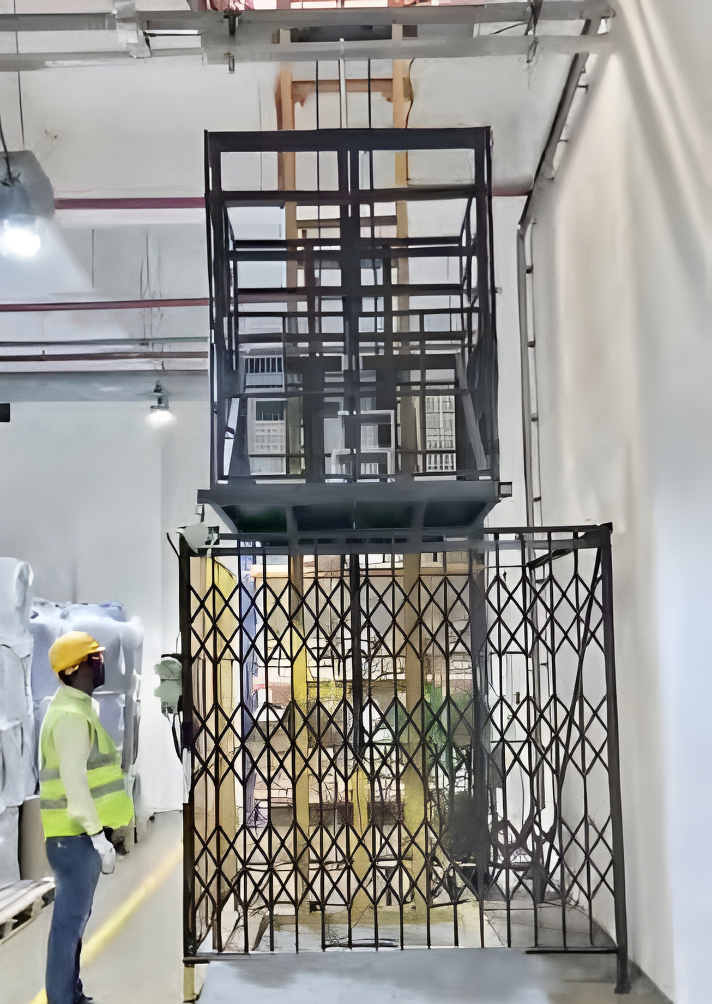 | GOODS LIFTS Goods or Cargo or Luggage lifts are basically used in industry shop floors for safe, secure, convenient and fast methods to transport loads from... View product → |
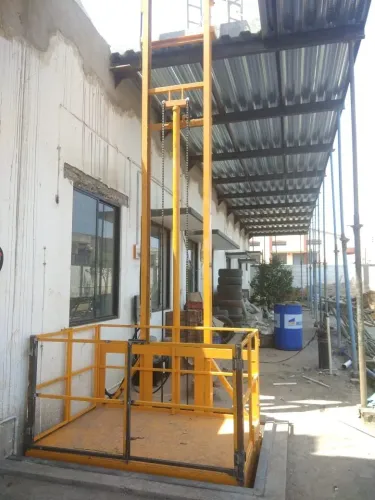
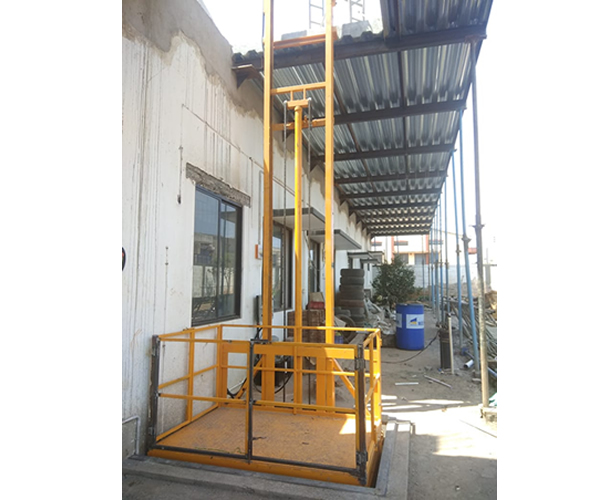 | GOODS LIFTS Goods or Cargo or Luggage lifts are basically used in industry shop floors for safe, secure, convenient and fast methods to transport loads from... View product → |
Frequently asked questions
How do you choose a goods lift layout for a factory?
Map the complete loading route from pickup point to destination, including floor openings, landing doors, turning areas and trolley access. Choose the lift car and door arrangement around the largest route you use every day.
How should you calculate industrial goods lift capacity?
Add the material, pallet, drum, bin, trolley and any person permitted during loading. Select capacity above that complete loading unit, then check its dimensions and centre of gravity against the car floor.
Which specifications determine daily usability and safety?
Compare platform dimensions, rated load, travel height, lifting speed, door type, landing accuracy, controls, guarding, emergency lowering and overload protection. These details affect loading time and safe operation more than motor size alone.
What must you check before installing a goods lift in a Surat factory?
Confirm pit depth, headroom, shaft size, foundation loads, landing openings, drainage, access for maintenance and the power unit location. Check electrical protection and ventilation for Surat’s hot, humid operating conditions.