A goods lift solves a floor-to-floor transfer, while a conveyor solves repeated movement along a fixed route; choosing the wrong one creates extra loading, waiting and handling work. By comparing travel direction, demand, load characteristics, building space, safety requirements and full installed cost, you can select a practical arrangement or combine both systems.
Key takeaways
- Choose a goods lift for batch movement between fixed levels.
- Choose a conveyor for repeated, continuous movement along one route.
- Compare cycle time, route length, load size and building constraints.
- Price guarding, interlocks, installation, maintenance and Surat site conditions.
Match the equipment to the movement pattern
A goods lift moves one pallet, trolley, cage or batch between defined landings; a conveyor moves multiple units repeatedly along a fixed route. The goods lift or conveyor in Surat decision is therefore about movement pattern, not a catalogue-capacity contest.
| Option | Movement pattern | Best fit |
|---|---|---|
| Goods lift | Cycle-based, floor-to-floor transfer | Ground-floor packing to a mezzanine; basement raw-material storage feeding production; production and dispatch on different floors |
| Conveyor | Continuous or repeated route flow | Cartons, textile rolls, sacks, bins or parts travelling between adjacent stations |
Choose a goods lift when loads move intermittently between fixed floors and waiting for one trip is acceptable. Each cycle includes loading, door interlocking, travel and unloading, so queueing increases when operators must wait for every trip.
Choose a conveyor when products must flow continuously between adjacent stations. It can carry several items at once, but it requires controlled spacing, compatible product dimensions and reliable upstream and downstream processes.
A standard horizontal conveyor does not replace floor-to-floor equipment. When levels differ, add a vertical conveyor, inclined conveyor, transfer tower or goods lift, with guarding and suitable transfer points.
The goods lift versus conveyor in Surat comparison should start with route geometry: use a lift for discrete vertical movement, a conveyor for stable repeated flow, and both when loads need vertical transfer followed by continuous movement.
Use demand, route and cycle time to make the choice
A goods lift fits intermittent, batch movement between fixed floors; a conveyor fits repeated flow along a stable route. Base the choice on vertical travel, horizontal travel, number of levels, floor layout, load frequency, pallet dimensions, load weight and required cycle time—not rated capacity alone.
| Option | Best fit | Warning sign |
|---|---|---|
| Goods lift | One pallet, trolley or cage between fixed floors; waiting is acceptable | Operators queue for every cycle |
| Conveyor | Predictable, repeated flow along a fixed route | Batches, destinations or routes change frequently |
| Lift plus conveyor | Vertical batch transfer with buffered floor-to-floor production | One machine is being forced to cover both directions |
Record these figures for each shift and for the busiest dispatch period:
- Loads per hour and trips per shift
- Loading time, unloading time and vertical or horizontal travel time
- Door-interlock delays, transfer delays and operator waiting time
- Pallet or cage dimensions, load weight and destination floor
Calculate peak demand separately from the shift average. A dispatch surge can create a queue even when the daily total looks modest. Use this worksheet: required cycle time = 60 minutes divided by peak loads per hour.
Compare that time with loading, door and transfer delays, travel, unloading and recovery time; if the total exceeds the available cycle time, one lift will not meet demand.
For goods movement options in Surat, use pallet trucks or forklifts for short horizontal moves, fixed conveyors for line-side flow, and a lift-plus-conveyor arrangement when floors need buffered production. Choose a conveyor for stable continuous flow; choose a lift for discrete vertical batches.
Check the building and the load before comparing quotations
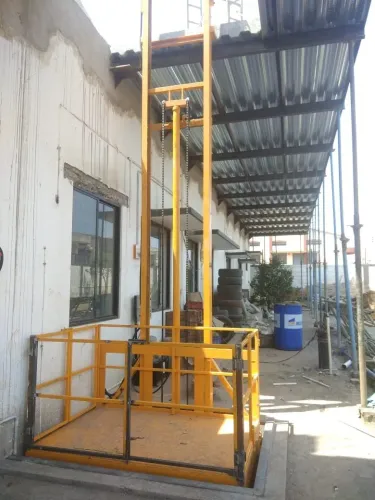
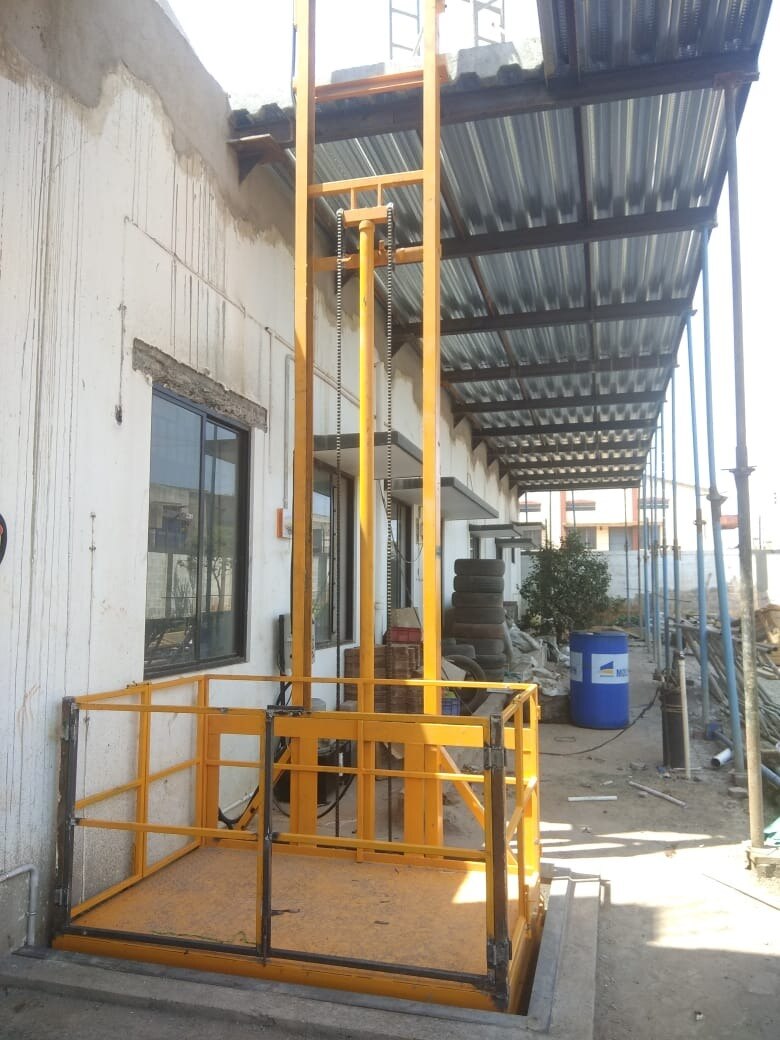
1. Measure the shaft or conveyor route before requesting a price. Record floor openings, landing space, headroom, pit or protected lower travel zone, staging area and approach-aisle width. For a small factory goods lift in Surat, sketch every obstruction and show where pallets wait before and after transfer.
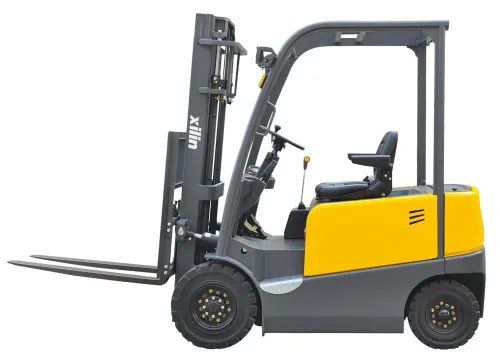
2. Make the lift drawing show the pallet-truck turning envelope, dock level, ramp gradient, landing sill gap, floor-level tolerance, door opening and loading from one side or two. Show whether a pallet truck or forklift enters the car.
A platform rated for 1,000 kg can still fail a 1,000 kg pallet when its footprint, edge loading or wheel load exceeds the platform design.
3. Give the supplier a load schedule stating maximum mass, centre of gravity, distributed and concentrated loads, pallet or crate dimensions, wheel loads, overhang and loading direction. Identify fragile goods, loose items, liquid containers and unstable packages; these need restraint, level control or slower handling rather than a capacity figure alone.
4. For a conveyor, specify route length, support points, transfer gaps, return-side clearance, maintenance access and accumulation space. Confirm belt support, roller diameter, side guides, cleats and controlled spacing, or cartons will snag, spill or collide.
In the goods lift versus conveyor in Surat decision, mark every loading zone and keep people out of a goods-only lift unless it is designed, interlocked, signed and approved for riding under the applicable Gujarat Factories Rules and inspectorate interpretation.
Price the complete system, including safety and Surat conditions
| Cost or condition | Goods lift | Conveyor |
|---|---|---|
| Installed work | Civil openings, shaft or enclosure, pit, headroom, staging, electrical supply and statutory inspection | Supports, transfers, guarding, controls, staging and electrical supply |
| Operating cost | Loading labour, forklift time, spares and production loss during maintenance | Labour, energy, spares, jam clearing and production loss during maintenance |
| Safety package | Landing-door interlocks, overload protection, upper/lower limits, emergency recovery, brake or valve-failure protection, isolation and rescue procedure | Guards at pulleys, chains, sprockets and nip points; emergency-stop access, restart prevention and safe jam-clearing access |
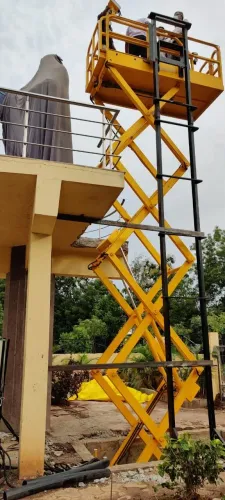
Do not compare purchase prices alone. A small factory goods lift in Surat suits intermittent, high-force, low- to medium-rise batches, but hydraulic models need checks for oil temperature, seals, hoses, leakage, pit protection and monsoon water ingress. Keep the hydraulic power unit above likely flood level.
Electric traction or screw-driven lifts can suit higher duty cycles or sites avoiding hydraulic oil. Check overhead and machine space, starts per hour, consecutive cycles, thermal class and brake holding; motor horsepower alone proves nothing.
For hot, humid or exposed premises, specify protected panels, suitable enclosure ratings, corrosion-resistant fasteners, drainage and maintenance access. Price loading and forklift time as well as production stoppage.
Use these goods movement options in Surat to price the real route, not just the machine: a pallet truck for short horizontal moves, a guarded conveyor for stable flow, or a lift plus conveyor for floor-to-floor transfer and distribution.
The firm rule is simple: choose a lift for fixed discrete movement, a conveyor for repeated route flow, and both when continuous movement follows a vertical batch transfer.
Specify the duty profile and decide whether one system or both is right
Choose one system for the dominant movement pattern, or combine them when vertical transfer and floor-level flow are both continuous.
| Option | Best fit | Main limitation |
|---|---|---|
| Goods lift | Fixed, intermittent movement between floors | Each cycle includes loading, interlocking, travel and unloading |
| Conveyor | Repeated flow along a stable route | It needs controlled spacing and separate floor-to-floor equipment |
| Both | Lift transfers batches vertically; conveyor buffers or distributes them on each floor | More controls, guarding and maintenance points |
For goods movement options in Surat, record these duty inputs before requesting prices:
- Payload, load dimensions, centre of gravity and loading direction
- Lift height or conveyor route, number of levels, transfers per hour and operating hours per day
- Peak dispatch demand, not only the shift average
- Ambient heat, humidity, monsoon exposure and likely water ingress
- Pallet truck, forklift or manual loading; number of operators
- Required availability and the production, safety or delivery consequence of a stoppage
Ask each supplier to show platform or belt dimensions, landing clearances, turning envelopes, staging areas, guards, emergency stops, maintenance access and the control sequence. Request starts per hour and allowable consecutive cycles; quoted motor power alone does not prove capacity.
A small factory goods lift in Surat suits fixed, discrete batches. A conveyor suits stable, repeated route flow. Aguatech Engineers Pvt.ltd. can help when the building, loading method and duty profile do not match a catalogue arrangement, but compare its design against the same civil, safety, maintenance and throughput criteria.
Choose a lift for fixed vertical movement, a conveyor for repeated route flow, and both when material must continue moving after floor-to-floor transfer.
Frequently asked questions
When should a small factory choose a goods lift instead of a conveyor?
Choose a goods lift when pallets, trolleys, cages or batches move between defined landings and continuous flow is unnecessary.
When is a conveyor the better goods movement option in Surat?
Choose a conveyor when units move repeatedly along a fixed route at a predictable rate between workstations, storage areas or loading points.
What should you check before comparing goods lift and conveyor quotations?
Check the building structure, landing heights, available floor space, route, load dimensions, load weight, power supply and access for installation.
What costs belong in a goods lift or conveyor comparison?
Include equipment, guarding, gates, interlocks, controls, civil work, electrical work, installation, testing, operator training and planned maintenance.