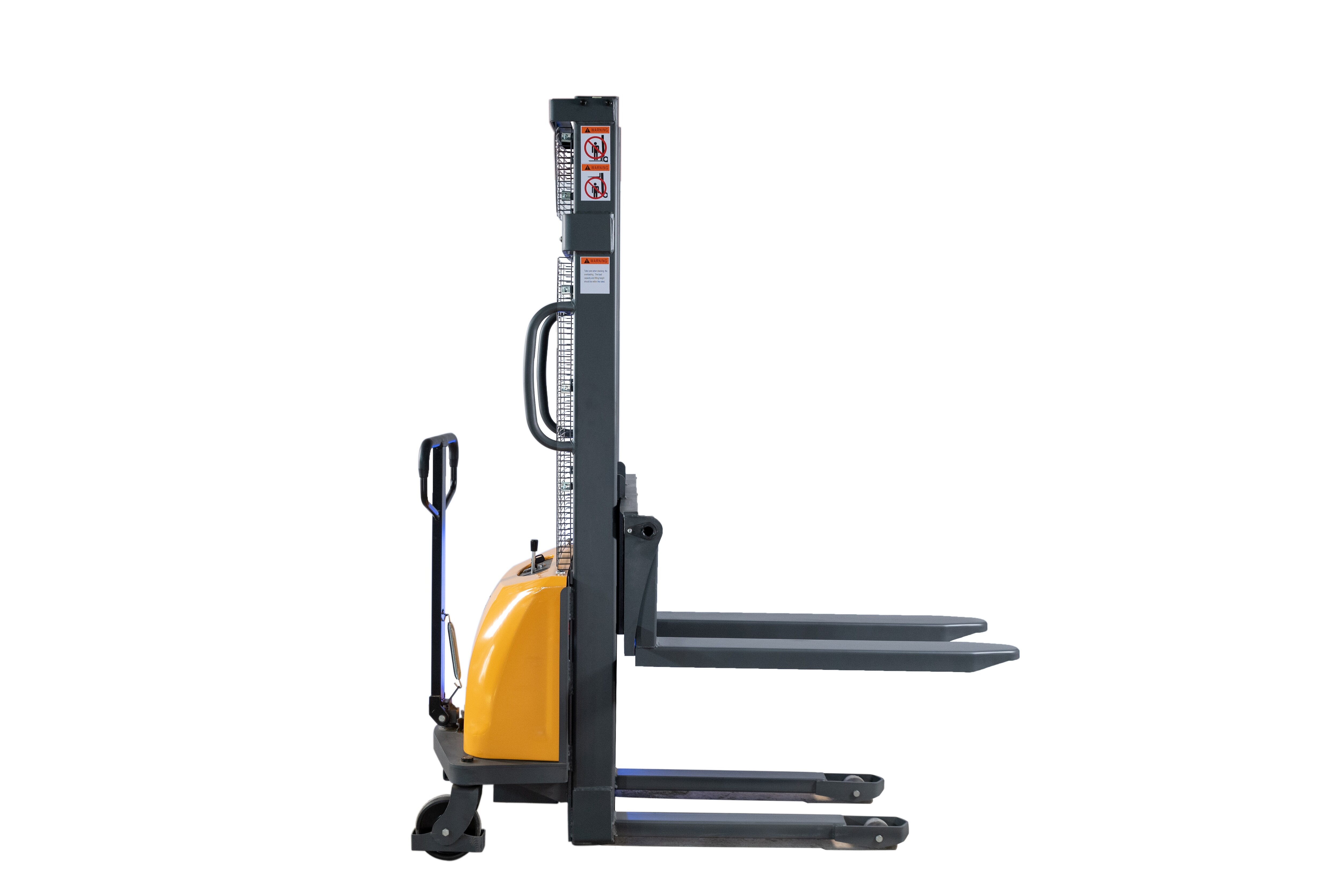
Choosing the wrong truck for a high-rack aisle can leave you with unusable lift capacity, unsafe clearances, or a machine that cannot turn at the rack end. You will be able to match each storage task to the right truck, verify rack and floor conditions, calculate usable capacity, and plan a site trial before buying.
Key takeaways
- Match rated capacity to load weight, load centre and lift height.
- Measure clear aisle width, rack depth and overhead obstructions before ordering.
- Confirm residual capacity at maximum lift, not just the truck’s headline rating.
- Run a Surat warehouse site trial with the actual pallets, racks and floor.
Where Electric Reach Trucks Deliver the Most Value in High-Rack Warehouses
The highest-value electric reach stacker applications in a high-rack warehouse are pallet put-away, retrieval, reserve-stock replenishment, order staging, and rack-facing work. The technically precise machine is usually an electric reach truck: it uses forks, a retractable carriage or mast, and an operator position designed for palletised loads.
| Electric reach truck | Container reach stacker |
|---|---|
| Forks and retractable carriage or mast | Spreader and telescopic boom |
| Pallets in storage racks | Intermodal shipping containers |
| High-rack aisles and warehouse floors | Container yards and handling lanes |
| Capacity matched to pallet load and lift height | Capacity matched to container size and outreach |
Use the truck to:
- Put away inbound pallets into upper rack locations without bringing a counterbalance forklift deep into the aisle.
- Retrieve reserve pallets for dispatch, production, or replenishment.
- Move reserve stock down to forward pick faces before order waves begin.
- Stage picked pallets in marked loading or dispatch positions.
- Face racks by aligning pallets, checking load position, and correcting protruding goods.
The terminology matters because a container reach stacker is not a larger warehouse reach truck. It requires different capacity, attachment, aisle, and operating specifications. A warehouse reach truck is not automatically suitable for uneven yards, container loading, or long outdoor travel; extended travel over rough slabs can damage the mast and make elevated loads unstable.
Use the machine classification that matches the load, floor, rack, and operating position—not merely the search phrase electric reach stacker applications.
Choose the Truck by Load, Lift, Aisle, and Operating Position
Choose the truck against the pallet, rack, aisle, and operator position—not the advertised lifting height.
| Option | Intended load and lift | Mast and operator position | Travel and surface |
|---|---|---|---|
| Electric reach truck | Pallet loads for high-rack put-away and retrieval | Retractable carriage or mast; seated operator | Indoor, smooth, level floors and narrower aisles |
| Narrow-aisle reach truck | Pallets where aisle width is tightly constrained | High-lift mast with compact turning geometry; seated or stand-up operator | Indoor, carefully controlled rack aisles |
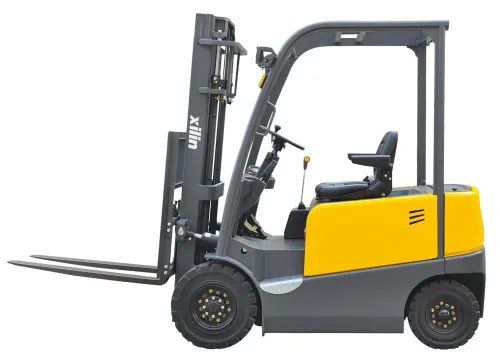
| Counterbalance forklift | Heavier loads and varied handling at moderate lift heights | Fixed mast with rear counterweight; seated operator | Needs more manoeuvring space and firm, level surfaces |
| Conventional electric stacker | Lighter, lower-duty pallet movement and stacking | Fixed mast; walk-behind or platform operator | Short indoor travel on smooth floors |
Treat warehouse stacker as a broad category, not as proof that every stacker has the same capacity, reach, or operating position. A reach truck fits high-rack work only when its capacity chart and dimensions match your site.
Check these figures before requesting a quotation:
- Maximum pallet weight and whether the load is uniformly distributed
- Rack beam height and required lift height
- Collapsed mast height
- Clear aisle width and turning radius
- Fork length and pallet entry dimensions
- Load-centre distance
- Attachment weight
- Residual capacity at the intended elevation
A nominal rating is incomplete without load centre, lift height, mast configuration, and attachment weight. Require the capacity plate and residual-capacity chart; capacity falls as lift height and load moment increase. A counterbalance truck needs space to turn, while a stacker suits lighter work.
Surface quality also matters: potholes, joints, ramps, and uneven yards can exclude indoor electric equipment.
Measure the Aisle and Check Rack Compatibility Before Ordering
Start with the clear distance between opposing rack faces, not a catalogue aisle figure. Measure the narrowest point, then subtract rack projections, pallet overhang, load overhang, floor markings, and fire-clearance zones. Measure the turning space required at both aisle ends as well.
No universal aisle width applies in Surat or elsewhere. The usable minimum depends on pallet size, truck geometry, rack type, and the manufacturer’s operating clearance; a quoted width without those assumptions is not a usable specification for high rack warehouse equipment.
1. Record pallet length, width, weight, condition, and fork-entry openings. Reject pallets that are broken, bowed, poorly supported, or incompatible with the beam spacing.
2. Record rack depth, beam spacing, backstops, upright protection, and the required placing clearance. Ask the rack supplier for allowable rack deflection; a moving or deflected beam changes the safe target.
3. Obtain the truck’s dimensional drawing: overall length, mast and carriage geometry, fork length, reach stroke, turning radius, and operating clearance. Check collapsed mast height against doors, sprinklers, and beams.
4. Test the worst case: the largest pallet and load overhang at the highest position. Confirm during approach, insertion, withdrawal, and turning that the load cannot strike uprights, beams, backstops, or stored goods.
5. Mark the measured aisle and exclusion zones on the floor, then conduct a loaded trial at both ends. Stop if the operator must steer into protection, cross a fire-clearance zone, or rely on rack contact for alignment.
Rack and truck drawings must match the actual bay, not nominal dimensions.
Verify Residual Capacity, Battery Duty, Floor Condition, and Safe Operation
A floor-level rating is not the capacity at the top rack position. Lift height, load-centre distance, mast configuration, attachment weight, and battery counterweight change the residual-capacity chart. For electric reach stacker applications, require the capacity plate and a chart covering your pallet weight, load height, and load centre; stop if those figures do not match.
Choose the battery by duty cycle, not shift length alone. Count lift frequency, load weight, travel distance, acceleration, traffic, cold-store operation, and opportunity charging. Lead-acid batteries need a designated ventilated charging area, controlled charging, cooling time, and water checks; lithium-ion batteries require a compatible charger and approved charging system. Never interchange chargers.
Inspect the floor for joints, potholes, ramps, drainage, flatness, level, and load-bearing capacity. Uneven slabs increase mast sway and make accurate placement harder.
Use this operating sequence:
- Approach the rack squarely and align the forks with the pallet openings.
- Extend the carriage only after the truck is stable and the forks are level.
- Place the pallet without contacting uprights, beams, backstops, or stored goods.
- Retract the carriage fully.
- Lower the load to travel height.
- Check overhead, side, and rear clearance.
- Confirm the path is clear, then reverse.
Mark pedestrian routes, protect rack ends, control speed at intersections, and use the load backrest where the load requires it. Evaluate operators on the actual truck, rack layout, load, and emergency procedures before authorising independent work.
Turn the Specification into a Surat Warehouse Site Trial
Before committing, run the candidate truck through the actual Surat warehouse, not a showroom aisle. Use your pallets, rack bays, floor joints, aisle ends, charging location, ambient conditions, and highest storage position. Include damaged-pallet conditions if they occur in daily work.
Ask the supplier to demonstrate:
- Loaded put-away and retrieval at the highest planned beam
- Reserve-stock replenishment and rack-facing work
- Emergency stopping with a representative load
- Turning at the tightest aisle end
- Travel across joints, ramps, and uneven transitions
- Battery change or charging, including access, time, and charger compatibility
Record the following on the trial sheet:
- Residual capacity at planned beam height and load-centre distance
- Collapsed mast clearance, fork reach, and turning radius
- Visibility into the rack, noise during travel, and stopping distance
- Floor response, mast sway, pallet stability, and placing clearance
- Battery process and the supplier’s service response time
| Compare measured result | What to compare | Why it matters |
|---|---|---|
| Nominal capacity | Rated load at floor level | It may overstate high-rack performance |
| Residual capacity | Approved load at your beam height | It determines safe put-away |
| Quoted aisle | Measured turning clearance with your pallet | It exposes unusable geometry |
Buyers searching for an electric reach stacker for high rack storage in Surat or an electric reach stacker in Surat should compare measured performance, not nominal capacity. Aguatech Engineers Pvt.ltd. can support dimensional verification, application matching, and site-specific planning; location alone does not prove suitability.
Related products
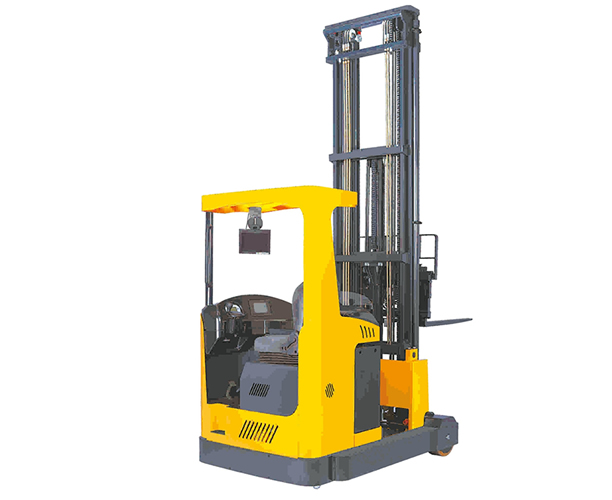 | REACH TRUCK This is again the larger version of an Electric Reach Stacker and is designed to work in narrow aisles. View product → |
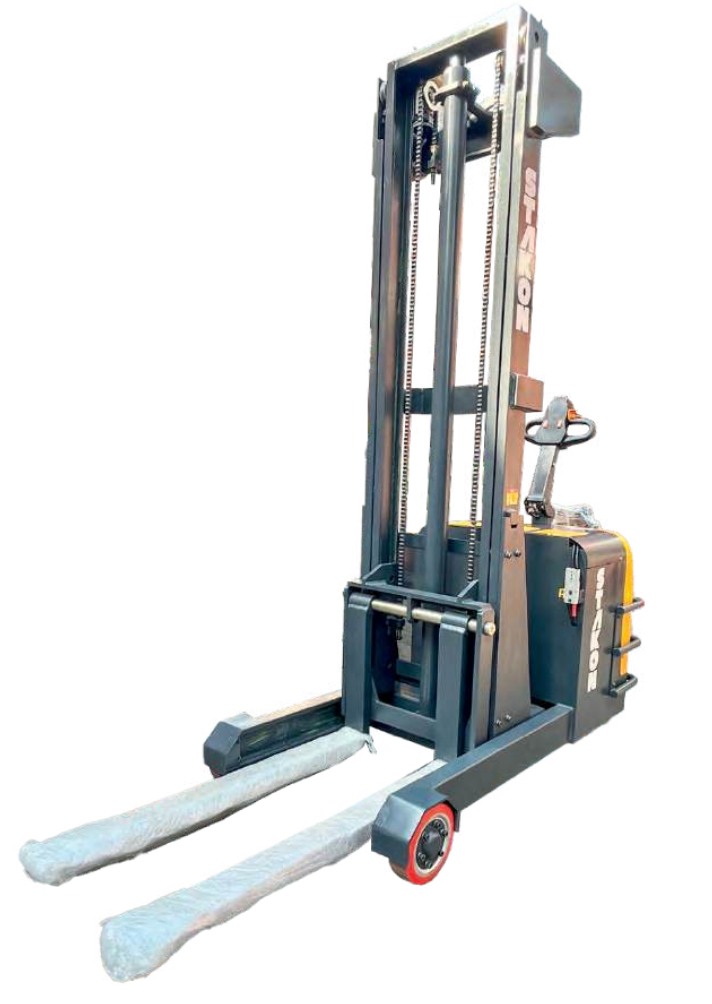 | STACKERS This can be termed as the larger version of an Electric Stacker and is designed for specific application. View product → |
Frequently asked questions
Where do electric reach trucks deliver the most value in high-rack warehouses?
They suit pallet put-away, retrieval, reserve-stock replenishment, order staging and rack-facing work where low emissions and precise positioning matter.
How should you choose an electric reach truck for high-rack storage?
Compare the required load weight, load centre, lift height, aisle width, operating position and pallet-handling pattern.
What should you measure before ordering a reach truck?
Measure clear aisle width, rack beam height, rack depth, pallet dimensions, travel routes, doorways, floor transitions and overhead obstructions.
Why must you check residual capacity?
A truck’s usable capacity falls as lift height and load centre increase, so verify the capacity shown on the actual load chart at your required height.
What should a Surat warehouse site trial include?
Test the truck with your heaviest pallets, highest rack locations, actual aisle clearances, floor conditions, charging routine and operators.
Related products
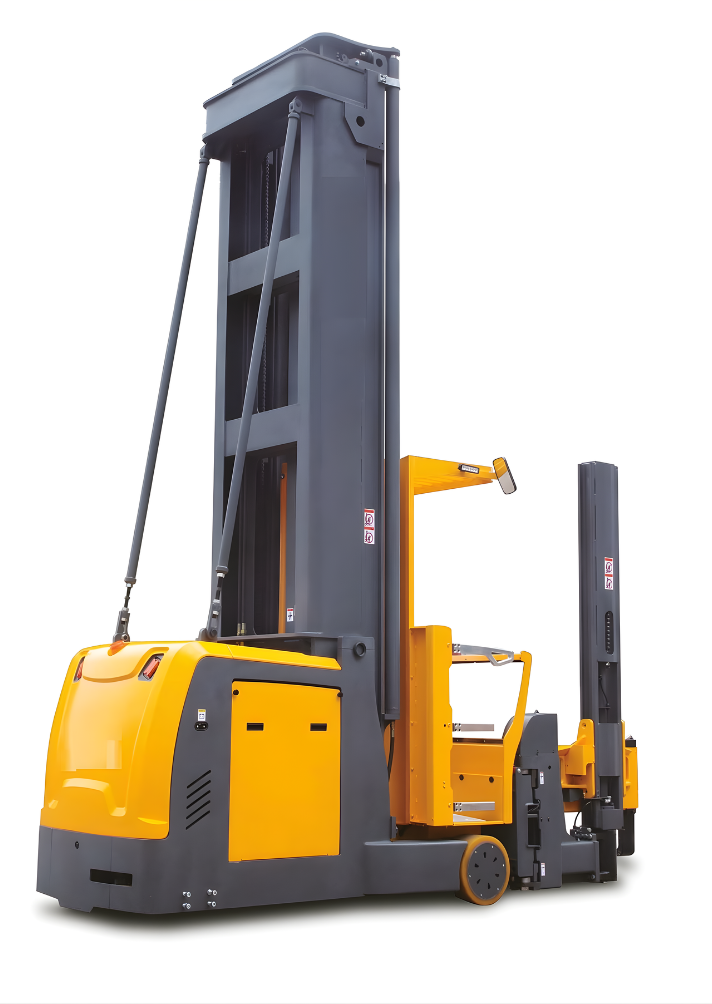 | Narrow Aisle Reach Trucks A narrow aisle reach truck is an electric warehouse vehicle designed for high-density storage, operating in aisle widths often less than 12 feet,... View product → |
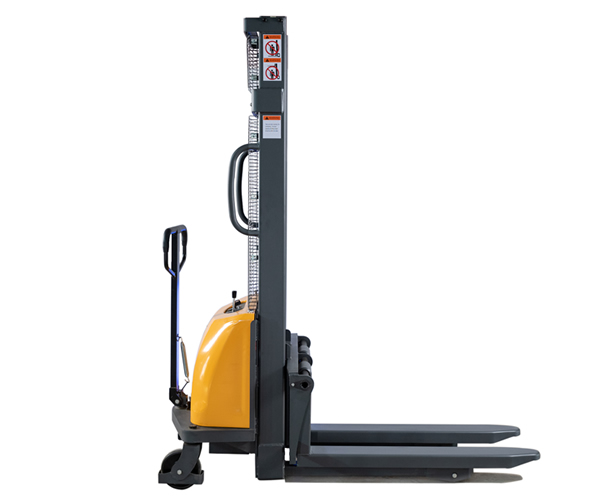 | STACKERS These hydraulic stackers are most extensively used in various industries and by using this effective Semi Electric Hydraulic Stacker users can... View product → |