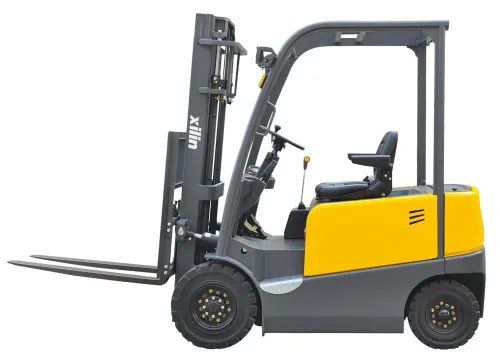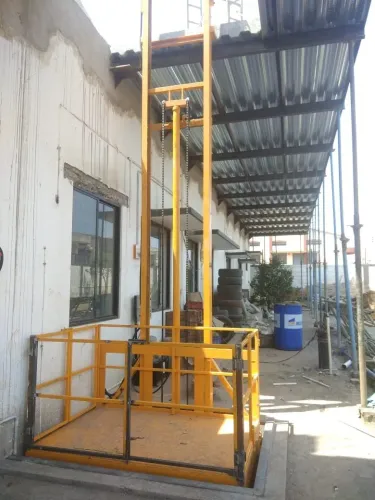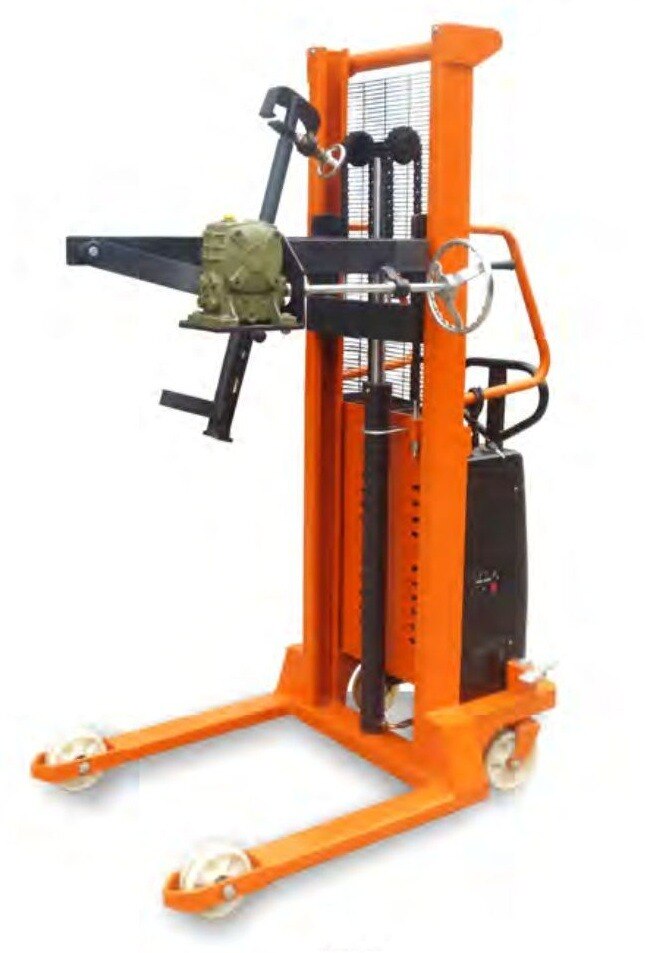
A drum stacker cum tilter can load a platform truck only when its reach, stability, gripping method and travel path match the actual drum and vehicle interface. By the end, you will be able to check the deck, compare drum tilter specifications, define a safe loading sequence and require an acceptance test before the equipment is approved.
Key takeaways
- Measure deck height, route width, turning radius and loading-edge clearance.
- Compare rated capacity, reach, drum diameter range and gripping method.
- Keep the drum low and upright until the truck-deck transfer.
- Test the equipment with a real drum at full reach and tilt.
Check the Platform Truck Route Before Choosing the Stacker
A platform truck route is suitable only when the deck height, approach width, turning radius and loading edge match the drum stacker cum tilter for platform truck loading. Measure the complete envelope, including the raised drum, clamp, mast extension and any side-shift, not the drum alone.
| Interface | Check before entry | Reject when |
|---|---|---|
| Tail lift or access plate | Positive seating, adequate width, marked safe capacity, lip geometry and level transition | The plate capacity is unmarked, unsupported or lower than the combined wheel and axle loads |
| Dockboard or bridge plate | Positive seating, movement restraint, edge support and marked safe capacity | It shifts, flexes excessively or cannot carry concentrated wheel reactions |
| Ramp or vehicle threshold | Width, slope, threshold height, surface grip and marked safe capacity | Wheels could drop into a gap, strike an abrupt edge or overload the transition |
Do not treat the platform truck payload as approval for its tail lift, dockboard or access plate. Compare each interface with the stacker’s concentrated wheel loads and axle loads; small wheels can create high local reactions at an edge even when the total drum weight is within the vehicle payload.
- Confirm the deck is level and free of holes, loose plates, oil and debris.
- Check door height, overhead clearance, mast extension and truck-side obstructions.
- Verify the stacker’s minimum lift, approach width and turning radius at the actual deck height.
- Immobilise the vehicle with set brakes and wheel chocks, or an effective mechanical restraint, before entry.
A platform truck loading equipment assessment is incomplete until these measurements and capacities are recorded.
Compare Reach, Capacity and Drum-Gripping Specifications
The deciding figures are the rated load at the actual reach, lift height and drum centre of gravity—not the headline capacity. Require a rating plate and load chart for the complete drum stacker cum tilter, including the attachment.
| Specification | What to verify | Why it matters |
|---|---|---|
| Rated load and load centre | Permitted drum mass and load-centre distance | A forward centre of gravity reduces capacity |
| Lift and reach | Maximum lift height, full-reach residual capacity and minimum mast height | The unit may reach the deck but lose lifting capacity there |
| Mobility | Turning radius and required approach clearance | A nominal reach is useless if the machine cannot align squarely |
| Attachment | Fork or clamp dimensions and adjustment range | The grip must suit the drum diameter, height and lifting point |
| Tilt function | Actual angle, direction and stop limits | Forward discharge, rearward return and rotation are different duties |
| Rotation rating | Stated capacity reduction during rotation | A 500 kg lifting rating does not prove safe rotation at 500 kg |
Match these drum tilter specifications to the drum’s mass, diameter, height, construction and centre of gravity. Confirm whether the unit handles one drum or multiple drums; wider spacing changes wheel reactions and stability.
Specify compatibility with steel, plastic, fibre, open-head and closed-head drums. Identify whether the grip needs a rim, reinforced chime, bung or intact sidewall. A rim clamp designed for a steel chime can deform or release from thin-wall plastic.
Ask whether motion is powered, manually assisted or protected against free fall, and separate lifting, rotating and holding capacities in the purchase record.
Use a Low, Upright Sequence at the Truck Deck
Immobilise the road vehicle before platform truck loading equipment crosses its threshold. Set the trailer brakes and wheel chocks, or apply an effective mechanical restraint; never rely on the platform truck’s parking brake alone.
1. Inspect the route, dockboard, bridge plate, tail-lift lip, ramp or threshold. Confirm each interface is wide, positively seated, secured against movement and marked for the required load.
2. Position the platform truck squarely with the deck. Approach with the drum stacker cum tilter for platform truck loading carrying the drum low and upright.
3. Align the clamp or forks with the drum. Engage the specified rim, chime, body or lifting feature, then check that the grip is fully seated and the drum cannot slip.
4. Lift only enough to clear the floor. Travel within the manufacturer’s permitted speed and grade limits, keeping the drum low and upright.
5. Do not travel with a raised or tilted drum unless the manufacturer expressly permits that movement. A high or tilted load can tip, roll or release during braking.
6. Align the stacker with the truck deck and cross the secured interface under its stated capacity. Keep the machine square to prevent a wheel dropping at the edge.
7. Lower the drum onto a level bearing surface. Confirm stability before releasing the gripping device, then remove the stacker without touching or disturbing the drum.
8. Secure the drum separately against forward, rearward and lateral movement. The gripper is handling equipment, not transport restraint.
Control Stability at Full Reach, Tilt and Deck Transfer
At full reach, keep the combined centre of gravity of the drum stacker cum tilter and drum inside the stacker’s stability polygon during approach, lifting, travelling, alignment and release. A high or forward drum centre of gravity narrows the margin; tilting can move it forward or sideways and increase mast loading.
Check the manufacturer’s residual capacity for the actual lift height, load centre, attachment position, drum diameter and tilt angle. Do not use the headline capacity for every movement.
| Check | What to compare | Consequence if exceeded |
|---|---|---|
| Lifting | Rated load and residual capacity at height and reach | Forward tipping or overload |
| Tilting | Permitted load at the stated angle and drum diameter | Increased mast load or clamp release |
| Transfer | Wheel reactions, axle loads and edge loading | Deck, lip, plate or floor failure |
For platform truck loading equipment, compare calculated wheel reactions and axle loads with the truck’s axle limits, deck rating and local floor capacity. Inspect deck deflection and the transition across the tail-lift lip or dock plate; a small wheel can impose a damaging concentrated load at the edge.
On a slope, follow the specified load-dependent grade and braking limits, not a generic forklift rule. Keep the operator’s sightline open to the drum, deck edge and wheels. If the load blocks forward view, use the approved travel direction or a spotter. This applies to the complete drum handling equipment assembly, not the tilter alone.
Approve the Equipment Through a Real-Load Acceptance Test
Approve the unit only after a witnessed acceptance test using the actual drum, or a verified equivalent with the same mass, diameter, height, centre of gravity and gripping surface. Run it through the real platform-truck interface at the highest intended lift, maximum horizontal reach and intended tilt angle.
1. Check clamp retention before lifting, during travel and while tilting. Confirm that rotation or tilt stops at the specified position, without drift or uncontrolled release.
2. Inspect hydraulic hoses, cylinders and fittings for leakage under load. Test the parking brake and service brake on the actual approach surface, then check wheel and outrigger clearance at the loading edge, dock plate or tail-lift lip.
3. Transfer the drum onto the truck deck and measure deck deflection. Release the clamp only after the drum is stable, then prove that the stacker can reverse out without touching or shifting it.
4. Apply independent cargo restraints against forward, rearward and lateral movement for the planned vehicle movement. The gripper is lifting equipment, not transport restraint.
Require the supplier’s complete assembly load chart, drum compatibility statement, operating manual, interface limits and current inspection records. The chart must distinguish lifting, tilting, rotating and holding capacity; nominal capacity alone is inadequate drum tilter specifications.
A manufacturer such as Aguatech Engineers Pvt.ltd. is useful when it supplies data against your drum and truck interface, not merely a headline rating. Record the approved drum, route, lift height, tilt angle and restraint method for the drum stacker cum tilter for platform truck loading and related drum handling equipment.
Related product
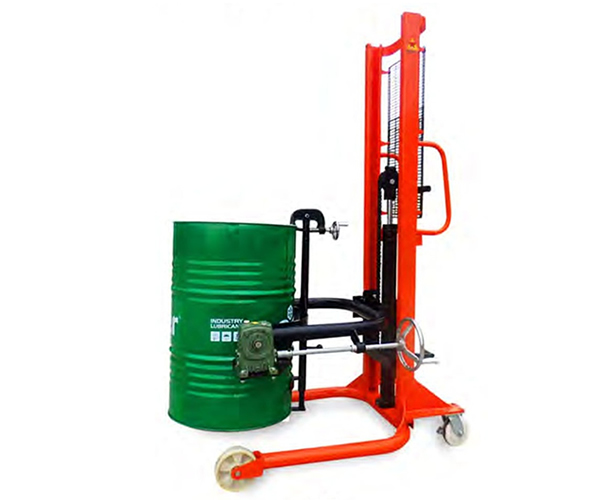 | DRUM HANDLING EQUIPMENT DRUM/BARREL STACKER-CUM-TILTER As the name indicates, most establishments have to handle drums/barrels of different sizes and materials on daily and/or regular basis. View product → |
Frequently asked questions
What should you check before choosing a drum stacker cum tilter for platform truck loading?
Measure the platform truck’s deck height, approach width, turning radius and loading-edge clearance. Include the raised drum, clamp, mast extension and side-shift in the equipment envelope.
Which drum tilter specifications matter for platform truck loading?
Compare rated capacity, maximum reach, drum diameter range, gripping method, lift height, mast dimensions and the remaining capacity at full reach.
How should you load a drum onto a platform truck?
Keep the drum low and upright while travelling, align squarely with the truck, approach the deck slowly, and transfer only after confirming clearance and stability.
How do you approve platform truck loading equipment?
Run a real-load acceptance test using the intended drum, route and truck. Check travel, braking, gripping, full-reach stability, tilt control and deck transfer.