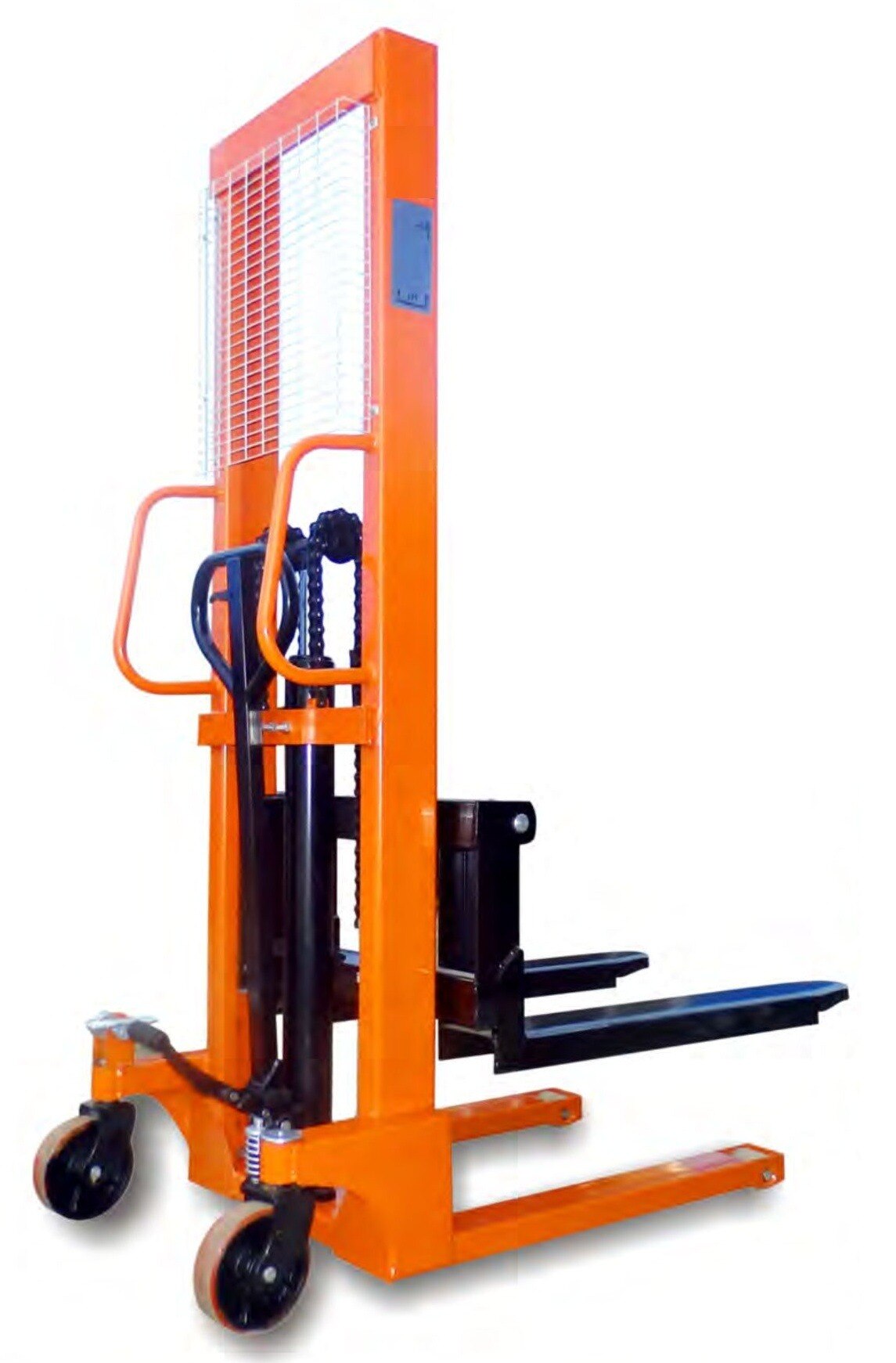
A headline capacity and maximum lift height do not tell you whether a manual stacker will handle your longest pallet, fit your aisle or roll safely across your floor. By checking the capacity chart, pallet dimensions, site constraints, operating effort and acceptance tests, you can compare quotations against the work the machine must actually perform.
Key takeaways
- Match rated capacity to load weight, lift height and centre of gravity.
- Measure pallet openings, aisle width, turning space and floor condition.
- Test pushing, lifting and lowering with a representative load.
- Get local service response times, spare-parts terms and warranty coverage in writing.
Match capacity to the real load, height and centre of gravity
Calculate capacity from the heaviest load at its furthest centre of gravity and the fork height you need, then confirm both against the manufacturer’s capacity table.
Do not buy from a headline figure: a 1,000 kg rating at a 500 mm load centre does not prove 1,000 kg is safe at 700 mm or at maximum lift.
Measure load centre horizontally from the fork face to the load’s centre of gravity. Long cartons, liquid containers, overhanging fork tips, an uneven pallet, or a damaged pallet can move that point outward or make the load unstable. Ask for the rating for the longest, heaviest load actually handled and its real distribution.
- Set required fork height as pallet height plus load height plus clearance above the rack position; use the fork or pallet height, not just the rack-beam height.
- Request manual stacker load details and manual stacker specifications showing permissible capacity at each lift height and load centre, plus maximum lift, lowered fork height, fork length, fork width and maximum fork spread.
- Check the quotation for mast height lowered and raised, overall length and width, turning radius, wheel type, unladen weight and the stated load-centre basis.
Treat the chart value as usable capacity only when the pallet is sound, the load is centred and the forks fully support it. If the actual centre or lift height falls outside the chart, stop and require a revised rating; never compensate by guessing a safety margin.
Verify that the mast, guard and backrest do not block the operator’s view at storage height.
Confirm pallet fit, aisle space and floor compatibility
A stacker will only work if its forks enter your pallet, its steering geometry fits the aisle and its wheels remain stable on your floor. Check these points before comparing prices.
Record these dimensions for both the pallet and the exact stacker model:
- Pallet length, width, bottom-board layout and fork-pocket size
- Fork length, outside width, minimum height and maximum spread
- Overall stacker length and width, mast height when lowered and raised, and turning radius
- Wheel type, ground clearance, unladen weight and permitted floor gradient
- Floor loading, surface condition, joints, ramps and any uneven or damaged areas
A fork-over-leg stacker may not enter a pallet with bottom boards. A straddle-leg model can often handle a closed-bottom pallet, but the pallet must leave clearance between its edges and the legs.
Do not accept a “narrow aisle” claim based only on outside width. Request the working-aisle figure for your pallet dimensions, stacking direction, fork length, steering method and turning radius.
Test the machine with your pallet on the narrowest aisle, then travel with the maximum planned load, stop on the site’s steepest gradient and place the load at the highest required position. Keep the load raised only as far as operation requires.
If starting, steering or stopping across distance, ramps or uneven floors demands excessive force, compare an electric travel model. Add these checks to your manual stacker buying checklist.
Compare lifting method, pushing effort and site conditions
A stacker that is easy to pump while empty can become exhausting when operators repeatedly move a full load. Compare starting, steering and stopping effort over the actual travel distance, including ramps, joints and uneven flooring—not lifting capacity alone.
| Option | Lifting and travel characteristics | Best site fit |
|---|---|---|
| Hand-pumped hydraulic, hand-pushed | Low purchase complexity, but repeated pumping and loaded pushing consume operator effort | Short movements on smooth, level floors |
| Foot-pumped hydraulic, hand-pushed | Reduces bending and speeds lifting, but does not reduce loaded travel force | Intermittent stacking with short travel distances |
| Electric lift, hand-pushed | Removes repeated pumping; the operator still supplies starting, steering and stopping force | Frequent lifting where routes remain short and level |
| Electric lift and travel | Lowest physical travel demand, with battery charging and maintenance requirements | Long routes, ramps, uneven floors or multi-shift use |
Ask for a demonstration with your pallet, maximum planned load and actual floor. Check that the stacker can:
- Start, steer and stop fully loaded in the narrowest aisle and on the site gradient.
- Enter the pallet, travel with the load raised only as needed, and place it at the highest storage position.
- Lift smoothly through the full stroke, hold a suspended load without creeping, lower a partial load under control, and operate overload protection.
- Show no cylinder or hose leakage; inspect wheels, steering, forks and any parking brake.
- Provide visible capacity marking, legible warning labels, emergency or safe lowering, and a documented pre-use check consistent with ISO 3691-5.
Inspect safety features and test the machine under load
Do not approve the stacker until it passes a loaded demonstration on your pallet and your actual floor surface. An empty fork can lift smoothly while a worn seal, faulty lowering valve or incorrect relief setting fails under load.
1. Ask the supplier to use the maximum planned load. Check pallet entry, steering through the narrowest aisle, travel with the load raised only as operationally necessary, stopping on the site’s gradient and placement at the highest required position.
2. Compare the load chart with your load centre and lift height. The visible capacity marking must match the quotation; a nominal 1,000 kg rating is not enough if capacity falls at a 600 mm load centre or maximum lift.
3. Operate the hydraulic system through its full stroke. Check smooth lifting, controlled lowering with a partial load, overload protection and the ability to hold a suspended load without creeping. Inspect the cylinder, hoses, fittings and floor beneath the machine for leaks.
4. Complete the operator and maintenance part of your manual stacker buying checklist. Reject missing warning labels, damaged forks, loose or damaged wheels, poor steering, and a failed parking brake where fitted. Verify emergency or safe lowering and obtain a documented pre-use procedure.
5. Record the acceptance result against ISO 3691-5 safety requirements for pedestrian-propelled industrial trucks. Keep the load chart, test observations and defects with the purchase file, and correct every defect before service.
Get a written local-service commitment before placing the order
Require a signed local-service commitment before you pay. Your record of what to check before buying a manual stacker in surat should identify who will inspect, repair and supply parts after delivery, not only who issued the quotation.
1. Make the manual stacker supplier in Surat demonstrate the exact machine with your pallet, maximum planned load and actual floor. Require entry into the pallet, travel with the load raised only as needed, steering through the narrowest aisle, stopping on your gradient and placing the load at the highest required position.
2. Get written service coverage stating the response time, inspection intervals and contact person. A promise of “after-sales support” is not enough.
3. Require a parts list covering hydraulic seals and hoses, wheels, lowering valves and forks, with lead times and local availability. Proprietary wheels or seals sourced outside Surat can make a low-priced stacker uneconomic in a high-cycle operation.
4. Make the warranty document name exclusions, including overloaded use, damaged pallets, misuse and unauthorised repairs. Ask who pays for travel, labour and replacement parts.
5. Put the agreed acceptance inspection and first service date on the purchase order. Aguatech Engineers Pvt.ltd. should be asked to record these commitments alongside the machine’s serial number, capacity chart and delivery documents.
Related product
 | STACKERS Manual Stackers are the most commonly used equipment in a workshop, warehouse or factory and most economical way of providing highest safety and most... View product → |
Frequently asked questions
How do I match a manual stacker to my actual load?
Use the heaviest load, required fork height and furthest centre of gravity. Check these details against the manufacturer’s capacity table rather than relying on the maximum advertised rating.
What pallet and site measurements should I confirm before buying?
Check pallet entry dimensions, fork length, overall stacker width, aisle and turning space, doorway clearance, floor levelness and the floor’s ability to support the loaded machine.
How should I compare manual stacker lifting methods and pushing effort?
Compare hydraulic or other lifting arrangements, lift speed, handle force, steering effort and braking. Test the machine on the actual slopes, thresholds, floor surfaces and travel distances at your site.
Which safety checks should I perform before ordering?
Inspect the mast, forks, chains, hydraulic system, wheels, brakes, guards, load backrest and lowering controls. Test lifting, lowering, steering and braking with a representative load.
What local service commitment should a manual stacker supplier provide?
Request written warranty terms, response times, inspection intervals, spare-parts availability, technician coverage in Surat and the process for reporting breakdowns.