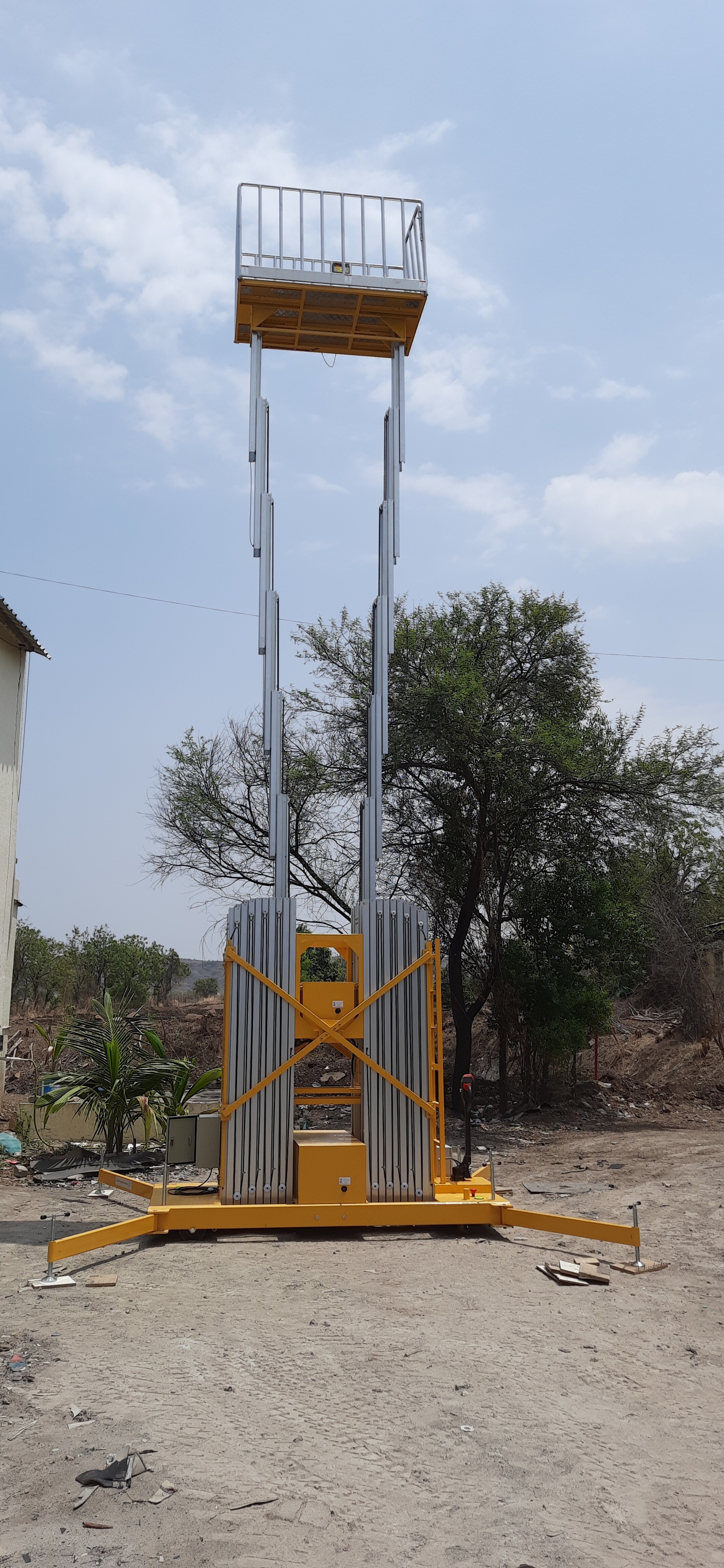
Choosing the right machine starts with the maintenance task, not the mast count. You will be able to calculate the required reach, test a Surat factory’s access and floor conditions, specify the equipment precisely, and compare price and supplier support without treating unlike machines as equivalent.
Key takeaways
- Match platform height and outreach to the exact maintenance point.
- Measure doorways, aisles, floor condition and setup space before ordering.
- Specify rated load, closed dimensions, battery runtime and charging requirements in writing.
- Compare safeguards, operator training, landed cost and local Surat support.
Match the platform to the maintenance task and required reach
1. A single mast aerial work platform suits one operator carrying light tools to a defined indoor or sheltered maintenance point. It is not a universal machine size or capacity: “single mast” only describes the lifting arrangement.
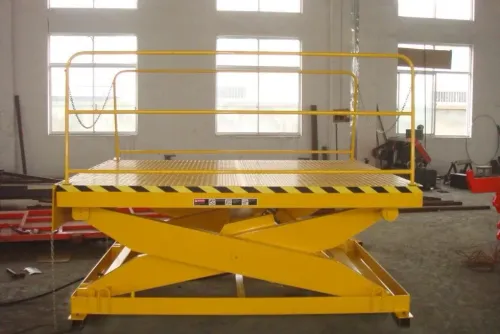
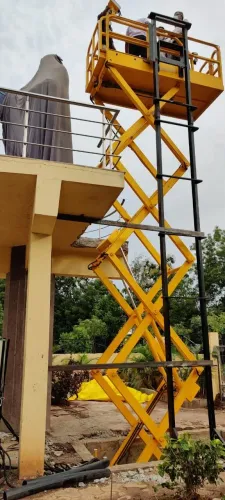
2. The normal job sequence is simple: position the machine below a light, cable tray, pipe, sign, sensor, ventilation unit, or overhead machine; raise one operator; complete the task; lower the platform; and relocate it. Choose a scissor lift instead when several workers, bulky replacement parts, or a broad working area must be supported.
3. Separate platform height from working height. Platform height is the deck elevation; working height combines deck elevation with the operator’s practical reach inside the guardrails. Measure the task height, subtract the operator’s safe reach from inside the platform, and use the result to specify the required platform height.
Ask the supplier to state both figures.
4. Do not count standing on the guardrail, climbing the toe board, leaning outside the rails, or stretching beyond the gate. Measure clearance above the raised platform as well as task height, including pipes, sprinkler lines, beams, fans, ceiling services, and other obstructions.
5. Confirm the platform’s rated load for the operator and tools. If the job needs two workers, heavy parts, significant horizontal reach, or repeated access across a wide production area, a single mast platform is the wrong choice.
Test the Surat factory route, floor and setup footprint
1. Walk the complete maintenance route with a tape measure. Record doorway width and height, lift-car length, width and height, aisle width, turning space, machine-room entrances, emergency exits, and distances between lights, sensors, cable trays, production lines, and each work point.
A single mast aerial work platform in Surat must reach every point without removing doors or stopping production.
2. Obtain the machine’s overall width, length, collapsed height, transport weight, turning radius, and deployed outrigger or stabilizer envelope. Stabilizers can make a narrow machine too wide for an operating aisle, and they must not block fire exits, conveyors, dock edges, or pedestrian routes.
Confirm that the raised mast clears beams, pipes, fans, sprinklers, and other overhead obstructions.
3. Inspect every setup position for level, smooth concrete. Reject locations with pits, open drainage channels, broken joints, loose plates, oil patches, or abrupt floor transitions. Ask the facility engineer to confirm concrete strength and permissible floor loading, especially above basements and on mezzanines.
Request allowable slope, gradeability, slope-alarm behaviour, wheel or caster type, and whether the model uses outriggers or automatic levelling.
4. Confirm indoor-only or indoor/outdoor approval, wind limits, and paving restrictions before using the machine near loading docks or outside factory doors. Record the route, setup footprint, and floor limits on the purchase specification so a supplier cannot verify only transport dimensions while ignoring the operating envelope.
Specify capacity, dimensions and battery performance in writing
A comparable quotation must state maximum platform height, maximum working height, rated platform load, and the operator-plus-tools limit. Rated load includes the operator, hand tools, consumables, spare parts, harness or lanyard equipment, and every object carried onto the deck. A second person is prohibited unless the machine is specifically rated for two occupants.
| Platform height | Deck elevation | Compare with the required task height |
|---|---|---|
| Maximum working height | Deck elevation plus practical reach inside guardrails | Use for access planning |
| Usable payload at required height | Permitted load at that elevation | Compare this, not the brochure maximum |
Ask for these dimensions and construction details in writing:
- Platform length, platform width, entry opening, overall machine length and width, collapsed height, machine weight, mast material, and wheel or caster type
- Power source, battery voltage, battery chemistry, charger type, and charging time
A taller machine can have a lower allowable payload or a larger footprint. Confirm the payload at your required height before comparing offers.
For a battery machine, ask how many lifting and travel cycles one charge supports, whether charging needs ventilation, the expected recharge time, replacement-battery price, and whether a spare battery or opportunity-charging plan supports multiple shifts.
Request an itemised single mast aerial work platform price covering the machine, battery, charger, delivery, commissioning, taxes, warranty, and maintenance; reject a single headline figure with no exclusions.
Verify safeguards, inspection points and operator readiness
Before every shift, confirm that the platform’s safeguards work and that the operator is fit, trained, and authorised to use it. A machine that raises normally but has failed emergency lowering is not ready for service.
- Test emergency-stop buttons at ground and platform level, manual emergency lowering, platform and ground controls, control interlocks, limit switches, overload protection, tilt or slope alarms, wheel brakes, and audible alarms.
- Inspect mast sections, welds, pins, fasteners, platform gate, guardrails, toe boards, wheels, brakes, hydraulic or electrical components, cables, battery case and terminals, charger, and warning labels.
- Confirm battery isolation works before maintenance or fault investigation. Use non-marking wheels where the factory floor requires them.
- Check for a structural crack, damaged cable, leaking component, failed safeguard, or unreadable label. Remove the machine from service and report the defect; do not rely on a later repair note.
Ask whether the platform has a designated fall-protection anchorage and whether the manual requires a harness or lanyard. Never attach fall protection to a guardrail.
Train operators on ground and platform controls, isolation, charging, slope limits, overhead hazards, rescue arrangements, and defect reporting. Keep the training record with the machine file.
Request the applicable edition of EN 280 or ISO 16368, test records, rated load, wind rating, slope limits, and the supplied declaration or certificate. Review these documents alongside Indian workplace requirements; a foreign-standard certificate does not automatically prove local compliance.
Compare machine types, landed cost and Surat supplier support
A quote is comparable only after you identify the equipment class: self-propelled MEWP, push-around platform, mast lift, or warehouse order picker. “Single mast” describes the lifting arrangement, not a universal height, capacity, or travel capability.
| Option | Compare against the job | Reject or reconsider when |
|---|---|---|
| Single mast | One operator, light tools, fixed points, short relocations, vertical access | Two workers, heavy parts, horizontal reach, rough paving, or continuous travel |
| Ladder | Lowest setup cost and immediate repositioning | The task requires guarded elevated access or both hands for work |
| Scaffold | Stable, broad work area | Frequent relocation makes erection and dismantling costly |
| Scissor lift | Several workers, bulky parts, broad platform area | Doorways, floor loading, or narrow aisles cannot accept it |
| Double mast | Greater height or payload | Its footprint and price exceed the measured task |
For landed cost, request separate lines for machine price, delivery to Surat, taxes, commissioning, operator familiarisation, warranty, preventive maintenance, battery and charger, spare-parts lead time, annual maintenance, and emergency breakdown response. A single mast aerial platform supplier in surat should state the deployed footprint and service commitment, not only transport dimensions.
Ask a single mast lift manufacturer in surat for maintenance intervals, local technician availability, and battery replacement cost. Aguatech Engineers Pvt.ltd. belongs in the comparison when it provides those documents, demonstrates the machine on your factory route, and matches the measured height, floor, payload, and access limits.
Related product
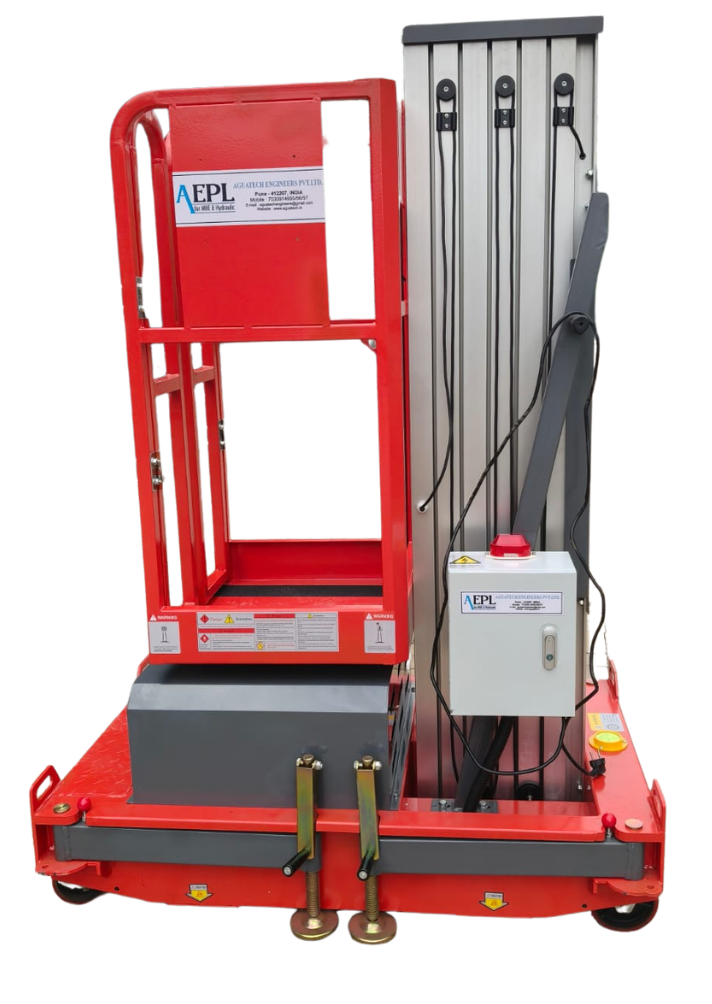 | Aerial Work Platform – Single Mast Aerial Work Platform – Single Mast A Single Mast Aerial Work Platform (AWP) is a compact, vertical-lifting device designed for safe, single-person access to high places. View product → |
Frequently asked questions
How do you match a single mast aerial platform to a maintenance task?
Define the working height, horizontal reach, operator-and-tool load, work duration and indoor or sheltered operating conditions before selecting the platform.
What should you check on a Surat factory route before delivery?
Measure doors, aisles, lift openings, turning areas and setup zones, then confirm floor strength, slopes, thresholds and surface condition.
Which specifications should appear in the written quotation?
Request rated capacity, platform dimensions, maximum working height, closed height, machine width, battery type, charging time, expected runtime and safety features.
What safeguards and operator checks matter before use?
Verify emergency lowering, guardrails, gate interlocks, tilt or overload protection, wheel brakes, inspection records and operator training.
How should you compare a single mast lift with other access equipment?
Compare it with podium steps, scaffolding, scissor lifts and boom lifts by reach, mobility, setup time, floor access, purchase cost and local service support.