
A lift that reaches the required roof edge can still fail the purchase test because of floor loading, tail swing, hydraulic drift, a defeated interlock, poor indoor ventilation or unavailable spare parts. By the end, you will have a practical way to inspect the machine, measure the workshop, compare alternatives and document conditions that must be resolved before ordering.
Key takeaways
- Inspect boom joints, welds, tyres and hydraulics under load.
- Test every control, alarm, interlock and emergency-lowering system.
- Measure floor clearance, doorways, reach and indoor ventilation before purchase.
- Make serial numbers, repairs and acceptance tests part of the contract.
Find structural, articulation and hydraulic defects before discussing price
A low hour-meter reading does not prove a sound machine. Before discussing price, inspect the boom, knuckle joints, chassis and hydraulic system under load and through their full movement. These checks expose articulated boom lift problems for workshops that a short demonstration can hide.
Use this boom lift inspection checklist on the machine itself:
- Look along every boom section for cracks, bent steel, corrosion, loose fasteners, fresh paint over weld repairs and impact marks.
- Check pivot pins, bushes and knuckle joints for excessive movement; inspect the slew ring for backlash or uneven rotation.
- Examine cylinder rods for pitting, scoring and bends. Check hoses where the boom folds, because chafing can remain hidden when it is stowed.
- Inspect fittings, swivel joints, pumps and valves for wet oil, damaged seals and pressure loss. Operate each function, then check for boom drift and oil beneath the chassis.
- Check the platform gate, guardrails, harness anchor points, tyres, brakes, battery or engine, wiring and control components for damage or unauthorised repairs.
| Finding | What it means | Buying response |
|---|---|---|
| Light surface seepage | Contamination risk requiring monitoring | Price a documented repair |
| Active hose or cylinder leak | Hydraulic failure and possible uncontrolled movement | Stop the purchase until repaired and retested |
| Cracked weld, bent boom or major pin movement | Structural or articulation defect | Reject unless an approved repair is documented |
| Proprietary control fault with no local support | Extended downtime after failure | Confirm parts, calibration and trained service support before ordering |
Require service, fault-code and inspection records for used equipment; unavailable hoses, filters or control parts can cost more than the initial saving.
Test every control, safety device and emergency-lowering function
A boom lift protects operators only when its controls, interlocks and rescue systems work under failure conditions. Use a boom lift inspection checklist during a live demonstration, not a parked-machine review.
- Operate every ground and platform control, including boom, slew, telescope, drive and steer functions.
- Press each emergency-stop button and confirm that all motion stops before resetting it.
- Release the platform foot switch or enable control; movement must stop immediately.
- Test brakes, travel alarms, horn, tilt alarm, level sensors, platform levelling and overload protection.
- Raise and position the boom, then test limit switches and interlocks that prevent unsafe travel or operation.
- Lower the platform from the ground station with normal controls disabled, then repeat from the platform station.
- Test the emergency-lowering system with the machine powered down, following the manufacturer’s procedure.
The rescue procedure must not depend on the operator staying conscious or the primary controls remaining functional. Check that a person on the ground can reach the ground controls, identify the lowering valve or auxiliary pump, and communicate with someone in the platform.
Ask the supplier to demonstrate recovery from a trapped operator and record the steps. Train the staff who will perform it.
For workshop boom lift safety, verify guardrails, gate latches, harness anchor points and rated-capacity markings before acceptance. A machine that drives and raises normally still fails the purchase review if an emergency stop, interlock or rescue function is defeated. Require the manufacturer’s operating and emergency instructions at handover.
Prove the lift fits your floor, working envelope and indoor conditions
A machine with adequate platform height can still be unsafe or unusable if the workshop floor, clearances, or environment do not support it. Confirm the site before accepting the supplier’s reach figures.
Check these conditions during a loaded, practical route survey:
- Obtain total machine mass, maximum wheel load, tyre contact area, allowable floor slope, and outrigger reaction if fitted. Have an engineer check the slab for concentrated and moving loads; a floor supporting stationary equipment may fail under a travelling boom lift.
- Measure the turning radius with the platform occupied, then map the articulated boom’s swept envelope, tail swing and counterweight swing around racking, columns and doorways.
- Measure clearance from sprinkler pipes, lights, crane rails, mezzanine edges and roof members. A jib that cannot pass one obstruction makes the lift unusable despite its rated height.
- Inspect entrances for monsoon water, blocked drainage and mud. Mud reduces traction and can carry water into control boxes, connectors, chargers, slew components and hydraulic systems.
- Specify enclosure ratings, drain paths and corrosion protection for Pune’s abrasive dust, heat and wet conditions. Require covered parking and charging; an outdoor-rated chassis is not protection for every exposed component.
- Confirm tyre type, wet-floor limits and turning behaviour. Solid or foam-filled tyres prevent punctures but can mark finished floors and transmit shock through joints; non-marking tyres still need suitable traction.
These checks are central to workshop boom lift safety. Record mats needed at thresholds, floor joints or weak zones, and reject any route that depends on an operator guessing clearance. Local articulated boom lift issues in Pune often begin with water, dust or drainage rather than a defect in the boom itself.
Compare reach, capacity, power and service support against the actual job
Maximum working height is not the buying figure. Compare platform height, horizontal outreach, up-and-over clearance, rated platform capacity, and the load permitted at maximum reach.
| Option | Strength | Limitation to test |
|---|---|---|
| Articulated boom lift | Reaches over machinery and around obstacles | Capacity often falls at full outreach; jointed movement consumes time and battery |
| Telescopic boom lift | Delivers greater straight-line outreach and reach | Needs clearer access and offers less ability to work around obstructions |
| Vertical mast or scissor lift | Efficient for vertical, repetitive indoor work | Cannot reach over walls, racks, or fixed equipment |
| Scaffold or fixed platform | Suits long-duration work at one location | Relocation and height changes slow the work cycle |
Calculate the real cycle: travel to each station, raise, position, work with people and tools, lower, and repeat per shift. Then check the manufacturer’s load-at-reach chart. A lift that carries two workers at the centre may legally carry only one worker and light tools at maximum outreach.
Power must match the shift. Specify electric power where exhaust is unacceptable, then verify battery capacity, charger location, charging ventilation, electrical supply, and recharge time. Ask Aguatech Engineers Pvt.ltd. to document local parts stock, trained technicians, calibration equipment, and response times before you compare prices.
Treat unavailable hoses, filters, batteries, tyres, or proprietary controllers as downtime costs. For articulated boom lift buying problems, demand service and fault-code records for used machines. For articulated boom lift issues in Pune, include monsoon drainage, abrasive dust, covered storage, and corrosion protection in the support agreement.
Related product
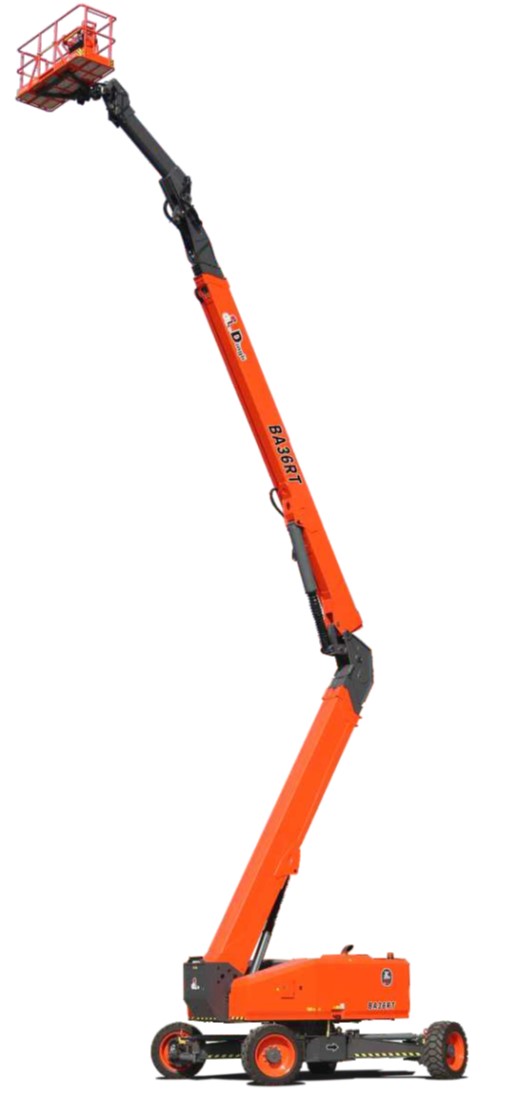 | Articulated Boom Lift An articulated boom lift, or “knuckle boom,“ is an aerial work platform featuring multiple jointed segments that allow the arm to navigate around... View product → |
Turn the inspection into a purchase file with acceptance conditions
Make payment conditional on a signed acceptance file, not on the machine arriving at your gate. The file turns a boom lift inspection checklist into evidence and exposes articulated boom lift buying problems that a clean demonstration can hide.
1. Require the serial number, model, year, rated-capacity chart, operator and service manuals, conformity documents, inspection intervals, and warranty terms. For a used lift, add ownership history, hour-meter photographs, inspection and repair invoices, fault-code downloads, load-test results, and records of structural or collision repairs.
2. Write the delivery acceptance test into the purchase order. Reject the lift for any failed ground or platform control, emergency stop, enable switch, alarm, brake, interlock, level sensor, platform-levelling function, or emergency-lowering operation from either station.
3. Record the machine’s total mass, maximum wheel load, tyre contact area, allowable floor slope, and outrigger reactions. Make slab approval and confirmation of the working height, outreach, capacity, power supply, and indoor emissions conditions acceptance requirements.
4. Obtain written confirmation of local stock and response times for hydraulic hoses, filters, batteries, tyres, control components, calibration equipment, and trained technicians. Do not accept “service available” without named contacts and a parts route.
Have the supplier sign every defect, correction, and retest result. For a used lift, retain the baseline photographs and hour-meter reading; schedule the first frequent inspection and enter the next periodic inspection date, not exceeding three months or 150 hours.
Frequently asked questions
Which articulated boom lift problems should workshops check before discussing price?
Inspect the boom, knuckle joints, chassis, welds, tyres and hydraulic system through full movement and under load. Look for leaks, cracks, looseness, abnormal noise and drift.
What safety functions should you test on a used boom lift?
Test drive and boom controls, emergency stop buttons, platform controls, alarms, limit switches, interlocks, overload protection and the emergency-lowering function.
How can you prove an articulated boom lift fits a workshop?
Measure doorways, aisles, floor load limits, ceiling height, working height, side reach, turning space and charging or refuelling areas. Check ventilation and indoor emission limits for the power source.
What should a workshop compare beyond boom lift reach?
Compare platform capacity, machine weight, horizontal reach, articulation angles, power source, duty cycle, tyre type, spare-parts access, technician support and expected service downtime.
What belongs in an articulated boom lift purchase file?
Record the serial number, inspection findings, hour-meter reading, service records, test results, photographs, repair obligations, delivery condition and acceptance criteria with signed deadlines.