
A 1-tonne label does not tell you whether a crane can safely lift your motor at its required outreach, clear your factory aisle, or travel across the floor. You will be able to calculate the required safe working load, define the dimensions and operating conditions, compare crane types, and test a supplied unit before production use.
Key takeaways
- Rate the crane at the hook position, not only its maximum brochure capacity.
- Measure aisle width, floor condition, headroom and travel distance before selecting crane size.
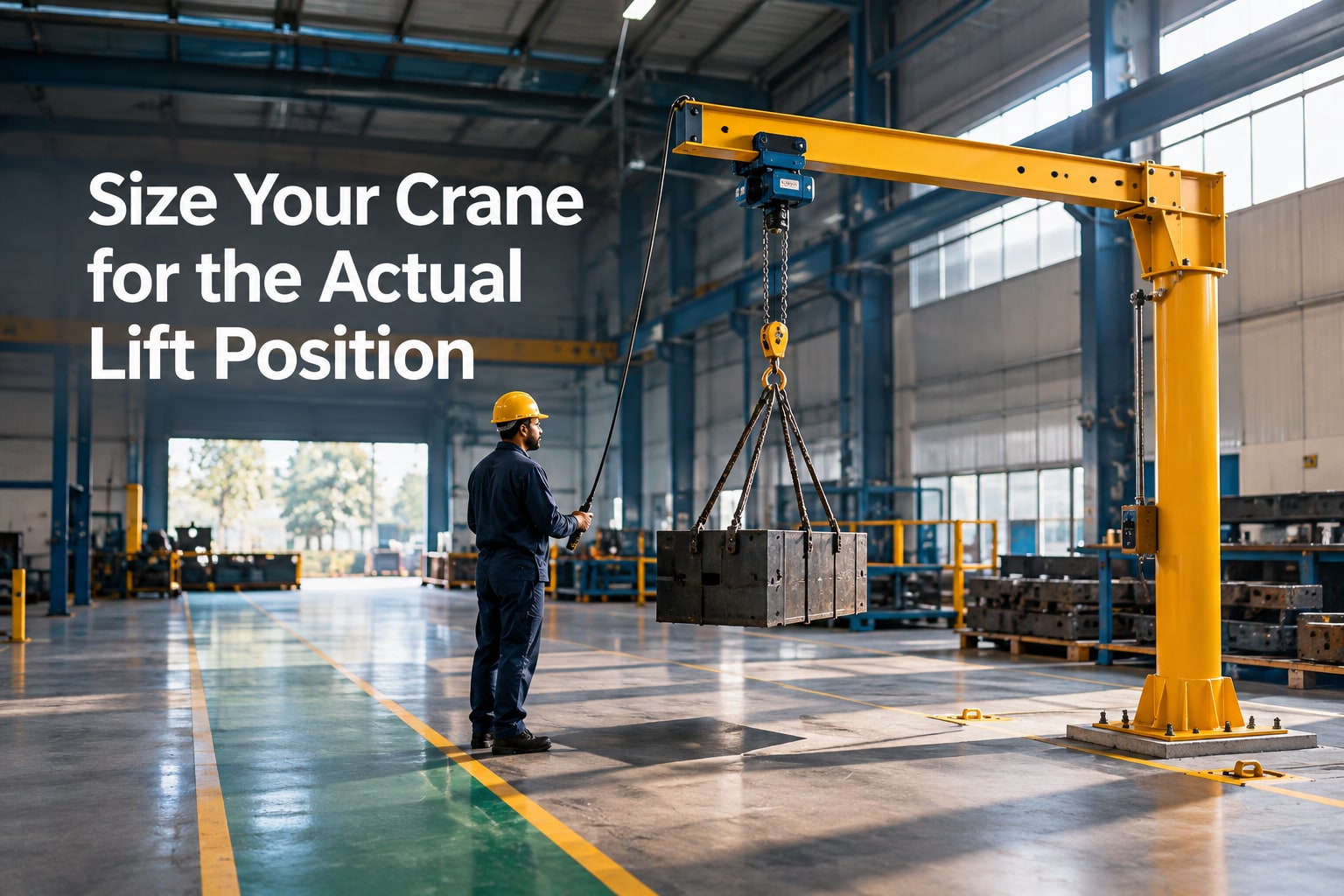
- Prevent side-pulling by aligning the hook directly above the load centre.
- Compare supplier drawings, load tests, warranties and installation documents before ordering.
Specify capacity at the actual boom or trolley position
Choose shop floor crane capacity from the load at the hook’s actual working position, not the largest number in a brochure. Common nominal classes include 500 kg, 1,000 kg, 2,000 kg and 3,000 kg, but the usable rating can fall as the boom extends.
| Boom or trolley position | Capacity to specify | Check before selection |
|---|---|---|
| Root or minimum outreach | SWL/WLL at this position | Supporting structure and minimum hook height |
| Mid-boom outreach | SWL/WLL at this position | Load moment and wheel or foundation loads |
| Maximum or telescopic outreach | SWL/WLL at this position | Stability, deflection and permitted travel |
Calculate the suspended load as the product, lifting attachment, hook block and hoist weight together. Add the dynamic allowance stated by the designer for starting, stopping and placing the load; do not invent a percentage. Compare the resulting load moment—mass multiplied by horizontal offset—with the crane’s rating at that position.
Side-pulling is not a capacity adjustment and can overturn or damage the crane.
Before requesting manual shop floor crane capacity in Pune, give suppliers these operating details:
- Gross load and centre-of-gravity location
- Sling, spreader or grab weight
- Required outreach, hook height and boom position
- Whether lifting, slewing and loaded travel are manual or powered
- Whether loaded travel is permitted on your floor
Ask for a capacity chart covering the supplied configuration. A headline shop floor crane capacity is insufficient without its position-specific SWL/WLL, attachment limits and stability conditions.
Match manual crane size to the Pune factory layout
A 500 kg, 1,000 kg, 2,000 kg or 3,000 kg rating is useful only when tied to the actual hook position. Record the lifted load, hook block and hoist weight, attachment weight, centre-of-gravity offset, and any starting or stopping forces.
A crane rated for 1,000 kg near the boom root may allow less at full outreach.
Measure these points before selecting the manual shop floor crane size:
| Check | Measure | Why it decides fit |
|---|---|---|
| Boom or trolley position | Outreach from support to hook centre | Capacity falls as load moment increases |
| Hook height | Highest and lowest hook positions | Determines access, lifting clearance and overhead obstruction risk |
| Overall length and width | End-frame, counterweight and wheel envelope | Prevents clashes with machines, walls and doors |
| Aisle and turning space | Straight travel width and turning radius | Affects movement between workstations |
| Span or boom length | Clear span, beam length and telescopic setting | Longer reach increases deflection and structural demand |
| Wheel or foundation load | Maximum load at each wheel or base | Concentrated force can damage a slab |
| Floor condition | Levelness, slope, pits, drains, joints and thresholds | Uneven ground can shift wheels or reduce stability |
Have the slab checked against the crane’s stated wheel loads, not just its average floor load. Mark the travel path and include columns, pallets, dock edges and emergency routes in the swept envelope. A portable gantry must move unloaded unless its design expressly permits loaded travel; never use side-pulling to gain reach.
Operate the crane without side-pulling or unstable travel
A side pull can tip a floor crane, bend a boom, or drag the load into a nearby machine. Keep the hook directly above the load’s centre of gravity, and select the SWL shown for the actual boom or trolley position—not the headline 2,000 kg rating.
Use a manual crane for factory lifting only after separating each movement: a hand-chain hoist for vertical lifting, a geared trolley for controlled cross-travel, and push travel only on a clear, level floor. Choose certified slings, shackles, lifting eyes, or a spreader beam that suit the load’s attachment points and protect against sling angle overload.
Before the lift, complete this check:
- Confirm the load weight, centre of gravity, attachment weight, and required hook height.
- Inspect the hook latch, load chain, hand chain, brake, trolley wheels, pins, welds, boom locks, and outriggers.
- Verify the SWL plate, boom setting, attachment method, and proof-test record match the supplied crane.
- Check floor condition, wheel path, aisle clearance, overhead obstructions, and exclusion zone.
- Raise the load 50 to 100 mm, stop, check balance and brake holding, then continue slowly.
Never stand under a suspended load or pull it sideways to gain reach. Do not travel with a load unless the manufacturer rates that configuration for loaded movement; keep it low, move on straight, level ground, and stop if wheels lift, the frame shifts, or the load swings.
Choose between a floor crane, gantry, jib, EOT or powered unit
A manual crane is the right choice for a manual crane for factory use when lifts are occasional, loads stay within one work bay, and operators can position the equipment without long travel.
Confirm the shop floor crane capacity at the actual hook position: a jib’s 1,000 kg rating near the column does not guarantee 1,000 kg at full outreach.
| Option | Best fit | Choose another when |
|---|---|---|
| Floor crane | Occasional lifts at several nearby points; no permanent foundation | The route is uneven, the load must travel while suspended, or wheel loads exceed the slab rating |
| Portable gantry | Several machines or loading points; manual lifting with a hand-chain hoist | The floor is not level or strong enough for concentrated wheel loads, or loaded travel is not permitted |
| Jib crane | One fixed workstation with short, predictable reach | You need broad coverage, frequent repositioning, or greater outreach |
| EOT crane | Repeated lifting and travel across a defined bay | Installation of runway beams, columns, or electrical systems is impractical |
| Powered unit | High cycle frequency, heavier loads, or powered lifting and travel | The low-use job cannot justify controls, maintenance, and power infrastructure |
Separate manual lifting from manual travel: specify whether the hoist, trolley, slewing, and long travel are hand-operated or powered. Choose a powered or EOT arrangement when frequency, travel distance, hook height, or operator effort makes manual movement slow and unsafe. Never use side-pulling to gain reach.
Compare Pune quotations, documents and acceptance tests
A 500 kg, 1,000 kg, 2,000 kg or 3,000 kg label is not enough to compare Pune offers. Require the safe working load (SWL/WLL) at each boom or trolley position, including the hook block, hoist weight, attachment weight, load-centre offset and stated dynamic or side-pull assumptions.
A one-tonne rating at the boom root does not prove one tonne at maximum outreach.
Ask each shop floor crane manufacturer in Pune for the same evidence:
- A quotation showing outreach, hook height, dead weight, minimum aisle width, wheel loads or foundation loads, manual operating effort and whether loaded travel is permitted.
- A drawing showing the supplied boom length, telescopic position, span, attachment method and floor or foundation requirements.
- The applicable Indian Standard or engineering design basis, plus the name of the responsible designer or competent person.
- Material and weld records, inspection points, operating instructions, maintenance schedule and rated-load test certificate.
- An acceptance test using the exact supplied configuration, with the rated load at the governing outreach; record deflection, stability, brakes, travel and hydraulic leakage.
| Comparison point | Reject the quotation when | Accept it when |
|---|---|---|
| Manual shop floor crane capacity in Pune | It states only “1 tonne capacity” | SWL is stated at every working position |
| Documents | A generic certificate omits span, boom or floor loads | Documents identify the tested configuration |
| Commissioning | Testing uses a shorter boom or different attachment | Rated-load results match your delivered crane |
Aguatech Engineers Pvt.ltd. should be compared on these same documents and tests, not on proximity or headline capacity. Pay the balance after recorded acceptance, not after fabrication alone.
Related product
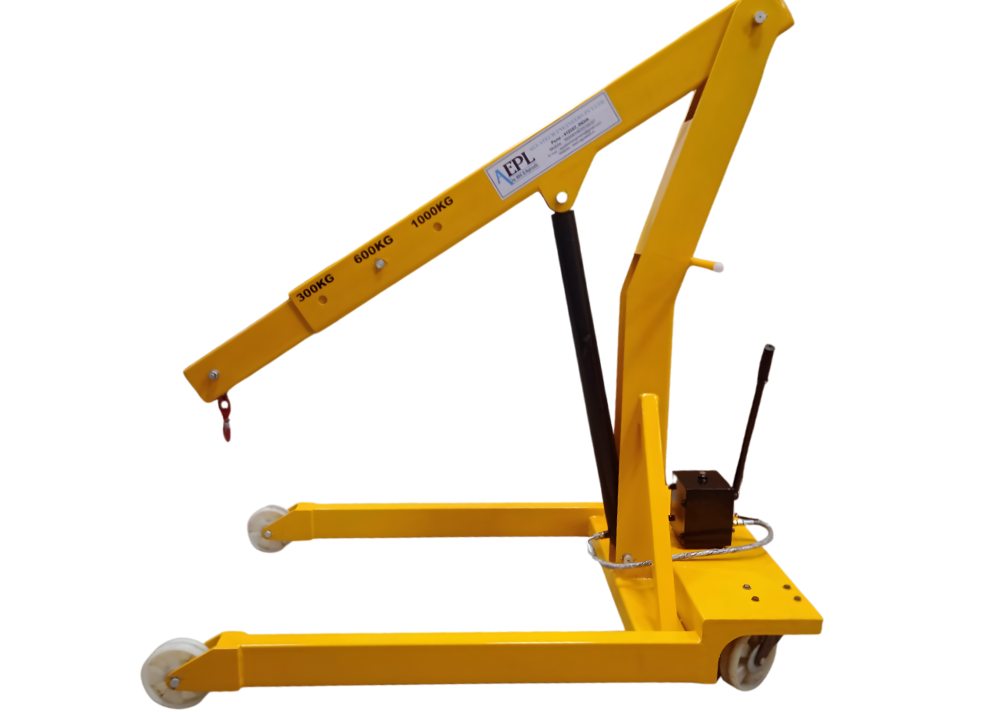 | Cranes A hydraulic floor crane, also known as a shop crane or engine hoist, is a powerful lifting device designed to handle heavy loads in a wide range of... View product → |
Frequently asked questions
How do you specify manual shop floor crane capacity?
State the load at the actual boom or trolley position, including hook, lifting accessories and any capacity reduction caused by boom extension.
How do you match a manual crane size to a Pune factory layout?
Check floor strength, aisle width, headroom, turning space, travel distance, machine clearances and the locations where loads will be picked and placed.
How can operators prevent side-pulling and unstable crane travel?
Keep the hook vertically above the load centre, avoid dragging suspended loads, use controlled travel and stop when the floor or load becomes unstable.
What should Pune factories compare in crane quotations?
Compare the rated load position, dimensions, materials, drawings, inspection records, load-test results, warranty, installation scope and acceptance-test procedure.