
The wrong machine can fit the rack but fail at the doorway, exceed the floor load, or leave too little capacity for tools and materials. Use the site measurements, reach calculation, specification checklist, quotation breakdown and acceptance tests below to compare equipment and select a platform that works safely in your Pune facility.
Key takeaways
- Measure the highest work point and identify obstacles before choosing platform height.
- Compare working height, platform height, capacity, dimensions and machine weight.
- Check doorways, floor conditions, charging access and battery runtime at your Pune site.
- Require safety controls, inspection records, acceptance tests and clear after-sales support.
Start with the access task, not the advertised height
Measure the highest point you must reach before comparing machine heights. For anyone searching “single mast aerial work platform for buying guide in Pune,” the key question is whether the job needs straight vertical access indoors or reach around an obstacle.
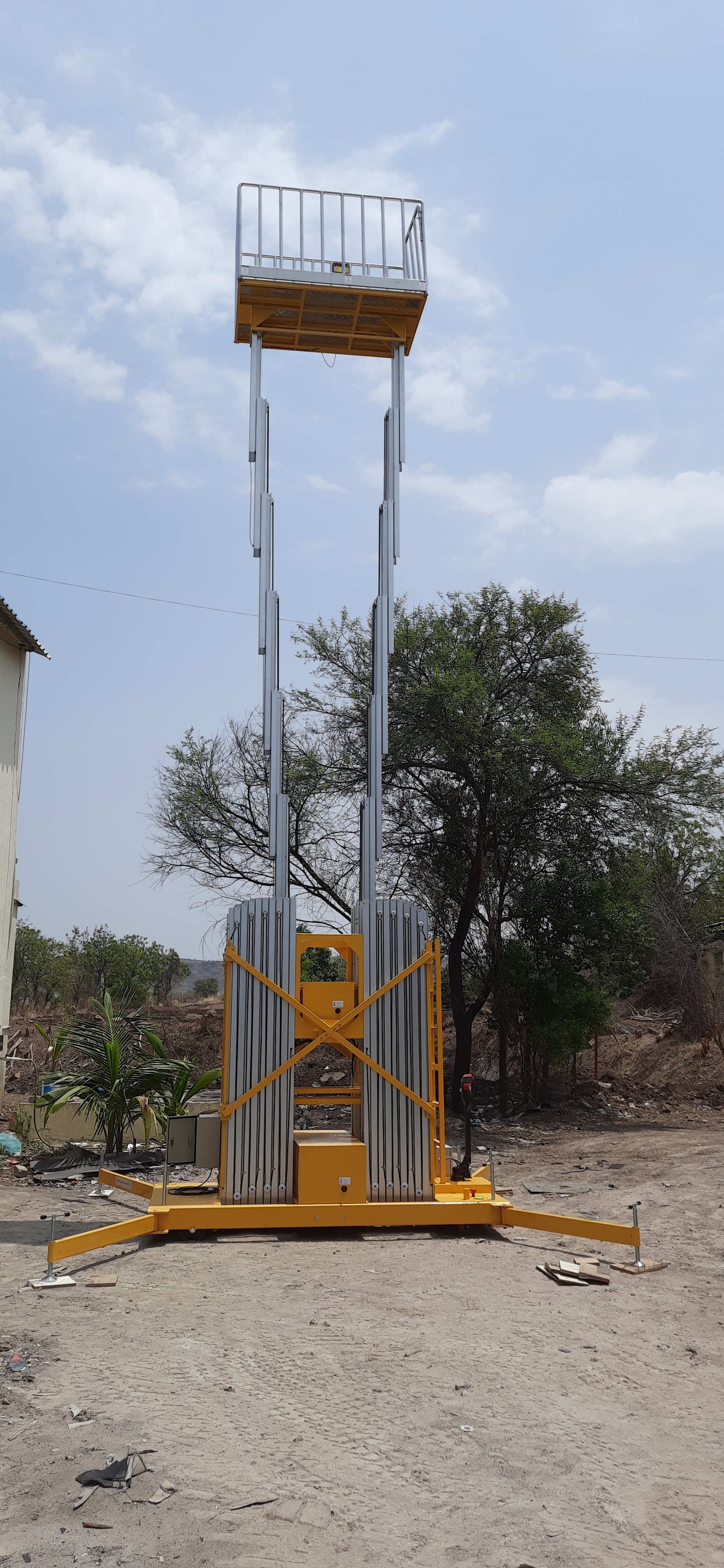
A single mast suits racks, lights, signs and maintenance points above a compact footprint; it is the wrong choice for lateral reach, frequent repositioning at height, rough ground, wind exposure or two workers carrying bulky tools.
Calculate the required platform height from the work point, not the ceiling. Subtract the operator’s practical reach while standing safely inside the platform, then add clearance for the tool and the required working posture.
For example, a 10.5 m light fitting and a 1.8 m safe operator reach indicate about 8.7 m of platform height, subject to the manufacturer’s rated working position.
Working height normally equals platform height plus operator reach. Do not compare a supplier’s “14 m” working height with another supplier’s 12 m platform height; they describe different measurements.
Ask every supplier to state these fields separately:
- Rated platform height and maximum working height
- Horizontal outreach and platform dimensions
- Rated capacity, including occupants and tools
- Machine width, length, stowed height and weight
- Turning radius, ground clearance and gradeability
If the task needs reach beyond the machine’s footprint, compare a self-propelled vertical mast, scissor lift or boom lift instead. The better purchase is the machine that completes the task with fewer repositioning moves, not the one carrying the tallest advertised number.
Compare platform height, working height and the complete specification
Request platform height and working height as separate figures before comparing any single-mast machine or price. Working height usually equals platform height plus the operator’s reach, so a supplier’s “14 m” may not match another supplier’s “12 m platform height.”
| Measurement | What to request | Why it matters |
|---|---|---|
| Platform height | Rated maximum platform height | Shows the deck’s actual elevation |
| Working height | Maximum working height and reach basis | Shows the highest point an operator can access |
| Outreach | Horizontal outreach | Exposes limits around obstacles |
| Machine envelope | Width, length, stowed height and ground clearance | Confirms route and storage fit |
| Capacity | Rated platform capacity and occupant limit | Prevents unsafe payload assumptions |
Calculate the required reach from the floor to the rack beam, ceiling fitting, sign or maintenance point, then allow for the operator’s working reach without exceeding the rated platform height. A platform that reaches vertically but cannot reach around an obstruction is the wrong machine; use a boom lift for that task.
Ask every supplier to state these aerial work platform specifications on the quotation:
- Platform dimensions, machine weight, minimum turning radius or operating footprint, and outrigger footprint
- Maximum wind rating, allowable floor slope and gradeability when powered travel is included
- Battery voltage and capacity, charger input, charging time and power supply
- Minimum doorway width, delivery clearance and stowed dimensions
- Applicable design and conformity standard, including the ISO 16368 edition and covered machine components
- Ground and floor loading limits, including maximum wheel or outrigger load
A standard statement does not replace a site risk assessment or operator training.
Check the Pune site route, indoor conditions and battery system
A single mast platform for indoor work is suitable only after it completes the actual Pune route, loaded and ready for use. Measure the route from unloading point to the work area; a machine that fits beneath a ceiling can still fail at a doorway, goods lift or sharp corridor turn.
- Record entrance clear width and height, corridor turning space, threshold height, ramp gradient, lift dimensions and lift capacity.
- Confirm stowed length, width and height, machine weight, wheel loads, ground clearance and the required outrigger footprint.
- Check floor loading limits and test every transition, ramp and uneven surface with the machine carrying its rated load.
- Ask for the loaded push force, wheel type, parking-brake performance and minimum turning space; complete a supervised route trial before purchase.
- Mark the final operating position and verify platform height, working height, rated capacity and clearance from racks, lights, sprinklers and electrical hazards.
Specify the battery voltage, amp-hour capacity, charger type, charging time, expected duty cycle and low-charge protection. Confirm where charging will occur, whether the charger needs a dedicated socket, and whether battery gases, heat or ventilation affect that room. A battery that lasts one shift on paper may not survive repeated lifting, repositioning and cold-storage conditions.
Use a single mast aerial platform when the task is vertical access within its footprint. Choose a boom lift when you must reach around racks, machinery or other obstacles.
Demand safety equipment, operating controls and acceptance records
Do not release the platform to operators until a competent person has inspected the machine, witnessed its safety tests and signed an acceptance record. A catalogue sheet does not prove that the delivered unit works.
1. Record the manufacturer, model, serial number, rated platform capacity and applicable design standard. Ask which edition of ISO 16368 applies and which machine components it covers. Confirm that the capacity includes the operator, tools, consumables and carried material.
2. Inspect the guardrails, toe protection, platform gate or chain, mast, wheels, tyres, welds, electrical cables, battery compartment and labels. Reject the machine for missing guards, damaged structure, leaking batteries, illegible warnings or an unsecured gate.
3. Operate every travel, lift and lower control from the platform and ground station. Test the emergency-stop buttons, interlocks, horn, brake or wheel restraint, and overload protection where fitted. An interlock that permits lifting with the gate open is a release-stopping defect.
4. With the platform at its highest position, demonstrate emergency lowering and confirm that the operator can reach and understand the control. Test rated-load lifting and lowering using a documented test load, not an estimate.
5. Run the battery charger through its connection and charging sequence. Measure the delivered machine’s length, width, stowed height, platform dimensions and weight against the Pune route and floor limits.
6. Record each result, test load, defect, corrective action and retest date. Provide operator familiarisation, fall-protection instructions and a rule against standing on rails or using ladders on the platform; issue the machine only after all defects are closed.
Build a comparable Pune quotation and choose supplier support
A low single mast aerial platform price in Pune can become expensive after delivery, downtime and battery replacement. Require one quotation with equipment, GST, freight, unloading, installation, commissioning, operator familiarisation, charger and batteries shown as separate line items.
| Compare this | Require from every supplier | Why it changes the decision |
|---|---|---|
| Delivered cost | Unit price, GST, transport between sites and commissioning | The cheapest factory price may not be the cheapest installed machine |
| Operating support | Preventive-maintenance interval, warranty, breakdown response time and critical-spares list | A failed lift can stop a maintenance job |
| Ownership cost | Battery and tyre replacement intervals, charging time, annual inspection and load-testing charges | Consumables and compliance support affect total cost |
| Machine fit | Platform height, working height, outreach, capacity, dimensions, weight, wheel loads and deployed outrigger footprint | A machine can fit the task but fail the route or floor-loading limit |
| Supplier evidence | Applicable ISO 16368 edition, covered machine features, manuals, test records and training plan | “Industrial grade” is not a design or conformity statement |
Ask Aguatech Engineers Pvt.ltd. or any aerial lift manufacturer in Pune to state the applicable ISO 16368 edition and the exact parts covered; conformity does not replace site risk assessment or operator training.
Before comparing, send every bidder the entrance width and height, goods-lift capacity, corridor turning space, ramps, thresholds and final floor condition. Reject quotes that omit stowed height, minimum doorway width, ground-bearing requirements or clearance for stabilizers.
A vertical single-mast unit is the wrong choice when the work requires reaching around an obstruction; price a boom lift instead.
Related product
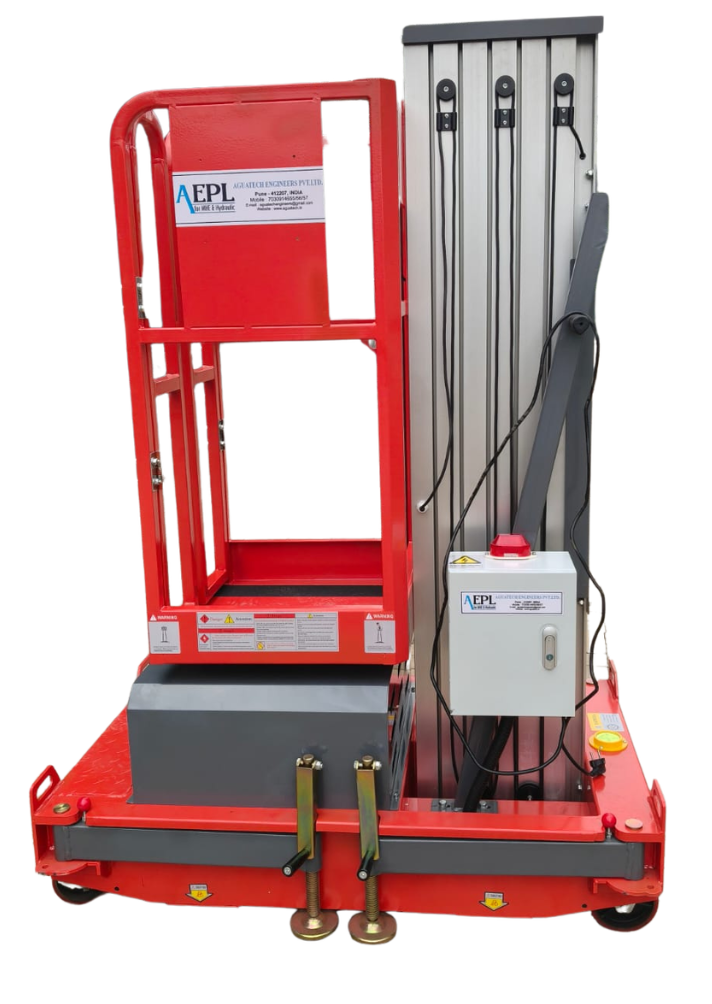 | Aerial Work Platform – Single Mast Aerial Work Platform – Single Mast A Single Mast Aerial Work Platform (AWP) is a compact, vertical-lifting device designed for safe, single-person access to high places. View product → |
Frequently asked questions
How do I choose a single mast aerial work platform for the access task?
Measure the highest point you must reach, then check whether you need straight vertical access or reach around an obstacle. A single mast platform suits indoor work where the task is directly above the machine; it is the wrong choice when the job requires horizontal outreach.
What aerial work platform specifications should I compare?
Compare platform height, working height, safe working load, platform dimensions, machine width, overall height, turning requirements, machine weight, gradeability and battery capacity. Ask suppliers to define each measurement so quotations use the same basis.
What should I check before using a single mast platform for indoor work in Pune?
Measure doorways, lift entrances, aisles, ceiling obstructions and floor transitions. Check floor load capacity, ventilation, charging location, battery runtime and indoor noise requirements before ordering.
What safety records and supplier support should I demand?
Request operating controls, emergency-lowering equipment, guardrails, interlocks, overload protection, inspection records, manuals, operator training and an acceptance-test report. Compare Pune quotations for commissioning, preventive maintenance, spare parts and response times.