A suitable stacker depends on more than the load printed on a catalogue page: you must match capacity, lift height, pallet openings, aisle space, floor condition and daily handling pattern. By the end, you will have a short decision path and a purchase specification you can test inside your own premises.
Key takeaways
- Size the stacker for your heaviest pallet and highest usable lift.
- Check capacity at the stated load centre, not only the headline rating.
- Measure pallets, aisles, doorways, floor slopes and storage locations first.
- Choose manual power when travel distances and daily handling volumes stay manageable.
Start with the job, not the catalogue
A manual stacker for small business in Pune should be selected from the heaviest pallet, highest usable storage position and longest daily travel—not from the catalogue’s maximum figures. A 1,000 kg rating at a 500 or 600 mm load centre does not guarantee 1,000 kg at greater reach, lift height or with an attachment.
Ask for a residual-capacity chart covering your load centre and required height.
Use this decision check:
- Choose a hand pallet truck if loads only move at floor level.
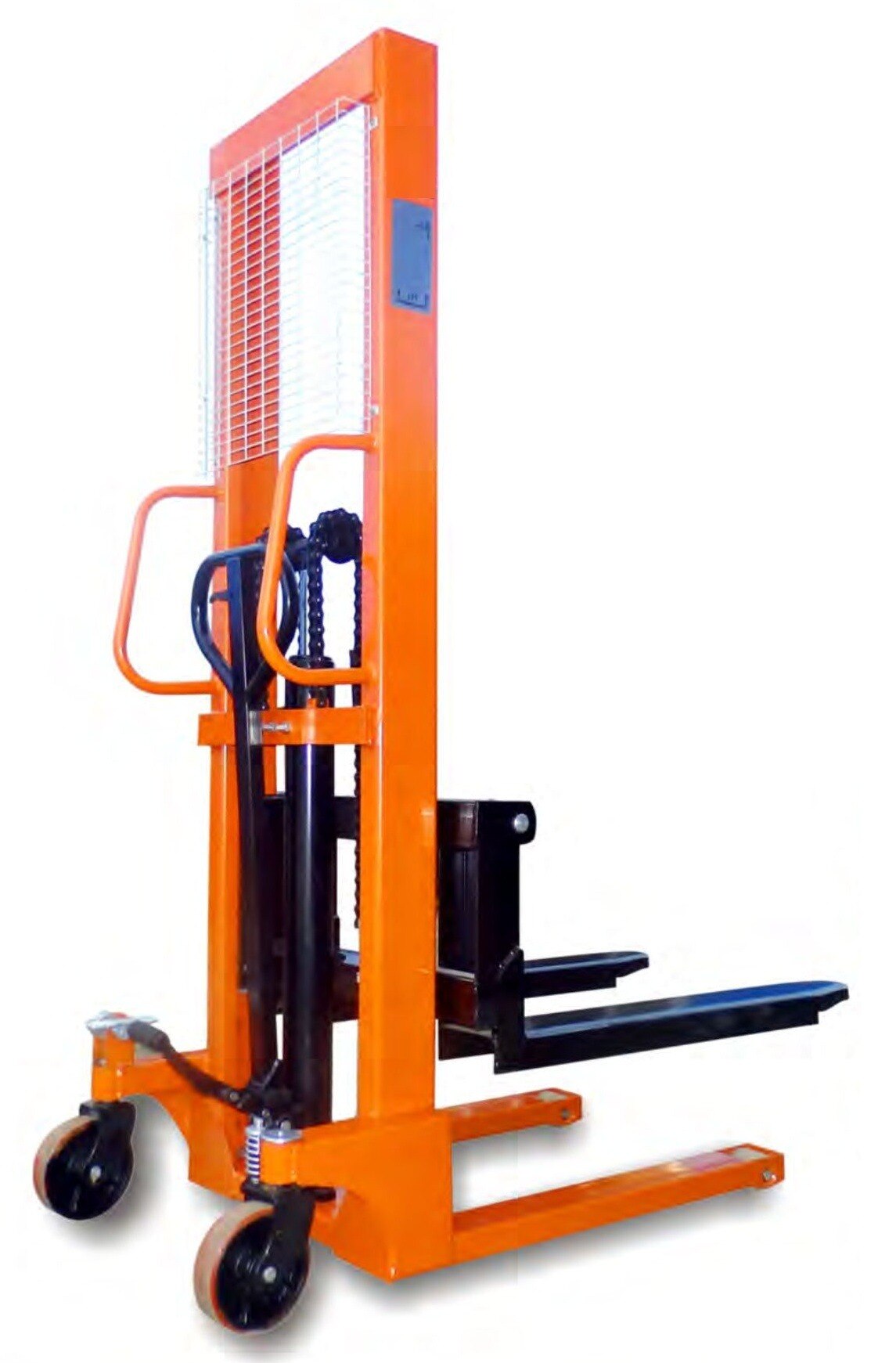
- Choose a hand-push, hand-hydraulic stacker for occasional stacking on level floors, short travel and moderate lift heights.
- Choose a semi-electric stacker when operators repeat lifts throughout the shift, travel beyond short distances or handle heavier pallets.
- Choose full electric power when daily handling is intensive, ramps are involved or repeated pumping and pushing create fatigue.
| Check | Hand-hydraulic stacker | Semi-electric or full-electric stacker |
|---|---|---|
| Load and frequency | Occasional lifts and short travel | Repeated lifts, heavier loads or long travel |
| Floor and route | Smooth, level indoor concrete | Longer routes, ramps or frequent movement |
| Pallet and lift | Confirm fork openings, width and usable lift | Confirm the same, plus mast clearance and battery access |
Test the proposed machine with the heaviest intended pallet on the actual floor. Broken concrete, expansion joints, drainage channels and wet monsoon surfaces can defeat small wheels. Before ordering, request parts lead times for wheels, seals, chains, rollers, batteries and chargers, and identify the first inspection provider.
Read capacity and lift figures as working limits
A 1,000 kg rating is not a universal promise. It applies at the load centre printed on the quotation—perhaps 500 mm or 600 mm—and at defined fork and lift conditions. Move the load centre forward with a longer pallet, offset load or attachment, and the allowable load falls.
For manual stacker selection in Pune, read the quotation in this order:
1. Confirm the rated capacity and stated load centre. Ask for the capacity or residual-capacity chart, not just a headline figure. It must show the intended load centre and maximum weight at each required lift height.
2. Check residual capacity at the actual placement height. A stacker rated for 1,000 kg at low lift may carry less at 2,500 or 3,000 mm because mast extension and forward load position reduce stability.
3. Specify the highest required fork height beneath the lowest obstruction. Measure the rack beam, ceiling, sprinkler, beam and door-lintel clearances. A quoted 3,000 mm maximum lift is useless if the mast, load or required clearance cannot fit safely.
4. Include the complete working load: pallet, goods, attachment and any uneven distribution. Never treat rated capacity as constant while raising the forks or pushing a raised load across joints, ramps or wet floors.
Ask the supplier to demonstrate the heaviest intended load at its real load centre and height on your floor. The chart and trial together reveal the working limit; a showroom rating does not.
Match the stacker to pallets, aisles and the building
Measure the route with a loaded pallet, not an empty stacker. Check the pallet entry openings, aisle width, doorway height and width, goods-lift dimensions and rated floor load before choosing a manual stacker for warehouses.
Match fork length, outside fork width, minimum fork height and fork-section dimensions to the pallet. Forks that are too long can hit the next pallet; forks that are too short leave less load support. Adjustable forks help only when their range suits the pallet openings and load.
Check these measurements on site:
- Pallet entry opening and fork spacing, including any bottom boards that block entry
- Stackers’ outside turning radius against the narrowest aisle, rack guards, columns and pedestrian routes
- Mast height and raised-load height beneath door lintels, beams, sprinklers and the ceiling
- Goods-lift door opening, cabin length and width, rated load, and permitted wheel or leg loading
- Storage-location clearance around the pallet, rack beam and adjacent loads
Choose straddle legs for open-bottom pallets only when the legs can pass around the pallet without striking racks or floor obstacles. A counterbalance model accepts more pallet arrangements but adds machine weight, turning radius and floor-loading demand.
Measure ramps and loading docks separately: specify the maximum gradient, surface and edge protection, because a raised load changes braking and stability. Ensure the quotation includes residual-capacity figures at the required lift height and actual load centre, not just the advertised maximum lift.
Choose manual power for the operating pattern
Choose a hand-push, hand-hydraulic stacker when loads are handled intermittently, travel is short and the operator can pump without slowing production. It costs less to operate than powered equipment, but every lift demands physical effort; repeated pumping across a full shift is a productivity and fatigue problem.
| Option | Main effort | Right choice | Watch-out |
|---|---|---|---|
| Hand pallet truck | Push and manual fork pumping; no stacking mast | Moving pallets at floor level over short distances | It cannot place loads into racks |
| Hand-push, hand-hydraulic stacker | Push by hand; raise forks with a hydraulic pump | Occasional stacking, low daily volume and limited travel | Lifting effort and slow cycling fall on the operator |
| Semi-electric stacker | Push by hand; powered fork lifting | Frequent lifting where travel distances remain short | You still provide the travel effort; add battery and charger controls |
| Full-electric stacker | Powered travel and lifting | Repeated moves, longer routes, heavier workflow or operator fatigue risk | Battery charging, maintenance, training and traffic controls add cost |
Use manual stacker options only after measuring the operating pattern. Choose a hand pallet truck if every load stays on the floor. Choose hand-hydraulic equipment if stacking is occasional; select semi-electric equipment when pumping is the bottleneck. Move to full electric when pushing, lifting frequency or travel distance limits output.
If a powered model sits unused for days, its battery and charger become unnecessary maintenance. If several operators stack throughout each shift, saving the purchase price can create a larger labour and fatigue cost.
Turn the choice into a Pune-ready specification
Before placing an order, make the supplier prove the machine on your premises. This is the practical test for manual stacker selection in Pune, where broken concrete, expansion joints, ramps, drainage channels and wet monsoon floors can affect traction and shock-load small wheels.
1. Run a floor trial with the heaviest intended load. Test pushing, braking, turning and lifting at the required height on the actual route, through the doorway and beneath the lowest beam, sprinkler or lintel.
2. Get written parts lead times for hydraulic seals, the pump assembly, load wheels, mast rollers, chains, batteries and chargers. Ask who performs the first inspection and who attends a breakdown; a cheap machine is costly if one failed seal stops your warehouse for weeks.
3. Require a pre-use inspection sheet covering forks, welds, mast, chains, hydraulic leaks, wheels, brakes or parking devices, controls and warning labels. Remove the stacker from service when a defect could affect safe lifting, and record the repair before returning it.
4. Require supplier training for every operator, including load-centre limits, pallet positioning, route hazards, parking, lowering, ramp use and the prohibition on carrying people. Repeat the briefing for new staff and retain signed attendance records.
For a manual stacker for small business in Pune, ask Aguatech Engineers Pvt.ltd. to document the trial result, residual-capacity chart, maintenance schedule and local response contact in the quotation, not merely promise support verbally.
Related product
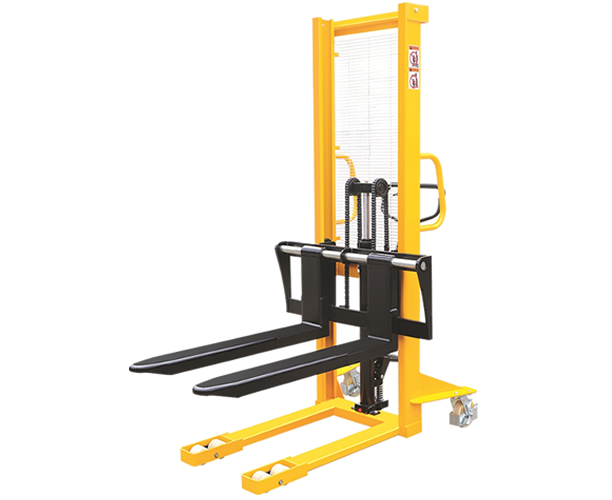 | STACKERS Manual Stackers are the most commonly used equipment in a workshop, warehouse or factory and most economical way of providing highest safety and most... View product → |
Frequently asked questions
How should a small business start manual stacker selection in Pune?
Start with the job: record the heaviest pallet, highest usable storage position, longest travel route and daily handling frequency.
Does a 1,000 kg manual stacker lift 1,000 kg at every height?
No. Confirm the rated capacity at the specified 500 or 600 mm load centre, then check how capacity changes with lift height, reach and attachments.
What should you measure before buying a manual stacker for a warehouse?
Measure pallet dimensions, aisle width, doorway clearance, rack depth, floor condition, ramps, turning space and the height of each storage position.
When is manual power suitable for a small business?
Manual power suits short travel distances, moderate daily handling and smooth, level floors; electric equipment is worth comparing when routes are long or handling is frequent.