Before the machine reaches the work area, the warehouse route, floor, overhead clearance, charging point and emergency arrangements must be checked against the manufacturer’s limits. By the end of the process, you should know how the unit is delivered, assembled, tested, documented and released for operation.
Key takeaways
- Complete a pre-delivery survey of access, floor loading and overhead clearance.
- Measure every doorway, aisle, ramp and turning point along the delivery route.
- Record tests, safety devices, manuals and operator training at handover.
- Set service intervals and nominate a contact before the AWP enters production.
What must be checked before the AWP reaches the warehouse?
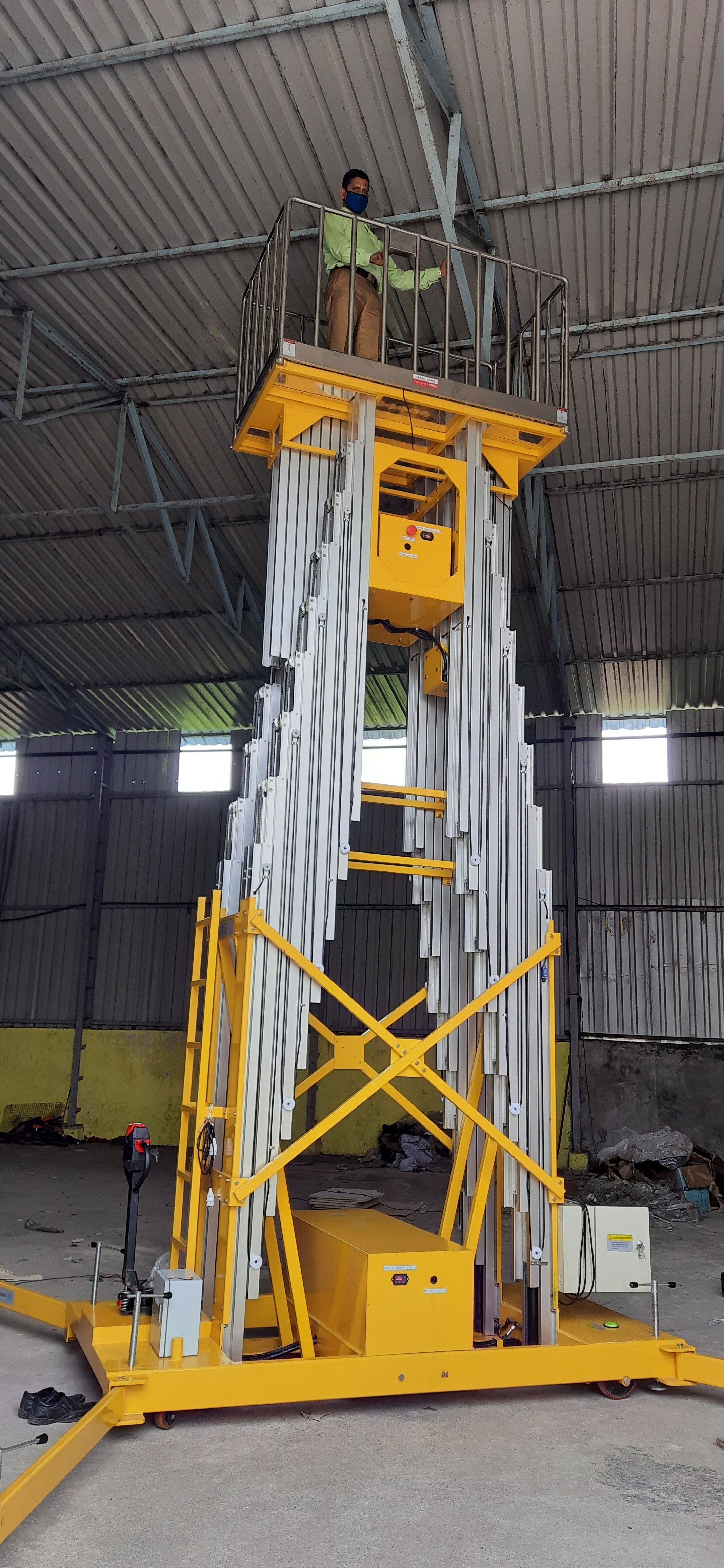
The pre-delivery survey decides whether an AWP can reach the work face and operate there without exceeding access, floor or clearance limits. Treat an AWP single for mast warehouse installation as a site-fit check, not a delivery formality.
1. Record the machine’s transport height and width, doorway and dock clear openings, lift-cabin dimensions, aisle width, turning radius, reversing space, ramps and every level change. Include the route from the vehicle to the work face.
2. Measure the required working height and the machine’s total operating height, including the guardrail, operator and load. Check roof structure, sprinkler pipework and heads, lighting, cable trays, doors, conveyors and rack beams.
3. Mark live electrical conductors on the route. Keep at least 10 feet from energized lines up to 50 kV unless the site rule requires more; higher voltages need greater separation.
4. Inspect concrete for cracks, damaged joints, slopes, drainage grates, soft patches and uneven transitions. A nominal warehouse floor rating does not prove that a dock plate, ramp or weak slab can support wheel or stabilizer loads.
5. Confirm the model’s permitted slope, travel surface and stabilizer requirements before approving the single mast AWP setup. Do not assume it can travel while elevated; that is allowed only when the manufacturer designed it for elevated travel.
Record rack-protection needs and the route’s emergency clearance. If any measurement fails, change the route or equipment before delivery.
How should the warehouse and delivery route be prepared?
Clear pallets, waste, packaging and parked equipment from the delivery route before unloading. Then isolate pedestrians with barriers and assign a spotter to control crossings and vehicle movement.
1. During single mast aerial work platform delivery, the carrier and installer must use the machine maker’s stated lifting, tie-down and unloading points. Never lift from guardrails, platform gates, control boxes or mast sections; improvised slings can bend components even when the total weight appears manageable.
2. Confirm whether the unit arrives ready to operate or requires mast sections, the platform, guardrails, stabilisers, battery or control equipment to be fitted on site. Protect rack uprights, sprinkler heads and doors before the truck is unloaded.
3. Protect concrete and coated floors with manufacturer-approved boards or mats where permitted. Secure the protection so it does not create a trip hazard or conceal cracks, weak slabs or damaged surfaces.
4. Choose a charging location that leaves exits, fire-fighting equipment, sprinkler discharge paths and required aisles clear. This decision belongs in the AWP warehouse installation plan, not after the machine is already inside.
5. For a lead-acid battery, provide ventilation, suitable electrical equipment, ignition-source control, eye and face protection, no-smoking controls and measures that prevent vehicle movement during charging.
6. Lithium-ion batteries require the specified charger and the maker’s thermal-event controls. Do not substitute lead-acid charging procedures for lithium-ion equipment.
What happens during the single mast AWP setup?
1. During the single mast AWP setup, the installer places the machine on an approved, firm and level surface, then aligns it with the work area. If fitted, each stabiliser or outrigger is deployed as specified, and the levelling or interlock system is checked. Never bypass an interlock because it slows setup.
2. Before energising the machine, the installer completes the pre-use inspection. The battery is connected only after charger compatibility is confirmed, and cables, connectors and visible hydraulic or electrical components are inspected for damage.
3. The inspection covers the platform floor, access gate, guardrails, toe boards, designated anchorage and fasteners. The control panel is checked for readable labels, emergency-stop operation, alarms, indicators and damage. This inspection must be complete before normal operation during the AWP warehouse installation.
4. Functional testing covers ground and platform controls, drive, lift and lower movement, brakes, emergency stop, emergency lowering, alarms, guardrail-gate interlocks and any outrigger or levelling cut-outs. Test travel only on the manufacturer’s permitted surface and within its slope and elevated-travel limits.
Do not assume the platform can move while raised; that is allowed only when the model is designed for it. Keep the platform clear of sprinkler discharge paths and maintain the site’s required overhead clearance.
What must be recorded before the machine is handed over?
The handover pack must identify the machine and prove that it is safe to use, not merely delivered. The record for an AWP single for mast warehouse installation should include:
1. Make, model, serial number, rated platform capacity, permitted occupants, maximum platform height and safe working load. State that capacity combines people, tools and materials; it is not an allowance added to the operator’s weight.
2. Battery type and condition, charger model and charging instructions. Attach the completed pre-use inspection, functional-test results, defects found, corrective action and confirmation that every safety-critical defect was closed.
3. The operating manual, daily pre-use checklist, travel and slope limits, emergency-stop procedure and emergency-lowering instructions. Demonstrate emergency lowering at ground level and explain how the rescue plan reaches an operator disabled at height; an emergency stop alone is not a rescue plan.
4. The operator briefing must cover guardrails: never climb on rails, place ladders or boxes on the platform, lean outside the guardrail or exceed capacity. Use a harness only when the machine instructions or site risk assessment require it, and connect it only to the designated anchorage.
5. Record each operator’s briefing and name the person authorised to return the machine to service after a defect. For AWP service in Pune, also retain the authorised technician’s identity, inspection reports and the agreed post-repair release authority.
How should you arrange continuing AWP service after installation?
Commissioning is the start of the service plan, not the end of delivery. For awp service in Pune, name the technician authorised for your exact make and model before the machine enters routine use.
Ask the supplier to state:
- Planned inspection intervals and the inspection standard used
- Battery condition tests, charger diagnostics and charging-system checks
- Emergency-lowering test frequency and rescue-equipment checks
- Spare-parts stock, expected lead times and breakdown response time
- The report format, including measured test results and outstanding defects
- The person authorised to return the machine to service after a safety-critical repair, battery replacement, control fault or interlock failure
Compare the proposed arrangement with the documents that govern actual use.
| Document | Check | Why it matters |
|---|---|---|
| Machine manual | Model-specific limits, servicing tasks, charger and emergency procedures | A generic contract can omit a critical control |
| Site risk assessment | Route, floor, overhead hazards, charging area and rescue method | Warehouse conditions determine whether the plan is adequate |
| Service contract | Technician authorisation, response time, parts and return-to-service authority | A signature alone does not prove the machine is safe |
Schedule operator retraining after a major repair, repeated misuse or a warehouse-route change. A supplier such as Aguatech Engineers Pvt.ltd. can be evaluated against these handover and support measures, not delivery alone.
Recheck the operating area after rack changes, new conveyors, sprinkler alterations or floor repairs. A machine that passed commissioning can become unsuitable when its clearance, route or floor condition changes.
Related product
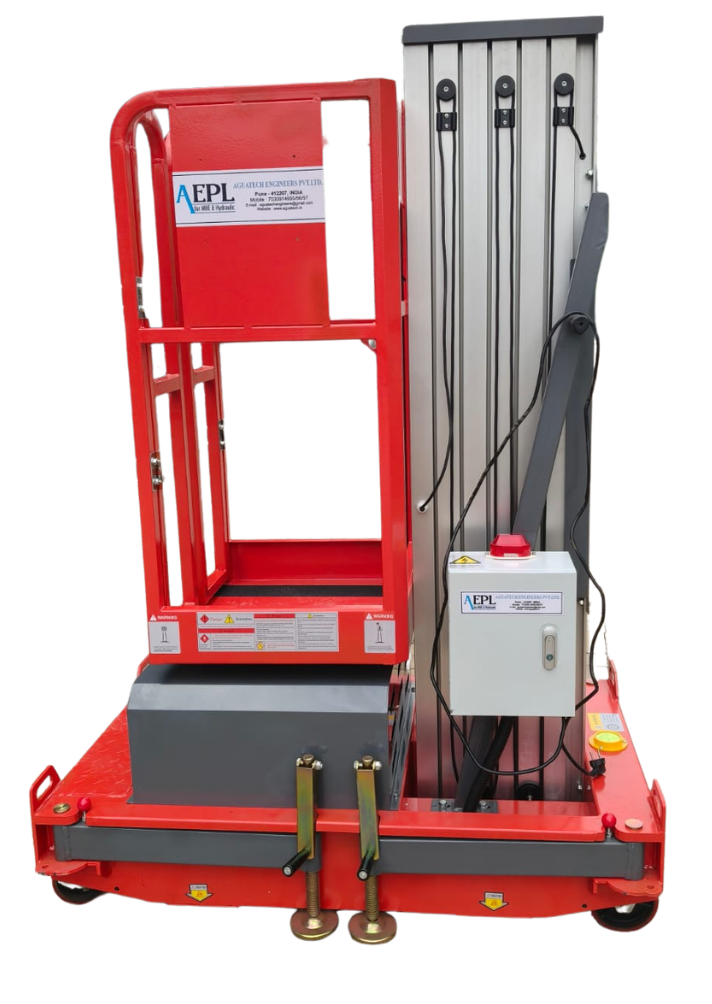 | Aerial Work Platform – Single Mast Aerial Work Platform – Single Mast A Single Mast Aerial Work Platform (AWP) is a compact, vertical-lifting device designed for safe, single-person access to high places. View product → |
Frequently asked questions
What must be checked before a single mast AWP reaches the warehouse?
Check the work height, platform position, doorway and aisle dimensions, floor capacity, overhead obstructions, power access and the machine’s transport dimensions.
How do you prepare a warehouse for single mast AWP delivery?
Clear the route, protect vulnerable floor areas, control pedestrian traffic, confirm loading and unloading space, and measure ramps, thresholds, doors and turning areas.
What happens during a single mast AWP setup?
The installer unloads and positions the machine, assembles or secures the mast and platform, connects required systems, checks stability and tests operating and emergency controls.
What should the AWP handover record include?
Record inspection and test results, safety-device checks, serial and identification details, manuals, maintenance requirements, operator training and outstanding actions.
How should you arrange continuing AWP service after installation?
Agree the service schedule, reporting contact, response process, inspection records and spare-parts arrangements with the supplier before routine use begins.