
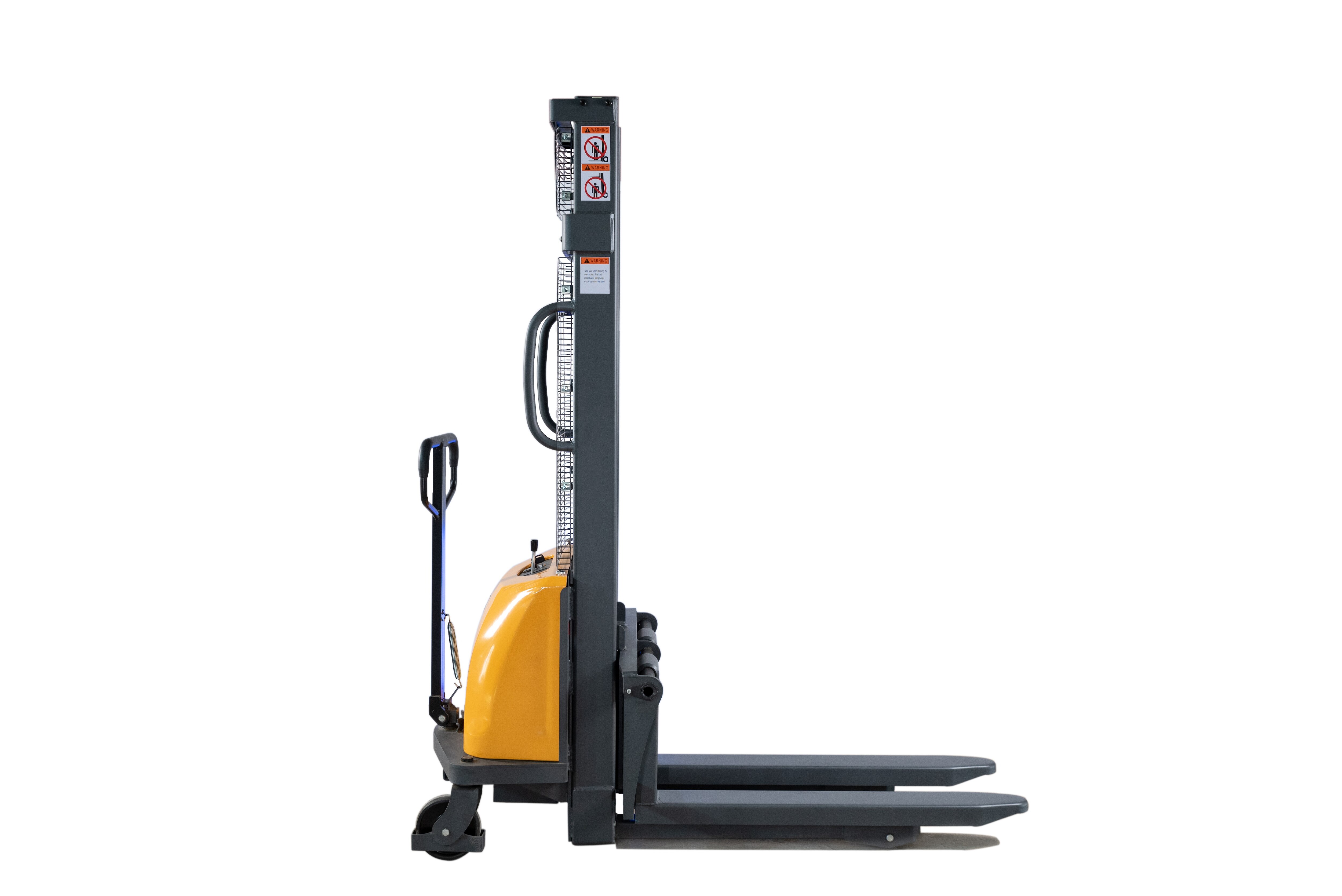
The correct choice depends less on the headline lifting capacity than on who supplies the movement: the operator, a hydraulic pump, an electric lift motor, or a traction motor. By mapping each plant route, load and shift pattern, you can decide whether a manual stacker is sufficient, whether powered lifting will reduce fatigue, or whether you need powered travel or another truck type.
Key takeaways
- Choose semi-electric lifting for repeated pallet handling and reduced pumping effort.
- Choose a manual stacker for short routes, light use and tighter budget control.
- Measure aisle width, load centre, lift height and floor condition before buying.
- Run both stackers on the real route with the actual load before deciding.
What movement does each stacker actually power?
The movement that matters is the one the operator no longer supplies. A manual stacker uses hand pumping to raise the forks and human force to push the load. A powered-lift stacker raises the forks by battery motor, but the operator still pushes and steers it.
A powered-travel stacker adds battery-driven traction, so the controls provide both lifting and horizontal movement.
| Option | Operator powers | Best operating pattern |
|---|---|---|
| Manual stacker | Pumps hydraulic lift; pushes and pulls travel | Occasional lifts, short routes, low utilisation |
| Powered-lift stacker | Controls fork lift; pushes and steers travel | Repeated pallet or bin lifting at nearby storage locations |
| Powered-travel stacker | Controls fork lift and traction | Long routes, frequent stop-start movement, ramps within the manufacturer’s limit |
For a semi electric stacker or manual stacker for automobile plants in Pune, define the drive arrangement in the enquiry; “semi-electric” alone is ambiguous. State lift height, rated capacity, load centre, aisle width, route length and shift duty.
The manual stacker versus semi electric stacker decision usually favours powered lift at a line-side supermarket, engine store or dispatch point where operators repeat lifting all shift. It does not remove the effort of long horizontal travel.
Choose powered travel when receiving, production and dispatch routes are long or congested; retain manual equipment for occasional movement over short, clear paths. Specify braking, horn, emergency stop, speed control and pedestrian segregation for either choice.
Compare the real operating cost, effort and route performance
A manual stacker usually costs less to buy and suits occasional pallet or bin moves over short, level routes. Choose a semi-electric warehouse stacker when repeated lifting, precise positioning and operator fatigue are costing more than the higher purchase price.
| Factor | Manual stacker | Semi-electric stacker |
|---|---|---|
| Purchase cost | Lower; no battery or charger | Higher; includes battery and powered system |
| Operator effort | Push, steer and pump the hydraulic lift | Push and steer if travel is manual; powered lifting removes repeated pumping |
| Lifting speed | Depends on pumping rate and load | Faster and more consistent for repetitive lifts |
| Travel speed | Limited by operator effort and route length | Manual travel remains limited; powered travel changes the result |
| Charging | None | Plan charging space, plug access and shift charging time |
| Maintenance | Hydraulic seals, wheels, forks and pump | Those parts plus battery, charger, motor and controls |
| Noise | Quietest option | Low noise, but alarms and motor sounds add disturbance |
| Utilisation | Best for occasional handling | Better for repeated line-side replenishment and high lift cycles |
| Route performance | Strong on short, level aisles; poor across long routes | Powered lift does not solve long horizontal travel, ramps or stop-start congestion |
This is the practical manual stacker versus semi electric stacker test: count lifts, push distance, turns and waiting time in a full shift. A powered-lift unit reduces fatigue, but it does not automatically move loads faster between stores and production. Specify whether “semi-electric” means powered lift only or powered lift plus powered travel.
Check floor joints, thresholds, dock plates, pedestrian crossings and turning space with the largest load. Faster movement increases collision energy, so require visibility around tall loads, braking, horn, emergency stop and speed control before comparing utilisation.
Match the stacker to automobile-plant applications in Pune
A manual stacker suits short, occasional moves where the operator pushes a light load from receiving to nearby storage. Choose powered lift when the same bins or pallets are lifted repeatedly; choose powered travel when stores-to-line routes are long, congested or include ramps.
| Task | Manual stacker | Powered-lift stacker | Powered travel stacker |
|---|---|---|---|
| Receiving docks | Short moves from dock to staging; avoid long runs | Repeated pallet unloading and placement near the dock | Dock-to-stores movement, thresholds and frequent stop-start travel |
| Storage | Low-volume racks with short travel and light bins | Repeated rack put-away and retrieval in a defined aisle | High-throughput rack work across multiple aisles |
| Production line | Occasional empty-container or small-lot delivery | Repeated lifting into line-side supermarkets and kitting positions | Scheduled replenishment from stores over long plant routes |
| Dispatch | Nearby pallet staging with few movements | Repeated pallet positioning at the dispatch lane | Continuous staging between warehouse, inspection and loading bays |
For semi electric stacker applications in pune, confirm whether “semi-electric” means powered lift with manual travel or powered lift plus powered travel. The distinction decides whether it can handle the route, not just the lift.
A stacker for automobile factory work must match container geometry, fork entry, rack clearance and pedestrian controls. Specify horn, emergency stop, braking, speed control and visibility around tall loads; powered travel increases kinetic energy, while manual pushing becomes impractical across a large plant.
Check load capacity, aisle fit and plant safety before buying
A stacker is safe only when its capacity at the actual load centre and lift height exceeds the heaviest complete load, not merely the pallet’s printed rating. A stacker for automobile factory use must be checked with the real bin, stillage, die, battery or pallet fitted.
1. Record the gross mass: load, pallet, container, fork attachment and any wrapping. Weigh the heaviest battery or die, not the average component load.
2. Measure the load centre from the fork face to the load’s centre of gravity. A forward-projecting die or deep returnable bin reduces capacity; compare this distance with the capacity plate and load chart at the required lift height.
3. Measure load length, width and underside clearance. Confirm fork length, fork spacing, entry openings and load distribution. A damaged pallet, narrow fork pocket or uneven battery can shift the centre of gravity.
4. Record the highest shelf, rack beam and required clearance above the load. Check the manufacturer’s capacity at that mast height and with the selected mast configuration; maximum lift height alone proves nothing.
5. Survey the route with the largest load raised only as required: rack-to-rack aisle, turning circle, floor joints, thresholds, ramps, dock plates and pedestrian crossings. A manual stacker that fits a stores aisle may fail on a long line-side route.
6. Specify visibility, horn, emergency stop, braking, speed control and tiller geometry. A semi-electric warehouse stacker with powered travel needs pedestrian segregation and stopping-distance checks; powered lifting does not remove collision risk around tall loads.
For each semi-electric stacker or manual stacker quotation, state drive arrangement, lift type, duty cycle and every measurement above. Safety comes from the matched specification, not the label.
Use a live route trial to make the final choice
Run the supplier’s proposed machine on your actual Pune route before choosing. Record pallets or bins moved per shift, loaded travel distance, lifting cycles, operator minutes, waiting time, battery charging and interruptions.
For a semi electric stacker or manual stacker for automobile plants in Pune, calculate:
Total cost per shift = labour cost + allocated purchase cost + electricity or charging cost + maintenance allowance + downtime cost.
| Option | Shift cost drivers | Trial evidence |
|---|---|---|
| Manual stacker | Lower purchase and maintenance cost; higher pushing and pumping effort | Operator minutes, fatigue, travel time and completed moves |
| Powered lift, manual travel | Lower lifting effort; no solution for long manual routes | Lift-cycle time, positioning accuracy and route distance |
| Powered lift and travel | Higher purchase and charging cost; faster repetitive movement | Travel time, battery use, braking and pedestrian interaction |
- Use production bins, pallets, load centres and rack locations from the intended application.
- Measure aisle width, turning clearance, floor joints, thresholds, ramps, dock plates and pedestrian crossings.
- Run the busiest shift pattern, including line-side replenishment, stops and queueing.
- Reject the proposal if forks miss the containers, visibility is poor, braking is weak, or the machine cannot complete the route without unsafe manual force.
State drive arrangement, lift height, rated capacity, load centre, battery specification and duty cycle in the enquiry. Aguatech Engineers Pvt.ltd. should document these figures against the trial results, not only quote a maximum capacity. This is the practical test for semi electric stacker applications in Pune.
Related products
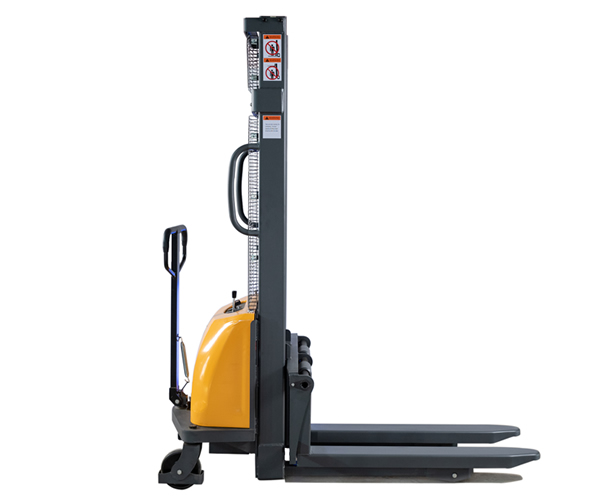 | STACKERS These hydraulic stackers are most extensively used in various industries and by using this effective Semi Electric Hydraulic Stacker users can... View product → |
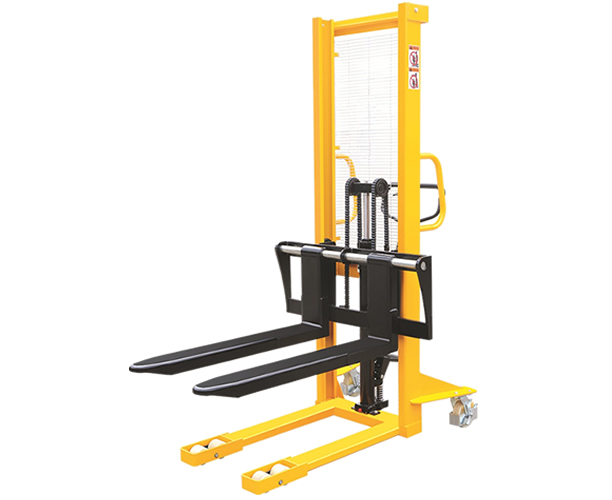 | STACKERS Manual Stackers are the most commonly used equipment in a workshop, warehouse or factory and most economical way of providing highest safety and most... View product → |
Frequently asked questions
What movement does a semi-electric stacker power compared with a manual stacker?
A manual stacker uses hand pumping to raise the forks and human force to push the load. A semi-electric stacker uses a battery motor for fork lifting while the operator still pushes and steers it.
Which is cheaper to operate: a manual stacker or a semi-electric stacker?
A manual stacker usually has lower purchase and charging costs, while a semi-electric stacker reduces repeated pumping effort and can improve productivity on frequent lifting routes. Compare total labour effort, charging, battery replacement, maintenance and route time.
Where do semi-electric stackers fit in Pune automobile plants?
They suit repeated movement of pallets, bins and components between stores, line-side locations, dispatch areas and loading docks when operators still need to control the route manually.
What must you check before buying a stacker for an automobile factory?
Check rated load capacity at the required load centre, maximum lift height, aisle and doorway width, turning space, floor condition, battery charging arrangements, visibility, pedestrian separation and site safety procedures.
How should you make the final choice between the two stackers?
Run a live trial on the actual route using the normal load, aisle congestion, floor transitions, rack height and shift pattern. Record lifting time, pushing effort, turning difficulty, charging interruptions and operator feedback.