
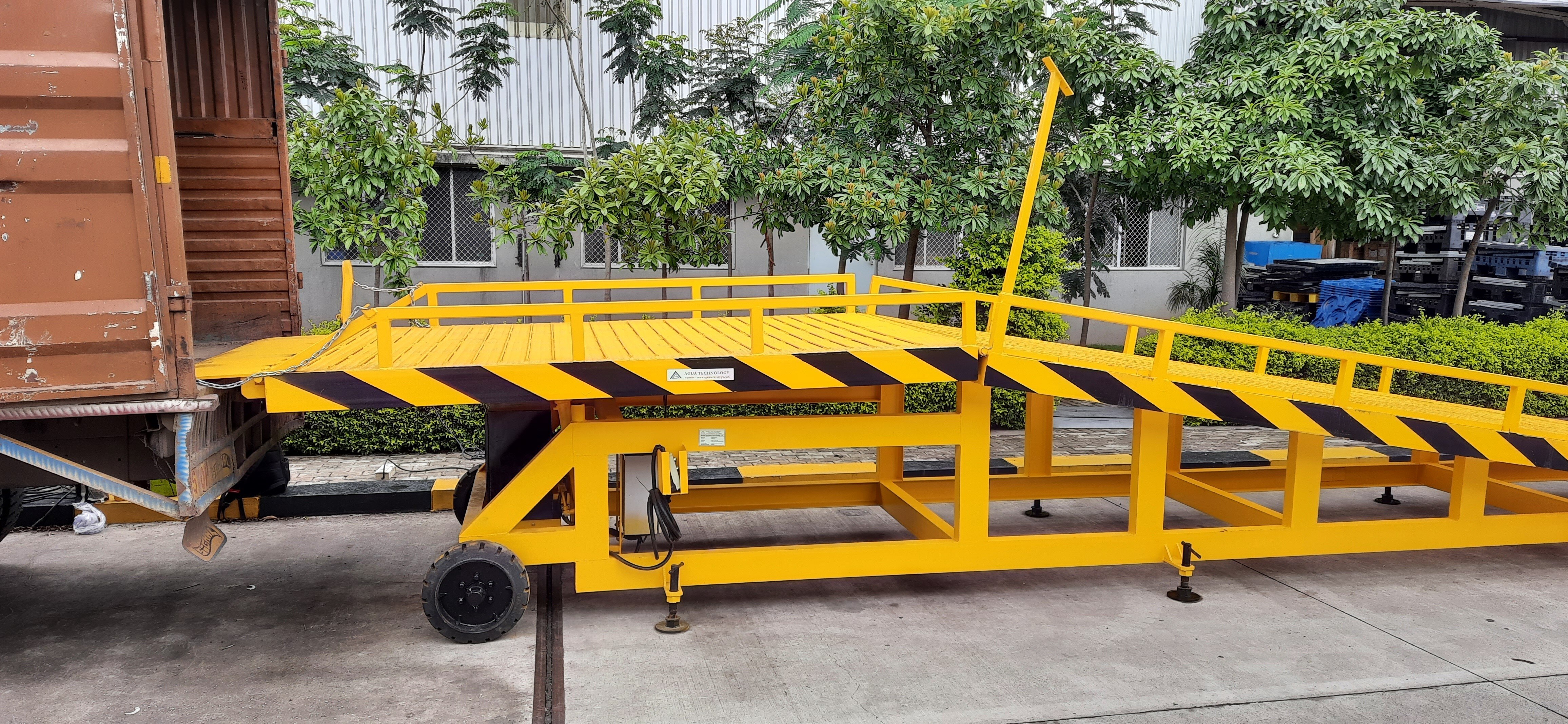
A tow truck and a mobile ramp must match in height, axle loading, wheel path, slope, traction and recovery-equipment clearance before anyone drives or winches a vehicle across the deck. By the end, you will be able to separate the loading use case, calculate the required ramp specification, plan a safe Pune-site setup and define an acceptance test for the supplier.
Key takeaways
- Identify whether you are loading the truck, a disabled vehicle, or goods.
- Match ramp capacity, slope and tow-truck deck height before purchase.
- Test hydraulic leaks, wheel stops, locking pins and bridge plates before loading.
- Run a Pune-site acceptance test with the actual truck and heaviest planned load.
First decide what the tow truck is loading
Decide whether the ramp loads the tow truck itself, puts a disabled vehicle onto it, or transfers goods between a dock and the tow truck.
| Use | Purpose | Main design question |
|---|---|---|
| Tow truck itself | Drives the truck onto a higher deck or platform | Can the ramp carry its gross weight and wheel loads? |
| Disabled vehicle | Winch or drives the recovered vehicle onto the tow truck | Do the vehicle’s tyres, steering, underbody and winch path clear the ramp? |
| Goods transfer | Moves pallets or equipment between a dock and tow truck | Does the ramp suit forklifts, pallet trucks, goods weight and dock height? |
A mobile yard ramp connects ground to a truck or container over a long incline and moves between positions. A fixed dock leveller bridges a small height gap at one loading bay; it is not a substitute for a mobile dock ramp.
Measure the tow-truck deck height at its lowest and highest working conditions, plus dock or ground height, available horizontal run, front and rear overhang, wheelbase, track width, tyre width and minimum ground clearance. Record the locations of winch housings and other low equipment.
Check approach, breakover and departure angles, including the transition at the ramp crest. A ramp can match deck height yet ground a bumper, cross-member or underbody component. Calculate grade from rise divided by usable horizontal run: 1.0 m over 8.0 m is 12.5%.
Do not use overall steel length; the usable run excludes lips and transitions and governs clearance, traction and winching effort.
Specify capacity, slope and vehicle compatibility together
A defensible specification pairs load ratings with slope and vehicle geometry; a mobile dock ramp that passes a vertical test can still fail under a winch-loaded tow truck.
Require the supplier to state maximum gross load, each axle load and individual wheel-load limits, with the assumed distribution between axles and across tyres. A tow truck carrying a disabled vehicle creates concentrated loads, not a uniform pallet load.
The grade is rise divided by usable horizontal run: 1.0 m ÷ 8.0 m = 12.5%. Use usable run, not overall steel length, then check transition geometry at both ends; a sharp crest can ground a cross-member even when the straight slope is acceptable.
Confirm traction and ground clearance at that grade, including wet steel, mud, oil and tyre contamination.
Ask for these figures and limits in writing:
- Allowable winch pull, tie-down-point ratings and permitted operating states, including winching, stopping, restarting and changing direction on the incline. These actions add horizontal and dynamic shock forces.
- Wheelbase, front and rear overhang, track, tyre width, minimum ground clearance, approach, breakover and departure angles, plus disabled-vehicle steering limits.
- Tyre paths, side-curb dimensions, wheel arches, winch housings and underbody equipment clearances.
- Deck material and thickness, drainage outlets and anti-slip treatment rated for wet steel, mud, oil and contaminated tyres.
For a mobile hydraulic dock ramp in Pune, reject a mobile dock ramp whose rating omits any of these conditions.
Position, connect and operate the ramp in the correct sequence
1. Establish a level, load-bearing approach before moving anything. Inspect slope, drainage, traffic separation, overhead clearance and side clearance. Leave room for tow-truck doors, a tail lift, winch lines and recovery equipment.
2. Move the unloaded ramp only through its rated towing arrangement or forklift pockets. Do not assume its tow connection permits movement while the ramp is raised or loaded. Apply the ramp’s parking brake or fit chocks before uncoupling or deployment.
3. Position the upper lip fully on the tow-truck deck or dock bearing surface. Make the specified positive truck or dock connection, install safety chains where required, and fit chocks or locking devices so the ramp cannot shift relative to either machine or the ground.
4. Raise the ramp with its hydraulic system, then install the specified mechanical raised-position support or lock. Hydraulic pressure alone is not a secure hold. Check that every tyre follows the intended path and that side curbs clear tyres, wheel arches, doors and recovery equipment.
5. Load at the permitted speed. For a disabled vehicle, attach the winch to the approved recovery point, keep the line aligned, winch steadily, and stop before changing direction or restarting unless the specification permits it. Once positioned, apply the tow truck’s parking brake, chock the vehicle and install rated tie-downs.
6. Unload in reverse: remove tie-downs only after the vehicle is secured, lower it under control, then remove chocks after it reaches stable ground. Lower and mechanically secure the ramp, disconnect chains and the positive connection, release the brake only for removal, and tow or forklift it away unloaded.
Stop immediately if a tyre leaves its path, the ramp shifts, traction changes or any component contacts the vehicle. For a mobile hydraulic dock ramp tow truck in Pune, record each operating limit before use.
Check the hydraulics and physical safeguards before every load
Inspect a mobile hydraulic dock ramp in Pune before every load, not only at the start of a shift. A small crack, bent pin or leaking fitting can become a deck movement while a tow truck is crossing.
- Examine deck plates, welds, hinges, cylinders, pins and edge protection for cracks, distortion, looseness or missing retainers.
- Check hoses and fittings for abrasion, bulges, exposed reinforcement and leaks. Confirm hose-burst protection, pressure relief, guarded hose routing and leak containment.
- Inspect wheels, the tow connection, safety chains and chocks. Verify the upper connection is positive and the chocks or locking devices cannot shift.
- Confirm the mechanical raised-position locks or supports engage fully before anyone enters beneath or beside the deck. Hydraulic pressure alone cannot hold a raised ramp safely.
- Test the controls from a position away from tow-truck traffic, and check that the stop function or emergency stop halts movement.
Record the power source, control location, lifting range, controlled lowering speed, filtration arrangement and access for hose replacement. Keep those details with the inspection record and report defects before deployment.
If the power unit fails or a hose bursts, stop movement, secure the tow truck, keep people clear and use only the designed emergency-lowering system. Never improvise with a jack or valve, and never work beneath an unsupported deck. After lowering, isolate the equipment and repair the failure before reuse.
Turn the specification into a Pune-site acceptance test
Before buying a loading ramp in Pune, issue this schedule to every supplier and require signed acceptance results against the same figures.
| Item | Record before testing | Pune-site acceptance |
|---|---|---|
| Height and length | Lowest/highest deck heights; usable horizontal length | Ramp reaches both heights without unsafe approach or breakover |
| Gradient | Maximum route gradient and ramp gradient | Passes the measured route, including crest and departure |
| Capacity | Gross load, axle loads, individual wheel loads and load distribution | Actual tow truck, disabled vehicle or goods load passes without overload |
| Pulling forces | Allowable winch pull, tie-down ratings and permitted stopping or restarting | Winching and tie-down access remain safe on the incline |
| Wheels and edges | Wheelbase, track, tyre width, diameter, pressure and minimum clearance | Actual tyre positions stay within the deck and side-curb profile |
| Traction | Deck finish, drainage and limits for wet steel, mud, oil and tyre contamination | The specified contaminated surface remains controllable |
| Towing and locking | Unloaded towing state, rated connection and safety chains | Raised ramp uses a positive mechanical lock, not hydraulic pressure alone |
| Failure response | Hose-burst protection, relief valve, emergency stop and controlled descent | Power loss stops movement; the designed lowering system works without anyone beneath the deck |
Run stopping, restarting, winching, emergency-stop and controlled-descent tests. A uniformly distributed factory load proves neither compatibility nor concentrated wheel capacity.
For a mobile hydraulic dock ramp tow truck in Pune, ask Aguatech Engineers Pvt.ltd. to review the measured route, drawings and signed test record before approval. Reject any result using substitute tyres, easier heights or dry surfaces when wet contamination is part of the route.
Related product
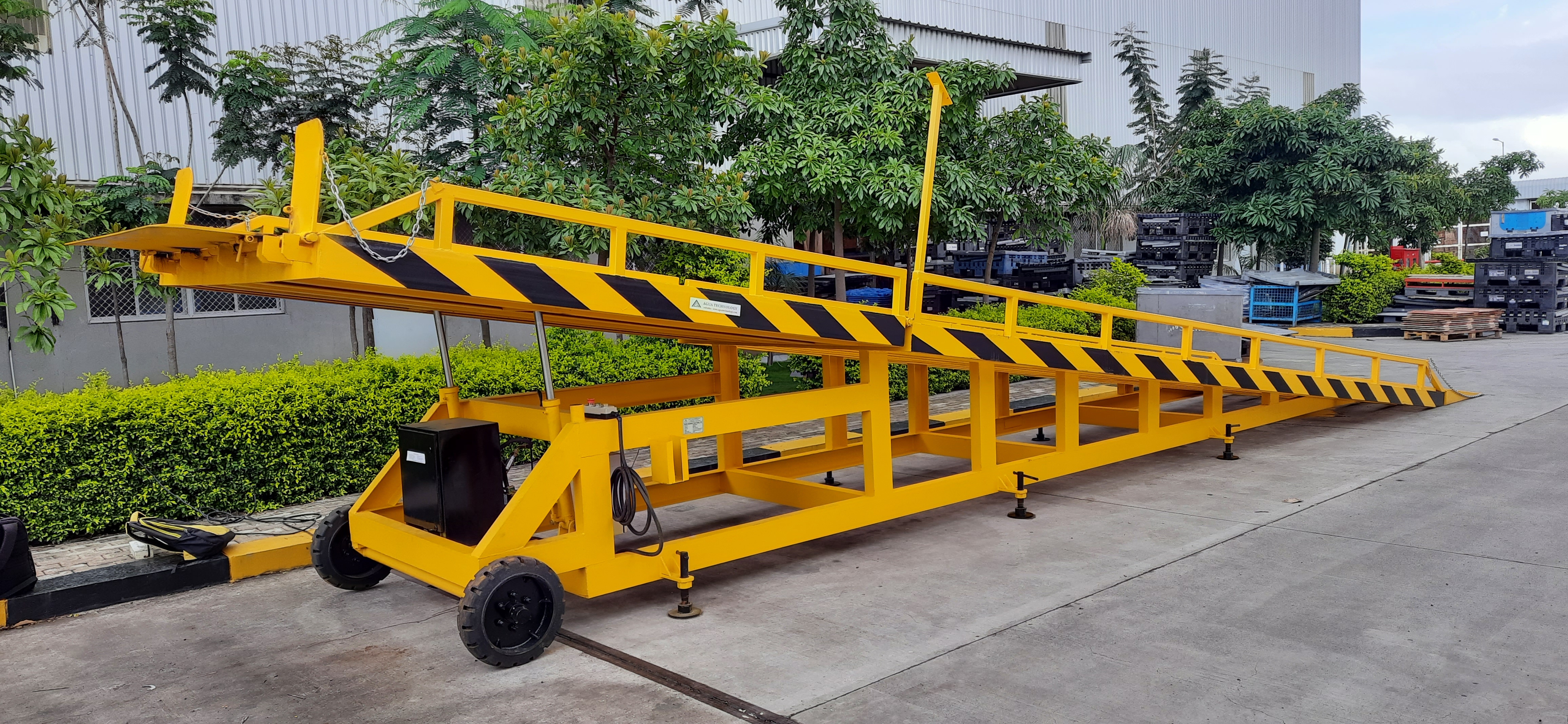 | LOADING/UNLOADING PLATFORMS OR DOCKS A loading/unloading dock is typically an elevated opening (or openings) in a building's sidewall where shipments are sorted and staged for loading... View product → |
Frequently asked questions
What should you decide before choosing a mobile hydraulic dock ramp for a tow truck?
Decide whether the ramp loads the tow truck itself, puts a disabled vehicle onto it, or transfers goods between a dock and the tow truck.
How do you specify a mobile dock ramp for tow truck loading?
Specify safe working capacity, ramp slope, deck height, tow-truck dimensions, approach angle and vehicle compatibility together.
What sequence should you follow when operating a mobile hydraulic dock ramp?
Position the ramp, secure its wheels and supports, connect the hydraulic system, align the bridge, and load only after the safeguards are engaged.
What should you inspect before every tow truck load?
Check hydraulic hoses, cylinders, fluid leaks, wheel stops, locking pins, bridge plates, deck condition and physical guards.
How do you accept a loading ramp at a Pune site?
Test it with the actual tow truck, loading route, dock height and heaviest planned load, then record clearances, stability and operating results.