
A lift that fits beneath a mezzanine, conveyor or factory roof can still fail at the loading point, on the floor or during maintenance. Use the measurements, load data, application limits and supplier documents below to compare a low-profile scissor lift with a pit-mounted lift, forklift or other material-handling option before you approve a purchase.
Key takeaways
- Measure the fully lowered lift, load and overhead obstruction together.
- Match rated capacity and deck size to the heaviest, widest load.
- Specify material handling only; do not use a lift table for people.
- Check slab strength, power supply, guarding and maintenance access before installation.
Start with the collapsed height and the actual clearance envelope
Start with the collapsed height: “low profile” means the lift’s fully lowered height, not its raised height or platform size. A low profile scissor lift for low clearance areas in Pune fits only when its complete clearance envelope fits the room, including the platform, load and any top-of-platform obstruction.
Measure the intended position before comparing models:
- Record the lowest overhead obstruction, floor-to-floor height, door opening and conveyor clearance.
- Calculate usable lift travel and maximum raised height; do not treat either figure as interchangeable.
- Check aisle width, turning radius, floor flatness, slab capacity and the position of nearby traffic lanes.
- Include approach space, loading direction and any ceiling, mezzanine, duct or sprinkler obstruction above the platform.
| Layout | Main advantage | Main trade-off |
|---|---|---|
| Single-scissor | Usually the lowest collapsed height and simpler maintenance | Less vertical travel |
| Double-scissor | More travel from a compact footprint | Additional pivots and pinch locations |
| Multi-scissor | Greatest travel for a constrained footprint | More sensitivity to synchronisation and guide wear |
A low profile scissor lift in Pune can physically fit yet remain unsuitable on an uneven or weak slab. Confirm the base reaction loads, floor flatness and anchoring area before installation; nearby traffic also needs separation from the platform, ramp and moving scissor arms. Check the lowered drawing, not a catalogue photograph.
Match capacity, deck geometry and ramp design to the load
Advertised capacity does not tell you whether the table can handle your actual load. Specify whether it is a pallet, skid, bin, die, coil, drum or machine component, then record dimensions, centre of gravity, wheel loads, loading direction and eccentricity.
A uniformly distributed load spreads weight across the deck; a concentrated pallet or die load places high force in a small area and can exceed local deck or scissor reactions. Check usable deck area, not the outside platform dimensions.
- Record the load type, maximum mass, length, width, height, centre of gravity and any overhang.
- State wheel or axle loads, approach direction and whether the load enters or leaves from one side.
- For pallet-truck loading, specify minimum approach height, pallet-entry geometry, ramp angle, ramp load rating and compatibility with the truck’s wheels and axle loads.
- Reject a perimeter ramp if it creates a trip edge, blocks a shared aisle or forces extra pushing effort up a steep incline.
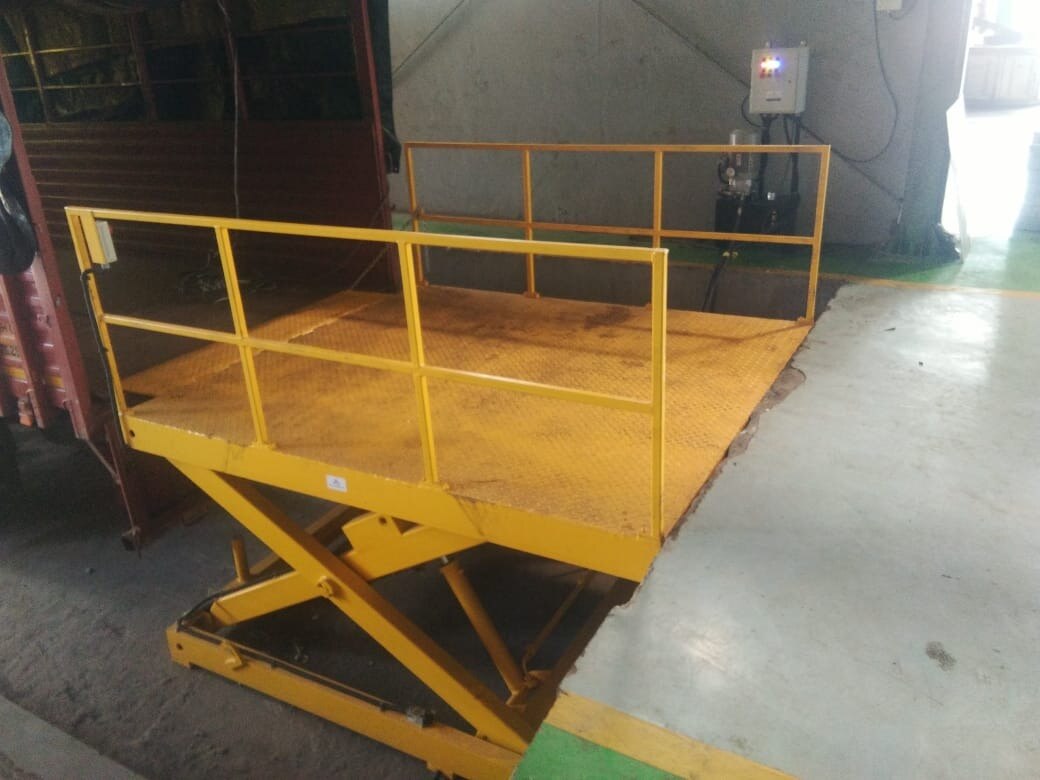
A low profile lift table for factories can be pitless, but its ramp consumes approach space and leaves a raised transition. A pit-mounted table provides a flatter loading surface; excavation, drainage and accurate civil dimensions then become part of the installation.
| Arrangement | Loading surface | Main requirement |
|---|---|---|
| Pitless | Ramp or recessed approach | Confirm aisle clearance, ramp rating and approach effort |
| Pit-mounted | Near-floor deck | Provide excavation, drainage and precise pit dimensions |
For a low profile scissor lift for low clearance areas in Pune, make the drawing show clear deck dimensions and every ramp transition, not just rated capacity.
Choose the equipment for materials, not people, and for the real workflow
Choose a low profile lift table for factories when the material and workflow fit a fixed lifting point, not simply because the table fits under a roof. A material table must not carry personnel; adding guardrails does not make it a worker platform.
Personnel lifting requires a design, access protection, controls, guarding, fall-protection provisions and risk assessment intended for that use.
| Arrangement | Best fit | Main limitation |
|---|---|---|
| Stationary anchored table | Repetitive production or loading-dock cycles | Fixed position; needs accurate anchoring |
| Mobile table | Several workstations with occasional lifting | Casters, handles and batteries add height and can reduce stability |
| Drum-handling table | Drums moved between floor and process height | Rolling or tipping requires a cradle, retaining lip, clamp or powered rollers |
Check that any attachment clears the scissor mechanism and does not reduce rated capacity. A low profile scissor lift in Pune may suit a pallet, bin or die, but confirm the load’s centre of gravity, wheel loads, loading direction and eccentricity rather than relying on headline capacity.
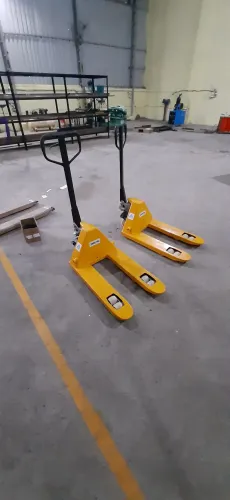
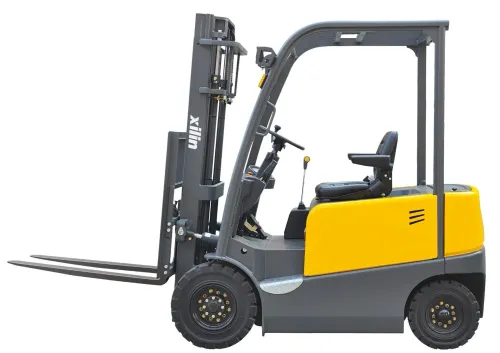
Forklifts and pallet stackers need aisle and turning space. Hydraulic hand pallet trucks suit short travel and modest lift heights; a custom loading platform suits a defined transfer route. A dock leveller addresses a vehicle gap and level difference, so specify bridge-plate strength, edge protection, wheel loads and vehicle-departure interlocks.
Do not substitute a lift table for that protection.
Verify the slab, power, protection and maintenance conditions before installation
A lift that fits beneath a conveyor can still fail on an uneven slab, inadequate power supply or inaccessible hydraulics. Before approving a low profile scissor lift in Pune, make the installer sign off the site conditions and operating limits.
1. Confirm concrete strength, slab thickness, floor flatness, drainage, anchor type and scissor-base reaction loads. Require the installer to state the anchor layout and allowable floor loading; physical clearance does not prove that an unreinforced slab can carry the rated load.
2. Identify hydraulic overload protection separately from hose-rupture or velocity-fuse protection. Ask for the controlled lowering rate under rated load and the test method used to verify descent control.
3. Specify the electrical supply in writing: 415 V three-phase or 230 V single-phase, 50 Hz, motor rating, control voltage, enclosure protection rating and earthing arrangement. These power packs are not interchangeable without checking motor starting current, available supply and duty cycle.
4. For repeated cycles or hot areas, request the duty cycle, cycles per hour, maximum oil-temperature limit and cooling provision. Excess heat thins hydraulic oil and can make lifting speed inconsistent.
5. Request the applicable portions of EN 1570-1, the ISO 12100 machinery risk assessment, and test or conformity documentation. A generic “CE” or “industrial standard” claim is not enough.
6. Confirm safe maintenance support: mechanical isolation during servicing, power-pack access, hydraulic-oil and filter access, standard spare parts, and service availability in Pune. A low clearance scissor lift supplier in Pune should document these points before installation.
Use the quotation to compare low-clearance suppliers on total fit and support
A useful quotation from a low clearance scissor lift supplier in Pune must let you compare fit, risk and support—not just price. Require a dimensioned general-arrangement drawing showing lowered and raised heights, usable platform, ramp, guards, power-pack location and maintenance access.
| Quotation item | Require this evidence | Why it matters |
|---|---|---|
| Machine and load | Capacity assumptions, load distribution, speed, controls and safety devices | A rated capacity can change with concentrated or eccentric loads |
| Installation | Installation scope, civil work, anchoring and electrical work | Prevents gaps over who supplies the slab, anchors, wiring and commissioning |
| Service | Warranty exclusions, preventive-maintenance intervals and breakdown response time | Exposes the real operating cost and downtime risk |
| Vehicle loading | Gap, level difference, bridge-plate strength, edge protection, wheel loads and vehicle-departure interlocks | A lift table is not automatically a dock leveller |
Ask for the applied portions of EN 1570-1, the ISO 12100 machinery risk assessment, and test or conformity documents. Reject a generic “industrial” or “CE” claim without identifying the application, controls and safety evidence.
Evaluate Aguatech Engineers Pvt.ltd. as a low clearance scissor lift supplier in Pune by placing its drawing, application assumptions, standards documentation, installation responsibility and service plan beside every bidder’s answers. For a low profile scissor lift in Pune, the supplier that leaves maintenance access or vehicle movement undefined has not supplied a complete quotation.
Related product
 | Low Profile Scissor Lift The low-profile electric/hydraulic scissor lift table loads and unloads skids with a pallet truck without the need for a pit when using the optional... View product → |
Frequently asked questions
What does low profile mean for a scissor lift?
It means the lift’s fully lowered height. Measure the complete clearance envelope, including the platform, load and any obstruction above the platform.
How should you select capacity and deck geometry?
Choose capacity for the heaviest load, then check its footprint, centre of gravity, approach direction and required ramp width against the deck.
Can a low profile scissor lift be used to raise people?
Use a material-handling lift table for materials only. People require equipment designed, guarded and certified for personnel lifting.
What must you verify before installing a low-clearance scissor lift?
Verify slab capacity, anchoring, electrical supply, drainage, guarding, pinch-point protection, access for maintenance and the actual operating clearance.