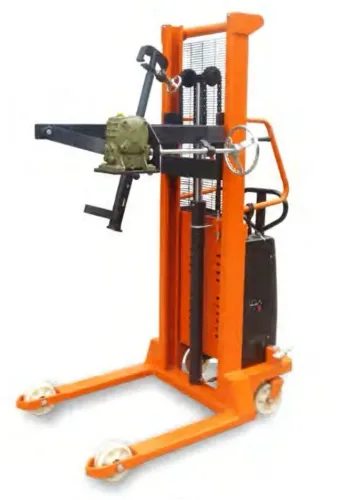

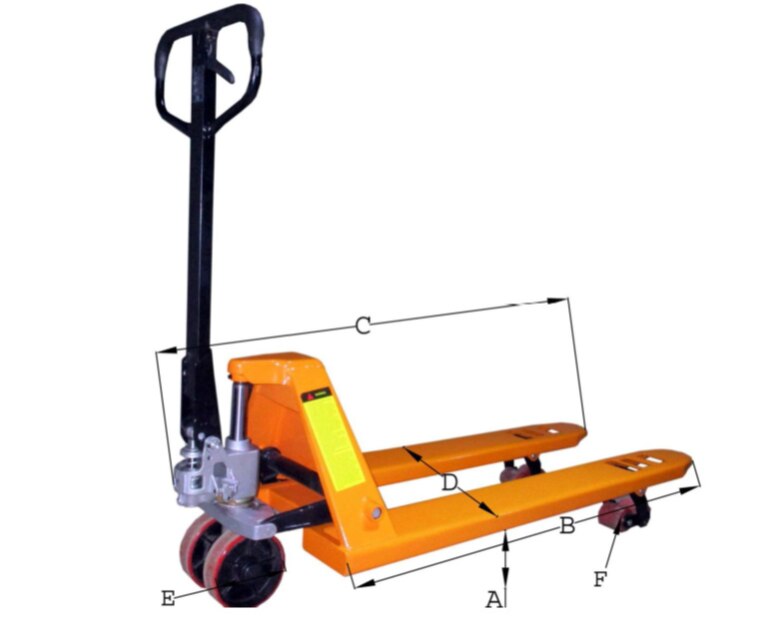
A die can weigh less than a truck’s headline rating and still become unsafe when its centre of gravity sits beyond the rated load centre, its base cannot clear the forks, or the truck is raised too high. By checking the load chart, measuring the die and route, and testing lifting and lowering behaviour under load, you can decide whether a high-lift pallet truck is suitable or whether a die cart, lift table, crane, or dedicated loader is safer.
Key takeaways
- Compare rated capacity at load centre with die mass and centre of gravity.
- Use a controlled pickup, travel, alignment, and handover sequence.
- Inspect hydraulics, wheels, brakes, forks, and floor conditions during faults.
- Choose a die loader with guided transfer when pallet-truck stability is insufficient.
Does the die fit the truck’s real capacity and fork geometry?
Resolve the truck’s real support capacity before discussing operation: compare rated capacity at a specified load centre, not die mass alone, with the die’s gross mass and actual centre of gravity. A forward-mounted die creates a larger overturning moment. A wide or long die can tip even below nominal capacity.
Obtain the manufacturer’s capacity and load-centre chart, capacity plate, and maximum-lift rating. This is the first selection question behind high lift pallet truck die loader problems in Pune.
Measure the die and press interface before choosing equipment:
- Die length and width
- Bottom clearance and fork-entry points
- Required fork insertion depth
- Distance between fork centres
- Press bolster height
- Approach clearance
- Required lift height
| Load condition | Figure to compare | Consequence |
|---|---|---|
| Floor level | Rated capacity at the stated load centre | This is not the safe figure for a raised die |
| Maximum lift | Residual capacity at maximum lift height | Use this figure for the required press transfer |
Support the die on both forks with adequate insertion. Never lift from one fork, a projecting edge, or improvised fork extensions; these arrangements shift the load centre and can overload a fork heel or destabilise the truck even when the die weighs less than the plate rating.
What is the safe sequence from die pickup to press position?
Treat a high-lift pallet truck as a positioning device, not an automatic press-loading machine. Use this sequence:
1. Inspect both forks, wheels, hydraulics, chains, steering, brakes, and lowering control. Remove the truck from service for defects; high lift pallet truck troubleshooting is not a substitute for repair.
2. Check the capacity plate and manufacturer’s data for maximum lift height, residual capacity at that height, fork spacing, approach clearance, and permission to travel with a raised load. Confirm the route is clean, level, and free of joints, grates, oil, and people.
3. Approach the die squarely at low speed. Keep everyone outside the travel, pinch, and die-transfer zones.
4. Align both forks with the die’s entry points and insert them fully. Never lift with one fork, a projecting edge, or an improvised extension.
5. Stop and confirm the die is centred between the forks, stable, and positively supported. Use chocks or die stops for narrow, uneven, overhanging, or off-centre dies; use alignment guides rather than sideways pushing.
6. Raise only enough to clear the floor. Travel at the manufacturer’s low travel height, using low-speed inching and no abrupt steering or braking.
7. Stop on a level surface near the press. Raise the die only for the final transfer, then lower it slowly onto the bolster, die cart, table, or guides.
8. Keep hands and feet clear while checking support and alignment. If the die cannot remain supported on both forks, stop and use a crane, clamp, lift table, or dedicated die-changing system.
How do you troubleshoot lifting, drift, and floor-control failures?
Use high lift pallet truck troubleshooting as isolation tests, not repeated pressure adjustment. A truck that lifts unloaded but stalls or creeps with a die points to a capacity, load-distribution, hydraulic-leakage, valve, or electrical fault.
For slow lifting, check:
- Die weight, centre of gravity, and distribution across both forks.
- Hydraulic oil level, contamination, trapped air, and a restricted suction path.
- A partially closed lowering valve.
- Leakage past the cylinder seal or lowering valve.
- Battery state of charge and voltage under lift load.
- Connector heating, charger compatibility, and damaged cables.
A running pump does not prove that the battery can maintain lift speed under load.
For drift acceptance, raise a known load, isolate the controls, and measure fork descent over a defined period. Apply the manufacturer’s drift limit; unexplained descent means taking the truck out of service.
In Pune, inspect uneven concrete, joints, ramps, dock plates, drainage grates, thresholds, oil, stamping fluid, wet surfaces, tight aisles, and congested presses. Small wheels lose traction on contamination and can drop into gaps, causing sudden load movement.
Before use, clean the route and truck, inspect wheels and forks, check hydraulic leaks, and confirm that safety warnings remain legible. A clean, level floor cannot correct a damaged wheel, bent fork, leaking valve, or missing warning.
When is a pallet truck the wrong die loader for press transfer?
A pallet truck is the wrong die loader for press transfer when the die must be pushed sideways, cannot remain supported on both forks, or requires repeated, tightly controlled changes. A manual hydraulic high-lift truck suits lighter dies and infrequent moves only when the operator can lift without excessive pumping and control the load.
Powered travel suits repeated movement, long routes, or heavier handling demands; it does not make side-shoving safe.
| Option | Best use | Main limitation |
|---|---|---|
| Manual hydraulic high-lift truck | Occasional, lighter-die positioning | Pumping effort and operator control limit duty |
| Powered-travel truck | Repeated movement and long routes | Needs guides for accurate transfer |
| Die cart | Low-profile movement into a press | Needs a separate lifting or transfer method |
| Lift table | Height adjustment and stable staging | Not a transport solution by itself |
| Forklift | Heavier loads and warehouse travel | Poor fine alignment without attachments |
| Crane or clamp | Dies that cannot stay supported on both forks | Requires overhead clearance and controlled rigging |
| Powered die loader | Repeated press loading | Less flexible than a general truck |
| Dedicated die-changing system | Frequent, precise, restrained transfer | Higher equipment complexity and cost |
Treat side loading as the disqualifying test. Pushing a die sideways into a press, or correcting alignment with the truck, loads the forks, fork heels, wheels, and hydraulic components in directions they were not designed to withstand. Use alignment guides, die stops, a low-profile die cart, lift table, or dedicated transfer mechanism instead.
A general industrial truck offers warehouse flexibility and lower complexity. Dedicated die loader handling equipment provides better restraint, alignment, and controlled transfer. Use a crane or clamp when positive support on both forks is impossible.
What should a Pune procurement specification include?
Send suppliers a written specification before asking for a quotation for a high lift pallet truck in Pune. State the following operating conditions:
- Gross die mass, overall length and width, centre of gravity, bottom clearance, fork-entry points, minimum fork insertion depth, fork spacing, press bolster height, and required lift height.
- Duty cycle, number of die changes per shift, aisle width, turning space, floor load rating, ramps, thresholds, joints, and dock plates.
- Stamping-oil and metal-chip contamination, plus whether the transfer requires lateral movement into the press.
Require the quotation to include the capacity/load-centre chart, capacity plate, residual capacity at the required lift height, permitted travel height, drift limit, battery voltage and capacity, charger requirements, maintenance access, and a demonstration using a representative die.
A nominal one-ton or two-ton rating is insufficient without these conditions; a forward centre of gravity or raised load can reduce the usable capacity sharply.
Ask Aguatech Engineers Pvt.ltd. to confirm the configuration against these measurements, rather than treating a catalogue rating as proof of suitability.
Compare each industrial pallet truck in Pune proposal against the same criteria:
| Criterion | What to compare | Why it matters |
|---|---|---|
| Alignment aids | Guides, stops, or table interface | Prevents side loading |
| Restraints | Chocks, clamps, or positive retention | Stops die movement |
| Service support | Pune response time and parts access | Reduces downtime |
| Operator training | Practical die-transfer training | Limits handling errors |
Related product
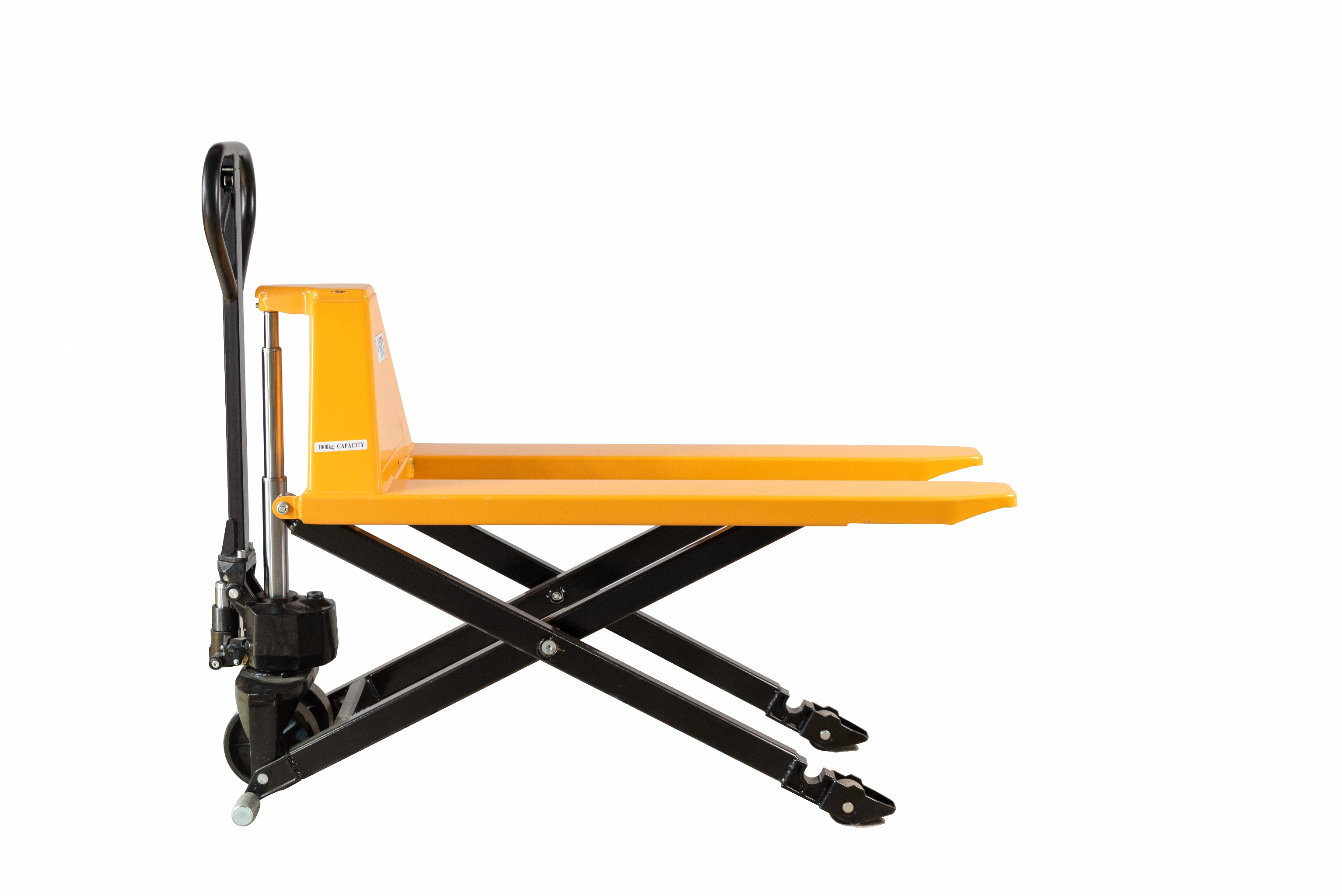 | Pallet Trucks A pallet truck (also known as a pump truck or pallet jack) is a wheeled trolley designed to lift and transport pallets. View product → |
Frequently asked questions
How do you check whether a high lift pallet truck can handle a die?
Compare the truck’s rated capacity at its stated load centre with the die’s gross mass, dimensions, and actual centre of gravity. Account for the forward overturning moment created by long or offset dies, rather than relying on die mass alone.
What is the safe sequence for moving a die from pickup to press position?
Inspect the truck, floor, die, and fork spacing first. Centre and fully engage the forks, lift only enough to clear the support, travel slowly with the die low, stop square to the press, and transfer only after alignment and press-side controls are secured.
What should you check when a high lift pallet truck will not lift or drifts down?
Check battery charge or power supply, hydraulic oil level, leaks, hose condition, valve operation, overload protection, fork obstruction, and wheel or floor contact. Remove the truck from service if it creeps down under load or shows hydraulic damage.
When is a pallet truck the wrong die loader for press transfer?
Use another solution when the die exceeds the truck’s capacity or load-centre limit, has an unstable centre of gravity, requires powered lateral transfer, needs precise press alignment, or must cross a floor gap, ramp, or uneven surface.
What belongs in a Pune procurement specification for die-handling equipment?
Specify gross die mass, dimensions, centre of gravity, fork entry points, lift height, press height, transfer distance, aisle width, floor rating and condition, duty cycle, power supply, safety controls, inspection documents, operator training, and local service requirements.