
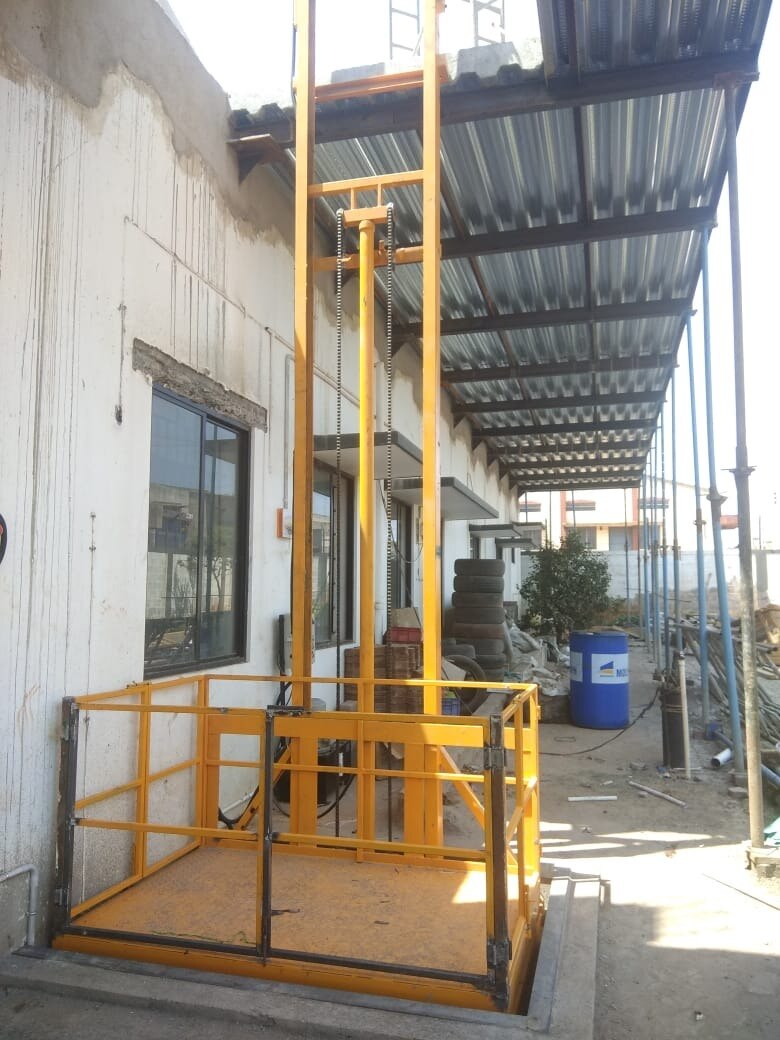
A monorail crane moves a load along a fixed horizontal route; a goods lift moves it between floor levels. To combine them safely, you must design the handover zone, load carrier, interlocks and operating sequence as one material-movement system rather than sizing two machines independently.
Key takeaways
- Use the monorail crane for horizontal travel and the goods lift for vertical travel.
- Confirm the lift platform is clear before transferring a suspended load.
- Interlock crane and lift controls to prevent movement during loading.
- Size both machines for load weight, dimensions, travel distance and transfer clearance.
How the crane and lift divide the material-movement job
The monorail crane handles horizontal travel; the goods lift handles vertical travel. Together, they move a load from a production line to a receiving floor without asking either machine to perform the other’s job.
- At the production line, the crane operator positions the hoist directly above the load’s centre of gravity. The operator attaches approved lifting gear, takes up slack, and raises the load clear of the work area.
- The crane trolley travels along its fixed beam toward the lift landing. This route suits repetitive point-to-point factory material movement, but the crane cannot leave its track to serve every position in the bay.
- At the handover zone, the operator lowers the load onto the goods-lift platform or into a designated load carrier. Side-pulling to correct poor alignment can swing the load and impose damaging forces on the hoist, trolley, runway, or platform.
- The crane withdraws to its safe parking position before the lift doors close. Interlocked gates and doors confirm that the platform is at the correct landing and that nobody can enter the shaft during travel.
- The goods lift moves the secured load vertically to the receiving floor. The monorail crane does not replace this step because its beam provides horizontal travel, not controlled floor-to-floor movement.
- At the upper landing, the lift stops and releases its door interlock only when the platform is level. The crane then collects the load, travels along its receiving route, and sets it down at the workstation or storage position.
How to transfer a suspended load into the lift safely
Keep the suspended load out of the lift during vertical travel. Lower it onto a rated pallet, platform or stillage before closing the lift doors, unless the lift has been specifically designed and controlled for suspended-load operation.
Leave clear space around the carrier, load, platform edges, door opening and shaft enclosure. Check the highest point of the load against the lift entrance and overhead structure, and check the widest point against guides, gates and walls.
Do not accept a clearance that depends on the load hanging perfectly still; a swinging load can strike the enclosure and impose horizontal forces on the lift.
Use this transfer sequence:
1. Confirm the load, carrier and rigging together are within the lift’s rated capacity. Account for pallet overhang, small wheels, drum curvature, uneven bases and concentrated point loads.
2. Position the monorail hoist directly above the load’s centre of gravity. Do not side-pull the load into alignment; trolley forces can skew the carrier, overload runway components and start a dangerous swing.
3. Raise only enough to clear the floor, travel horizontally along the beam and lower the load fully onto the lift platform. Chock wheels and secure drums, bins or unstable machine parts.
4. Remove the hook or keep it outside the enclosure before lift movement. Prevent the crane from travelling while the hook or load is inside the lift.
5. Close the lift door and landing gate, then verify their interlocks prevent movement while either opening is accessible. The gate must not open unless the platform is at that landing.
6. Keep people out of the shaft and lift enclosure throughout loading and unloading. A defined controller must authorise each crane, hoist, gate and lift motion; this discipline matters in goods lift applications with monorail access.
Which controls keep the combined system safe
No person should enter the shaft, stand below a suspended load, or open a landing gate until the lift, crane and access points have issued a safe-to-run permissive.
The electro hydraulic goods lift and the remotely controlled monorail crane need separate isolation points and a defined control exchange; pressing the lift emergency stop must not be treated as stopping the crane.
| Control | Required proof | Movement blocked when |
|---|---|---|
| Personnel access | Operators are authorised, the shaft and transfer zone are clear, and guards are closed | A person remains in the shaft, enclosure or danger zone |
| Landing gates and lift doors | The platform is at the selected landing and both closures are locked | A gate is open, or the platform is away from that landing |
| Crane handover | The load is controlled in the transfer zone and the hook cannot side-pull into the lift | The rail, hook or load can strike doors, beams, lights or guarding |
| Combined emergency stop | Crane motion and lift motion stop through identified circuits | Either machine reports a fault or loses its control signal |
Use this release sequence:
- Isolate and inspect both machines; confirm the runway, lift, gates, guards and rated pallet or stillage are sound.
- Clear the shaft and handover zone, then close and lock every gate not in use.
- Stop the crane before the load enters the lift. Set the load down before lift travel unless the lift is engineered for suspended-load operation.
- After a power failure, apply the trapped-load procedure: isolate both machines, secure the load, and use the specified manual lowering or recovery provision.
A combined risk assessment must also state who controls recovery and how stored hydraulic pressure or a suspended load is made safe.
Where this arrangement works and how to size it
Choose a goods lift and monorail crane when the route repeats between defined points: the crane moves loads along one fixed horizontal path, while the lift handles the floor-to-floor section. This suits a line feeding a mezzanine, a die store supplying presses on another level, or a warehouse sending pallets to an elevated picking floor.
| Route | Why it fits | Main constraint |
|---|---|---|
| Production line to lift landing | Short, repeatable transfer | Crane track must reach the loading position |
| Die store to press level | Controlled point-to-point movement | Confirm die centre of gravity and landing space |
| Warehouse floor to picking platform | Regular pallet replenishment | Lift platform and doors must suit pallet dimensions |
| Across an entire factory bay | Poor fit for a single monorail | Use branches, switches or a bridge crane |
Typical goods lift and monorail crane applications need a fixed route, predictable loads and enough space to set each load down on a rated pallet, platform or stillage before lift travel. Do not size the lift around a load hanging from the hoist unless the equipment is specifically designed for suspended-load operation.
Collect these inputs before selecting equipment:
- Maximum load mass, dimensions, centre of gravity and pallet or stillage type
- Pickup and delivery heights, number of landings, shaft dimensions and available headroom
- Horizontal travel length, curves, switches, obstructions and required hook height
- Loads per hour, duty cycle, acceleration limits and loading time
- Door clear openings, platform size, guarding and the building’s supporting structure
- Whether operators, goods only, or both will enter the lift
A monorail is the wrong choice when destinations change across the bay or loads need free positioning; added track sections can cost more space and control complexity than a bridge crane.
How to evaluate the lift, crane and installation as one system
Approve the arrangement only after the lift, monorail crane and building have passed one interface review. A rated lift platform does not prove that the floor, runway or shaft can carry the combined installation.
1. Test hydraulic performance against the actual load and duty cycle. Check lifting speed, stopping accuracy at each landing, platform level tolerance, pressure-relief setting, hose-burst protection, cylinder leakage and emergency lowering. Confirm that a power failure leaves the platform and any transferred load in a defined safe condition, not merely stopped halfway.
2. Give the structural engineer both load schedules. The crane introduces concentrated wheel, trolley and hoist reactions into the runway and its supports; the lift transfers reactions through its base, guide rails, pit and tower. Require calculations for impact, braking, lateral forces, floor openings, shaft guarding and local slab capacity.
3. Require the supplier to name the standards used for the complete installation. EN 15011 may apply to bridge and gantry cranes, while EN 14492-2 covers power-driven winches and hoists; machinery, electrical, structural and workplace-safety requirements also need identification. “Complies with crane standards” is not enough.
4. Collect approved layout and interface drawings, load charts, hydraulic and electrical schematics, risk assessment, test certificates, inspection records, operating instructions and maintenance intervals. Check that the emergency-stop circuit, isolation points, manual recovery, trapped-load procedure, gate interlocks and suspended-load controls cover both machines.
Aguatech Engineers Pvt.ltd. can be evaluated on whether its submission includes these interface calculations and documents, rather than on lift capacity alone.
Related products
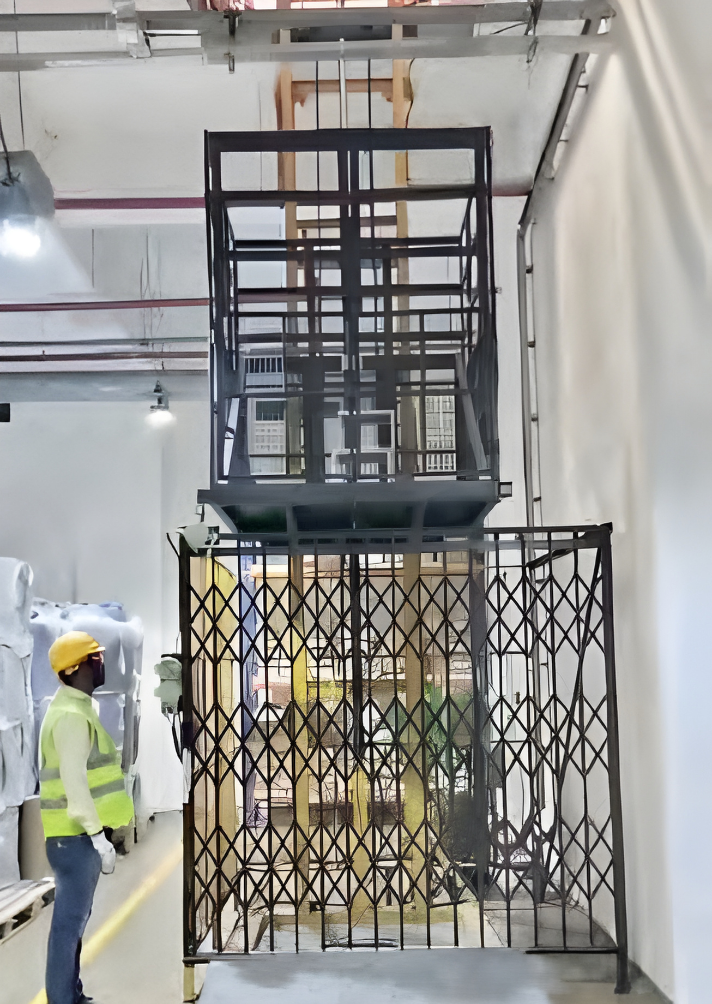 | GOODS LIFTS Goods or Cargo or Luggage lifts are basically used in industry shop floors for safe, secure, convenient and fast methods to transport loads from... View product → |
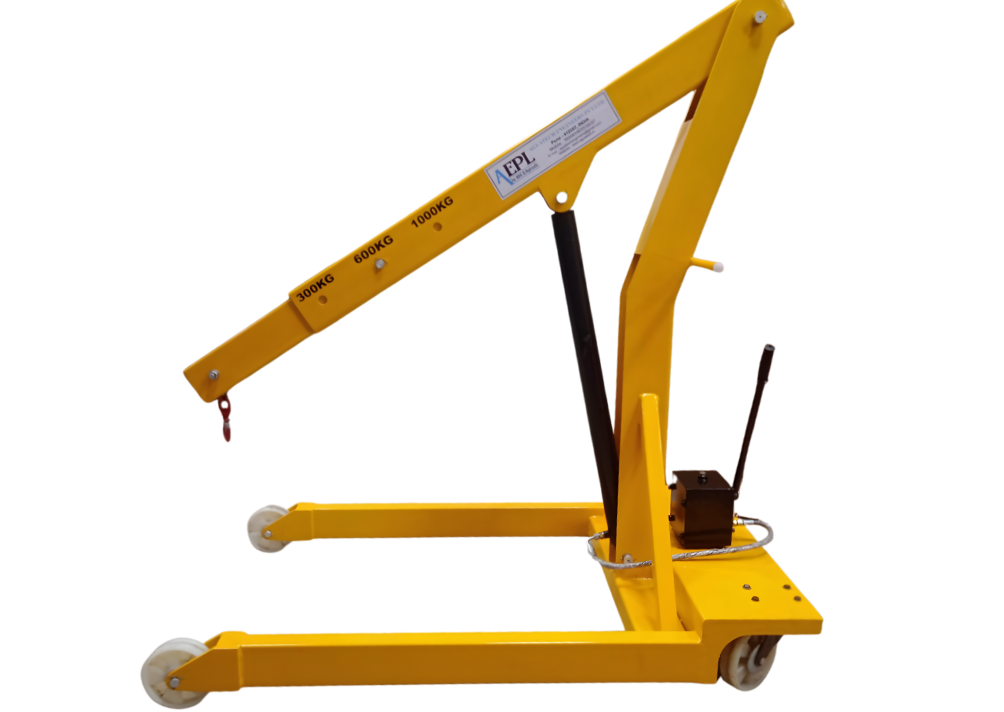 | Cranes A hydraulic floor crane, also known as a shop crane or engine hoist, is a powerful lifting device designed to handle heavy loads in a wide range of... View product → |
Frequently asked questions
What job does each machine perform in a combined material-movement system?
The monorail crane moves the suspended load horizontally along its track; the goods lift moves it vertically between floors.
How do you transfer a suspended load into a goods lift safely?
Stop and position the crane over the lift, confirm the platform is clear and rated for the load, lower it under controlled movement, and prevent lift travel until the load is stable.
Which controls help keep a crane-and-lift arrangement safe?
Use guarded lift doors, emergency stops, travel limits, overload protection, door interlocks and controls that prevent lift operation while the crane is transferring a load.
How should you size a goods lift and monorail crane together?
Check the load weight, load dimensions, centre of gravity, lift platform size, lifting height, crane span, travel path, transfer clearance and the combined duty cycle.
When does a goods lift and monorail crane arrangement suit a factory?
It suits factories that need repeatable movement between production and receiving levels where a crane can reach the loading point and the lift can serve the required floors.