
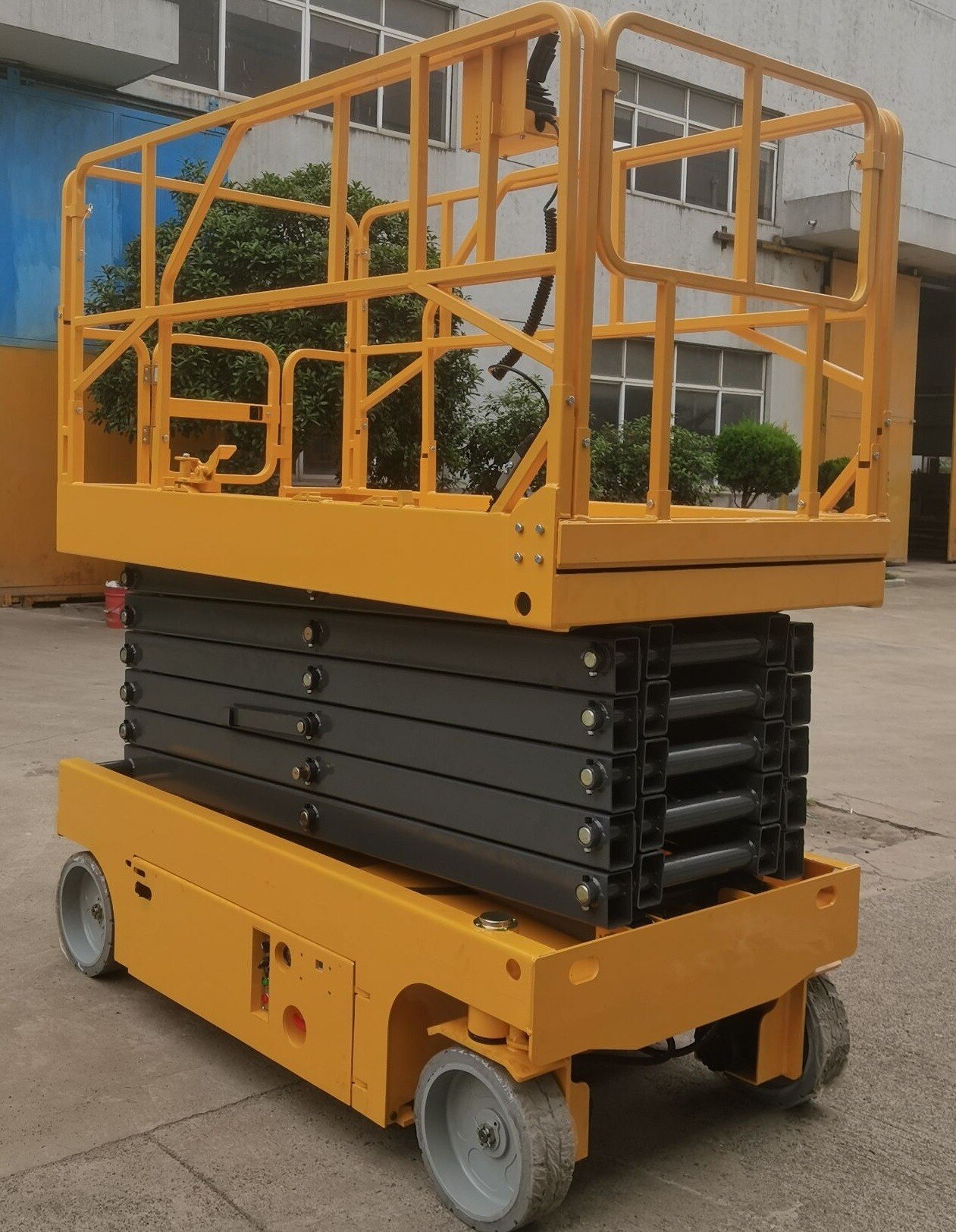
A towable scissor lift can move between loading bays without permanent installation, but its value depends on more than maximum height. You will be able to judge whether the machine fits your routes, dock surfaces, traffic controls, working reach and relocation pattern before comparing suppliers.
Key takeaways
- Confirm towing capacity, hitch type, safety pin, breakaway connection and electrical plug.
- Measure platform height, doorway clearance, bay width and the machine’s working footprint.
- Deploy stabilisers on firm ground and isolate vehicle, pedestrian and dock-edge hazards.
- Compare a mobile scissor lift with dock lifts, forklifts, boom lifts and fixed platforms.
What Towable Means at a Loading Bay
A high raised scissor lift towable is moved around a private loading site by a suitable towing vehicle, using the specified hitch, coupling, safety pin, breakaway connection and electrical connection. Confirm the vehicle’s towing capacity and the lift’s towing requirements before moving it.
For public roads, private-site towability is not enough: road travel requires the correct brakes, lights, coupling, registration and legal towing vehicle.
Plan the towing distance, turning route, door approach and parking position before coupling. Keep clear of dock edges, pedestrians, forklifts, trailer traffic and tight corners.
| Movement pattern | Towable lift | Self-propelled mobile scissor lift |
|---|---|---|
| Separated bays or occasional transfers | One machine can serve several docks, trailers, containers and fixed overhead assets | Travel may require more battery and driving time |
| Frequent short moves between adjacent bays | Coupling, stabiliser setup and restraint removal can be slower | Usually more productive on a smooth, suitable floor |
| Transfer between sites | Check road legality and towing distance | Requires transport equipment unless road approved |
After parking, staff must:
- Uncouple the towing vehicle, or secure it against movement.
- Apply brakes, use wheel chocks where specified and deploy the manufacturer’s stabilisers.
- Remove transport restraints, check the surface, and confirm levelness and platform clearance.
- Confirm the platform is empty before elevation.
Never tow, drive or reposition the unit while occupied or raised unless the manufacturer expressly permits a specific travel condition. The lift rises within its footprint, so place it close to the work face; it cannot reach over an obstruction like a boom lift.
Check Height, Capacity and Physical Fit Before Purchase
A machine fits a loading bay only when its dimensions, loads and overhead reach match the site. Request platform height and working height separately; working height commonly adds an assumed operator reach of about 2 metres.
Ask the supplier for these figures:
- Platform length and width, rated load, and extension-deck capacity
- Folded length and height, overall width, ground clearance, and towing weight
- Maximum wheel load and stabiliser-pad load
| Specification | Compare it with | What failure looks like |
|---|---|---|
| Stowed width | Bay-door opening | The lift cannot enter |
| Folded height | Shutters, beams and door tracks | The unit strikes overhead structure |
| Turning radius | Approach-lane width | Positioning requires unsafe reversing |
| Ground clearance | Dock plates, bridge plates and threshold ramps | Wheels drop, scrape or overload the route |
| Platform height | Lights, sprinklers, ducting and signage | The raised deck contacts fixed assets |
Rated load includes workers, tools, consumables and materials. A larger platform does not permit loose freight, pallets or long components against guardrails; those loads can fall, snag or shift the centre of gravity.
Do not accept a nominal floor rating alone. Concentrated wheel or pad loads, cracks, drains, expansion joints, dock levellers and unsupported slab edges can control the decision. Use trailer or container access only when the high raised scissor lift towable can approach without crossing an unrated plate or standing near an unprotected edge.
These checks apply to any loading bay equipment selection.
Stabilise the Lift and Control Bay Hazards
Prevent movement before raising a mobile scissor lift: park on level ground, apply its brake controls, and follow the manufacturer’s deployment sequence. Wheel chocks support this process; they do not replace it.
1. Secure the lift after towing. Uncouple or secure the towing vehicle, set its brakes, and chock wheels where required. Deploy outriggers or automatic levelling only on a surface within the manufacturer’s permitted slope.
2. Inspect the support surface. Stabilisers do not repair a weak slab, shifting dockboard, open edge, drainage channel, pothole, or machine parked partly on a ramp. Check wet monsoon contamination, cracks and slope again after every relocation.
3. Control bay traffic. Stop trailer movement, secure the vehicle, set trailer brakes, chock trailer wheels where required, and lock dockboards against movement. Separate pedestrians and forklifts, then use barriers or a controlled exclusion zone to prevent vehicle impact with the loading bay equipment.
4. Survey above the platform for doors, beams, sprinklers, pipework, lighting and electrical conductors. Use at least 10 feet of planned clearance from energised lines up to 50 kV; provide greater clearance for higher voltages.
5. Keep the gate closed and remain inside the guardrails. Do not use ladders or boxes on the deck, lean outside the rails, or transfer from the raised platform to a trailer or dock structure.
6. Recheck levelness, chocks, stabilisers, overhead clearance and traffic controls before every elevation.
Compare the Towable Option With Other Access and Handling Equipment
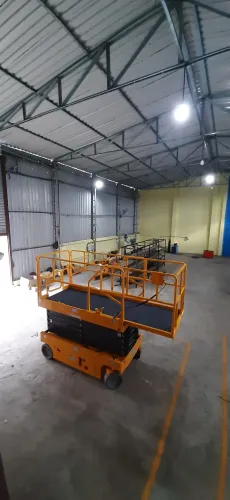
A high raised scissor lift towable suits separated loading-bay work because one machine can move between dock positions without a forklift or fixed installation. A non-towable mobile scissor lift may suit indoor movement with handling equipment, while a self-propelled unit is quicker for repeated short relocations on a smooth floor.
| Option | Main advantage | Limitation |
|---|---|---|
| High raised scissor lift towable | Transfers between separated bays and provides vertical access | Requires towing, stabilisation and a new setup check at each position |
| Mobile scissor lift | Easy indoor movement with suitable handling equipment | Needs separate handling for transfers between work areas |
| Self-propelled scissor lift | Productive for frequent short moves | Depends on battery charge, charging access and onboard drive systems |
| Ladder | Low-cost, compact access | Limited standing area and no comparable platform capacity |
| Loading dock lift | Moves goods or people between levels | Not a guarded overhead work platform |
| Forklift-mounted work platform | Uses an available forklift | Requires a compatible forklift, approved attachment and controlled operation |
| Boom-style machine | Reaches horizontally over obstructions | More machine than needed for work directly above its footprint |
Choose the towable scissor lift for repeatable access to lights, shutters, signage, sprinklers, ducting and dock equipment when the work face is close to the parked machine. Choose a boom-style machine when outreach over a trailer, obstruction or dock structure is essential.
For searches such as high raised scissor for lift towable benefits in Pune, the deciding question is not height alone: can the machine reach the work face without crossing the obstruction? A ladder cannot match its guarded deck, and a forklift platform is not a general substitute for dedicated lifting equipment.
Use a Pune Site-Check Before Selecting the Machine
Measure the site before you compare machines. For high raised scissor for lift towable benefits in Pune, the decisive evidence is the bay geometry, floor condition and work pattern—not the advertised working height.
1. Measure every bay door, storage route, turning radius, approach slope, threshold, dock plate, trailer position and parking area. Record folded height and width limits, floor construction, cracks, drains, expansion joints, uneven approaches and wet-season contamination.
2. Obtain the maximum permitted wheel load and stabiliser-pad load for each route. Compare them with dock plates, ramps, levellers, unsupported slab edges and floor ratings; total machine weight alone can hide a damaging point load.
3. Check that the parked machine leaves emergency routes clear. Confirm an indoor charging point, charging duration, battery replacement plan, spare battery or second machine will cover the shift without creating a loading bay equipment bottleneck.
4. Record towing distance and relocation frequency. Occasional transfers between distant bays favour towable capability; repeated moves between adjacent bays may favour self-propelled travel on a smooth floor.
5. Add a written overhead survey covering shutters, beams, sprinklers, ducting, lights, signage and electrical conductors. Draw a traffic plan that separates trucks, forklifts, pedestrians and the lift.
A supplier such as Aguatech Engineers Pvt.ltd. adds value by checking these measurements against platform height, folded dimensions, load ratings, ground clearance and stabilisation method rather than quoting working height alone.
Request:
- Dimensional drawing and operating manual
- Towing requirements, brake and coupling details
- Wheel and stabiliser-pad loads
- Slope limits and charging data
- A site demonstration on your measured route
Related product
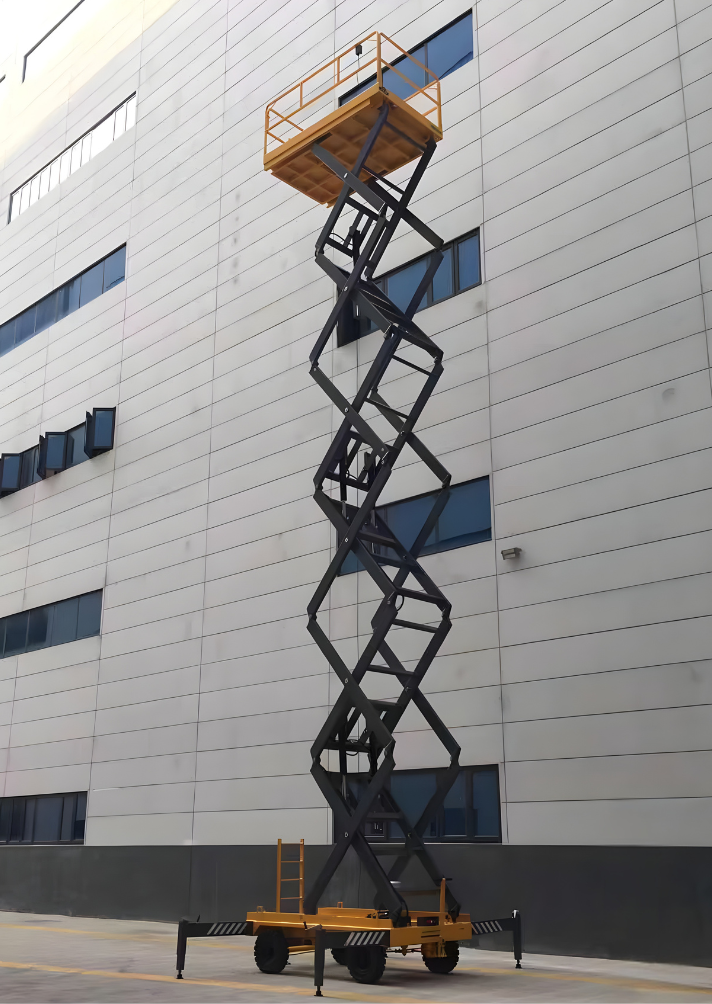 | HIGHLIFT MAINTAINANCE PLATFORM These are perhaps a revolutionary kind of equipment to be designed which almost replaced the conventional ladders which have their own limitations... View product → |
Frequently asked questions
What does towable mean at a loading bay?
A towable lift is moved around a private site by a suitable towing vehicle using the specified hitch, coupling, safety pin, breakaway connection and electrical connection. Check the vehicle’s towing capacity and the lift’s towing requirements before moving it.
What should you check before buying a high raised scissor lift towable?
Check maximum platform height, rated capacity, platform dimensions, stowed height, overall width, turning space, doorway clearance, ground conditions and the towing vehicle’s capacity.
How do you stabilise a towable scissor lift at a loading bay?
Position it on firm, level ground, deploy the manufacturer-specified stabilisers, keep clear of dock edges and traffic routes, and control vehicle and pedestrian movement before raising the platform.
How does a towable scissor lift compare with other loading-bay equipment?
Compare it with dock lifts, forklifts, boom lifts and fixed access platforms based on working height, reach, load capacity, manoeuvrability, setup time, floor conditions and the task’s frequency.
Why arrange a Pune site-check before selecting a mobile scissor lift?
A site-check confirms clearances, loading-bay layout, ground strength, towing routes, power access, operating height and the hazards that determine whether a towable lift fits the job.