
The right choice depends on whether drums move along one fixed route or serve several destinations at different heights and orientations. By the end, you will be able to compare workflow, conveyor design, site constraints, safety controls and operating data before selecting either system.
Key takeaways
- Choose a stacker for intermittent, mixed-route drum handling.
- Choose a conveyor for a fixed route and repeatable drum flow.
- Specify drum weight, diameter, height, route and placement points.
- Reject both options when drums need frequent manual intervention or unstable transfers.
Which system fits your drum movement pattern?
Choose the movement pattern before comparing specifications. A drum stacker cum tilter suits intermittent handling, mixed destinations, rack placement, and controlled rotation for dispensing. A conveyor suits a fixed route between known infeed and outfeed points, where steady flow matters more than flexibility.
| Option | Best fit | Main limitation |
|---|---|---|
| Drum stacker cum tilter | Individual picking, height changes, multiple destinations, tilting | Needs aisles, operator travel, power, and traffic control |
| Conveyor | Repetitive movement with consistent drum orientation and volume | Transfers, jams, and route changes complicate the system |
For drum stacker cum tilter or conveyors in Pune, map one complete journey: receiving, movement between workstations, lifting to rack or platform height, dispensing, and final placement. If drums leave the route for inspection, batching, or different storage levels, a stacker usually wins.
If every drum follows the same path at a predictable rate, a conveyor usually wins.
Do not compare only nominal capacity or purchase price. Before requesting specifications, define:
- Smallest and largest drum diameter, empty and full weights, and drum condition
- Required lift height, tilt angle, and dispensing position
- Travel distance, daily cycles, queue points, and acceptable transfer speed
- Aisle width, floor condition, turning space, and pedestrian segregation
Tilting changes the load centre. Request the capacity chart at the required lift height and tilt angle. For flammable liquids, add bonding, grounding, ignition-source control, suitable motors and switches, spill containment, and ventilation to the review.
How each option works from receiving to final placement
At receiving, inspect the drum for leaks, damaged chimes, missing labels and an unstable load before placing it on equipment. A drum stacker cum tilter takes one drum from the floor or pallet, secures it, and serves the required workstation. A conveyor accepts drums only at a defined infeed, with controlled spacing and orientation.
| Stage | Drum stacker cum tilter | Conveyor route |
|---|---|---|
| Receiving | Operator positions and clamps an individual drum. | Drum enters on a roller, belt or pallet conveyor. |
| Movement between workstations | Unit travels through an aisle to a selected destination. | Drum follows a fixed route through transfers and accumulation zones. |
| Lifting | Mast raises the drum to a rack, platform or machine height. | A lift table, vertical conveyor or transfer station must provide elevation. |
| Dispensing | Controlled rotation presents the outlet downward or at the specified angle. | A dedicated cradle, clamp, rotator or turntable must be added; friction alone is not safe. |
| Final placement | Operator lowers and releases the drum at the rack, machine or floor position. | Drum exits at a fixed point, often onto a pallet or staging area. |
The stacker supports mixed destinations and intermittent work, but its safe tilt rating is separate from its lifting rating. Confirm limits for drum mass, diameter, centre of gravity, lift height and tilt angle. For conveyors, verify retention during a power failure, transfer jams and damaged-chime conditions before relying on unattended flow.
Roller, chain, belt or pallet conveyor: which design is suitable?
For a fixed route with predictable orientation and steady throughput, conveyors usually beat a drum stacker-cum-tilter. Tipping or dispensing requires a dedicated cradle, clamp, rotator, powered turntable or transfer station; more belt speed or roller friction is not a substitute.
| Design | Stability and orientation | Loading, cleaning and transfer implications |
|---|---|---|
| Roller | Suits rigid drums and heavy loads, but widely spaced rollers can let a drum wobble or rotate. | Easy underside cleaning and accumulation, but impacts and back-pressure need controlled or zero-pressure logic. Transfers require matched speed, small gaps and containment. |
| Chain | Carries heavy loads and pallets positively, but exposed chains can catch damaged drum edges. | Handles dirty areas, yet cleaning and jam removal take more care. Use guards and a transfer plate at each gap. |
| Belt | Provides continuous support and traction, but a smooth belt does not stop sideways rolling. | Easier to clean; use side guides, profiled or cleated surfaces and protected end stops without trapping closures. |
| Pallet | Gives each drum a defined footprint and preserves orientation. | Best for palletized drums, barcode identification and forklift or stacker access; clean the pallet rather than conveying the curved shell directly. |
An industrial conveyor comparison must check the smallest and largest drums, empty and full weights, damaged surfaces, transfer gaps and speed matching. A stopped drum also needs safe containment, visible emergency-stop reset behaviour and jam removal without placing a worker between machines.
Accumulation needs specified spacing, stopping time, restart behaviour and no-impact logic. If drums must be lifted, rotated or placed at mixed destinations, a stacker-cum-tilter offers flexibility that a straight conveyor line does not.
When neither system is the safe or practical answer
Neither a standard stacker cum tilter nor a straight conveyor is the safe answer when the route, drum geometry or process changes beyond the equipment’s design limits. A conveyor loses its advantage when drums cross aisles, change elevation, require frequent manual transfers or travel between several destinations.
A stacker becomes impractical where turning space, traffic segregation or floor strength is inadequate.
| Condition | Why it rules out a standard system | What to investigate |
|---|---|---|
| Changing route, ramps or thresholds | A conveyor needs engineered transfers; a stacker can become unstable on slopes or uneven floors | Guided carts, lifts, ramps or a redesigned route |
| Uneven, weak or contaminated floor | Wheels may lose stability, and point loads can damage the slab | Floor-load survey, wheel selection and spill control |
| Tapered, dented, narrow or non-cylindrical drums | Rollers and clamps may not hold a consistent footprint | Cradles, palletised handling or a drum-specific attachment |
| Tight aisles or low headroom | A stacker cannot turn or lift safely; conveyor installation consumes fixed space | Compact lifting equipment or a revised layout |
| Tipping, inversion or metered dispensing | A conveyor transports the drum but does not control its load centre during rotation | Integrated rotator, cradle, clamp or powered turntable |
Do not treat a hazardous-liquid route as an ordinary industrial conveyor comparison. Flammable liquids require a hazardous-area and static-control review covering bonding, grounding, ignition sources, motor and switch suitability, spill containment and ventilation.
Reject a standard stacker if the filled drum’s load centre moves beyond its rated chart at the required lift height and tilt angle. Request that chart, not only the nominal capacity.
What to specify before requesting a Pune quotation
Give suppliers a measurable duty, not only “drum handling equipment in Pune.” State the full drum mass, including contents; diameter, height, material, bung position, pallet use and condition. For a drum stacker cum tilter or conveyors in Pune, describe the route, floor levels, rack height, aisle width, turning radius, transfer points and available electrical supply.
- Record drums per hour, peak batch size, operating shifts, travel distance, queue time and the required lift, tilt and positioning time.
- Identify pedestrian traffic, vehicle crossings, blocked-visibility zones, falling-load exposure, emergency-stop locations and whether operation is pedestrian, ride-on or remote.
- For flammable liquids, provide the liquid classification, bonding and grounding arrangement, ventilation, spill-containment plan and hazardous-area requirements. Do not treat low-voltage controls as proof of suitability.
- Request cleaning access, inspection intervals, battery-charging arrangements, hydraulic checks, spare-part availability and Pune service response.
| Option | Specify for the quotation | Demand from the supplier |
|---|---|---|
| Drum stacker cum tilter | Lift height, tilt angle, drum diameter, centre of gravity and aisle width | Separate ratings for lifting and tilting, plus a capacity-versus-load-centre chart at the required height and angle |
| Conveyor | Drum orientation, infeed and outfeed height, route length, accumulation points and transfers | Load rating, speed, guarding, jam recovery, spill control and cleanability |
Aguatech Engineers Pvt.ltd. can be included in the comparison only after these duty and site figures are supplied; otherwise quotations describe different machines under similar names.
Related product
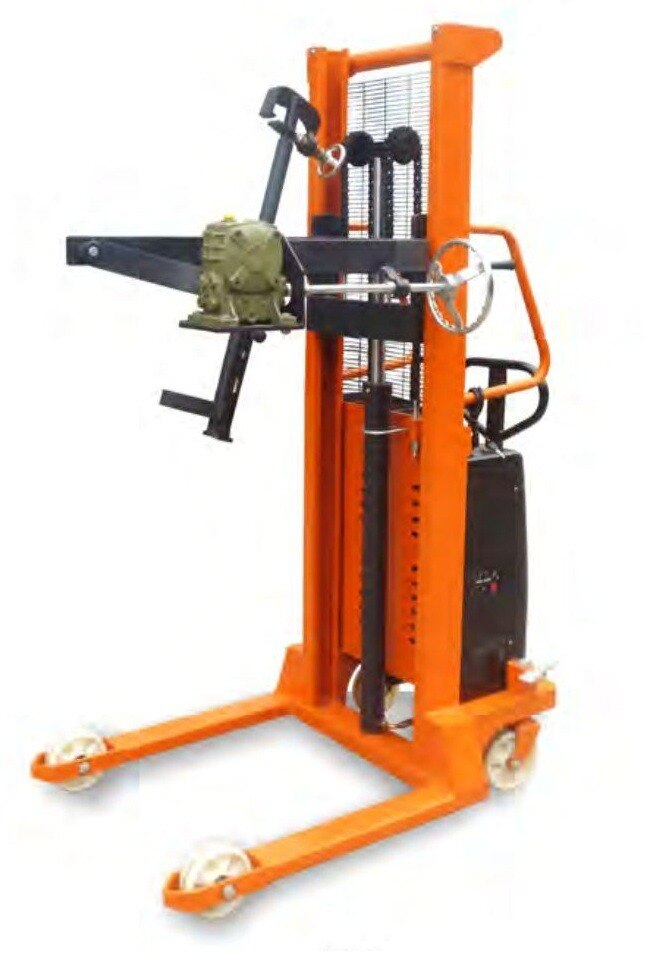
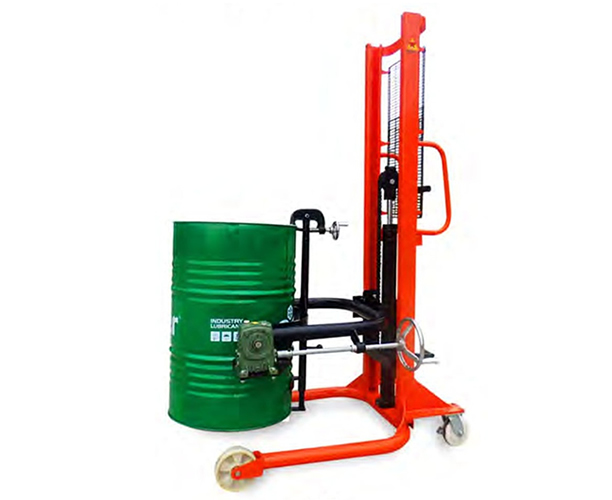 | DRUM HANDLING EQUIPMENT DRUM/BARREL STACKER-CUM-TILTER As the name indicates, most establishments have to handle drums/barrels of different sizes and materials on daily and/or regular basis. View product → |
Frequently asked questions
When should you choose a drum stacker cum tilter instead of conveyors?
Choose a drum stacker cum tilter for intermittent handling, mixed destinations, rack placement, and controlled drum rotation for dispensing.
When are conveyors the better drum-handling option?
Use conveyors when drums follow a fixed route between known infeed and outfeed points and steady flow matters more than flexibility.
Which conveyor design suits industrial drums?
Select roller, chain, belt or pallet conveyors according to drum stability, base condition, load weight, spacing, transfer points and required flow.
What information should you provide for a Pune quotation?
Provide drum material, diameter, height, weight, centre of gravity, pallet use, lifting and tilting needs, route length, elevations, throughput and final placement details.