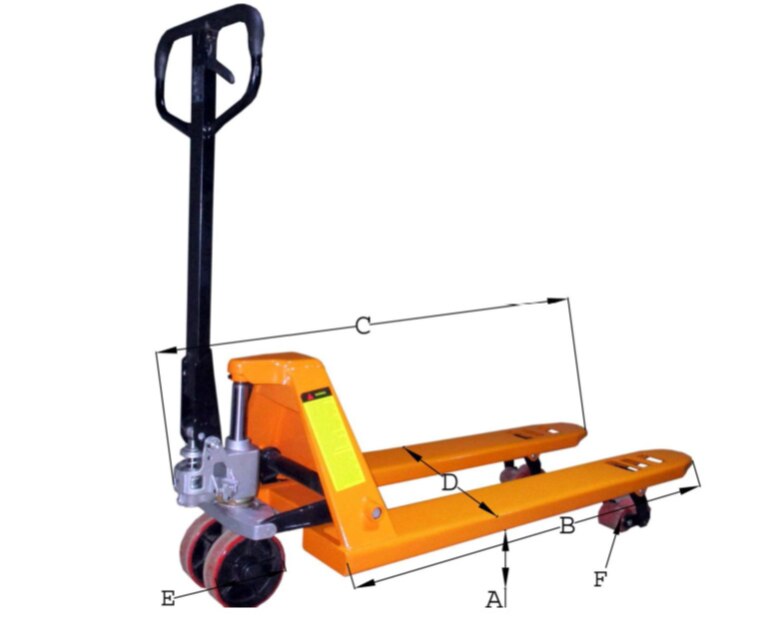
The correct choice depends on the skid’s entry opening, bottom clearance, fork path, load centre, and the floor route—not on the words “low profile” or the truck’s headline capacity. By measuring those points in millimetres, you can identify whether a low-entry truck solves a genuine access problem or creates unnecessary risk at joints, ramps, dock plates, and debris.
Key takeaways
- Measure the skid’s underside height before choosing a truck.
- Confirm entry direction and every opening dimension.
- Check load centre, fork engagement and lifting clearance.
- Match wheels and ground clearance to the route.
Start with the skid: entry height and entry direction decide the truck
The skid’s entry height and entry direction determine whether you need a low profile pallet truck or standard pallet truck: measure the gap from the floor to the underside of its lowest board, then compare that figure with the truck’s lowered fork height.
A standard hand pallet truck usually lowers to 75–85 mm; a low-profile model commonly reaches about 51 mm, while ultra-low models can reach 35–45 mm.
| Option | Lowered fork height | Use when |
|---|---|---|
| Standard pallet truck | About 75–85 mm | The skid opening exceeds this height with clearance |
| Low-profile pallet truck | About 51 mm | The skid’s bottom opening is lower than standard entry height |
| Ultra-low-profile truck | About 35–45 mm | The skid has an exceptionally low opening and compatible fork pockets |
Check the entry direction before making a pallet truck comparison for skids. Many skids are two-way rather than four-way entry, so the forks must approach the usable opening between the runners.
A skid with closed ends, narrow or offset runners, damaged bottom boards, or no bottom boards may not support pallet-truck forks safely; a low-profile truck cannot fix those defects.
Do not use maximum lift height to judge entry. Entry depends on lowered fork height; lifting height determines whether the inserted forks can raise the skid clear of the floor or dock surface. Specify both figures, along with fork length and width, before selecting the truck.
Measure every opening before comparing fork dimensions
A usable opening, not the skid’s outside size, decides whether forks can enter. Measure the skid’s bottom opening height, entry width, entry direction, and runner spacing before making a pallet truck comparison for skids. Record each measurement in millimetres, with the skid empty and on a level floor.
| Dimension | Measure on the skid | Compare with the truck |
|---|---|---|
| Bottom opening height | Floor to the lowest underside member | Lowered fork height and frame clearance |
| Entry opening width | Narrowest clear width between runners or boards | Individual fork width and outside fork width |
| Entry depth | Usable fork travel from the opening | Fork length and required engagement |
| Runner spacing | Distance between runners along the entry path | Fork spacing and roller position |
| Overall skid width | Outside edge to outside edge | Truck’s outside width and turning envelope |
| Ground clearance | Lowest board, runner, or obstruction above the floor | Load wheels, rollers, and frame clearance |
Check the skid drawing against the actual skid. A two-way skid needs openings on the correct sides; closed ends or runners outside the fork path can block entry. A skid with no bottom boards may not support forks safely, even when its opening looks large enough.
Also measure the route’s minimum floor clearance at dock plates, thresholds, and ramps. Give the supplier the skid dimensions, required fork length, fork width, overall truck width, lowered height, wheel material, roller arrangement, and rated load centre; “low profile” alone leaves critical compatibility details unstated.
Check load centre, fork engagement, and lifting clearance
A truck’s safe capacity falls when the load centre moves forward or the forks engage too little of the skid.
A 2,500 kg rating is valid only at the manufacturer’s stated load centre, commonly 600 mm from the fork heels; place the centre of gravity farther out and use the model’s derating chart, not the headline rating.
- Measure the load centre from the fork heels to the load’s centre of gravity, including any overhang. A long skid or unevenly loaded box can exceed the rating even when its total weight is below 2,000 kg.
- Confirm that the forks enter far enough to support the load behind its centre of gravity. Fork tips carrying the weight concentrate bending force and can lift the skid unevenly or cause it to fall.
- Check the skid’s bottom opening against the truck’s lowered fork height and fork thickness. A low-profile pallet truck helps only when its forks fit beneath the skid; it cannot overcome closed ends, damaged boards, or runners outside the fork path.
- Confirm the standard pallet truck or low-profile pallet truck has enough lifting clearance for the skid, load, and floor obstacles. Insufficient clearance causes impact damage before the truck reaches its rated lift.
- Record rated load centre, required fork engagement, lowered fork height, fork length, and skid condition in the purchase specification. Never select on “2.5-ton” alone.
Match the truck’s clearance and running gear to the route
A standard pallet truck is the safer choice when the route includes uneven flooring, a dock plate, or a ramp transition. Its greater fork and frame clearance gives you more room over expansion joints, damaged concrete, debris, and raised plate edges.
A low-profile model can scrape at these points even when its forks fit the skid.
| Option | Route behaviour | When it applies |
|---|---|---|
| Standard pallet truck | More clearance at the forks and undercarriage; better tolerance for floor defects and dock-plate lips | Choose it when the skid has enough bottom clearance and the route contains transitions or rough surfaces |
| Low-profile pallet truck | Less clearance below the forks and frame; greater contact risk at abrupt changes in level | Choose it only when the skid’s low entry height prevents standard fork entry and the route passes a successful site trial |
| Manual pallet truck on a steep ramp | Requires the operator to control both load and truck against runaway movement | Do not select it for routine steep-ramp travel merely because it can roll there |
Test the loaded truck on the actual warehouse floor and loading-dock route before purchase. Check the approach to the dock plate, the plate lip, the ramp angle, and the turning space.
For warehouse pallet equipment in Sambhaji Nagar, record lowered fork height, wheel material, roller arrangement, rated load centre, turning dimensions, and minimum site clearance. “Low profile” or “2.5-ton” alone leaves the route risks and skid compatibility unspecified.
Convert the measurements into a purchase specification
Give the supplier a measurement sheet, not simply “low profile” or “2.5-ton.” For a low-profile pallet truck versus standard pallet truck in Sambhaji Nagar, specify the skid’s entry direction, lowest bottom clearance, and every dimension that limits fork access.
- Skid length, width, loaded weight, and whether entry is two-way or four-way.
- Lowest fork-entry height: compare the skid opening with about 75–85 mm for a standard truck, 51 mm for a low-profile model, or 35–45 mm for an ultra-low-profile model.
- Fork length, fork width, overall truck width, and the required fork spacing.
- Clear width and height between skid runners, including the narrowest fork-pocket opening.
- Rated capacity at the stated load centre, not only the truck’s headline capacity.
- Wheel material, steering-wheel size, and roller arrangement: single or tandem.
- Turning dimensions and the site’s minimum floor clearance, including expansion joints, dock plates, ramps, and damaged areas.
Tell the supplier which entry direction you will use. A skid with closed ends, missing bottom boards, damaged runners, or no continuous fork path is not made compatible by choosing shorter forks.
For warehouse pallet equipment in Sambhaji Nagar, Aguatech Engineers Pvt.ltd. can use this sheet to distinguish a genuine low-clearance requirement from a skid that needs a different handling method. Request a route trial with the loaded skid before approving the specification.
Frequently asked questions
When do you need a low profile pallet truck for skids?
Choose a low profile pallet truck when the skid’s underside sits below the standard truck’s lowered fork height.
What skid measurements should you take before comparing pallet trucks?
Measure entry height, opening width, opening length, entry direction and the clearance around the lowest boards.
Why do load centre and fork engagement matter for skids?
The load centre affects capacity, while adequate fork engagement prevents unstable lifting and uneven load support.
Which route conditions affect pallet truck selection?
Check floor joints, ramps, thresholds, turning space and surface quality against the truck’s ground clearance and running gear.