

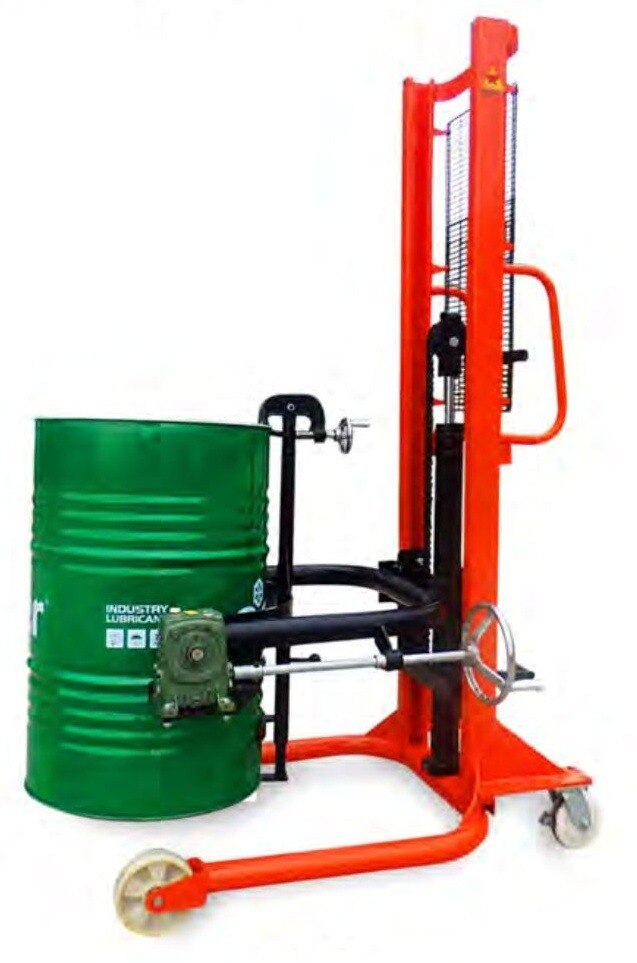
A barrel can reach the required height and still sit off-centre, rotate unexpectedly or lean during placement. You will be able to separate drum compatibility, operator setup, site conditions and mechanical faults, then decide when adjustment is unsafe and service is required.
Key takeaways
- Match drum diameter, height, chime profile and head construction to the gripper.
- Centre the barrel before lifting; inspect hooks, jaws, straps and contact surfaces.
- Check backlash, worn pivots, hydraulic drift and unequal cylinder movement.
- Stop adjusting when alignment remains inconsistent and request specialist service.
Is the barrel itself compatible with the gripping and rotation system?
A gripper can lift a barrel yet fail to locate its axis. Confirm diameter, height, chime profile, head construction and surface condition: a standard 210-litre steel drum is not equivalent to a plastic, thin-wall, open-head, tapered or dented barrel, and a damaged rim can defeat hooks.
Partially filled or viscous contents shift the centre of gravity during rotation.
| Drum type | Locating risk | Rotation consequence |
|---|---|---|
| Closed-head steel | Rigid head and defined chime | Usually repeatable if dimensions match |
| Plastic or thin-wall | Body flexes; jaws can deform it | Axis shifts under clamp force |
| Open-head, tapered or dented | Rim or body may not be concentric | Slip, tilt or eccentric rotation |
Specify these points before buying barrel positioning equipment:
- Drum diameter and height range, including taper, chime dimensions and rim damage limits.
- Empty weight, full gross weight, contents, viscosity and fill level.
- Rotation range, target angle accuracy, cycle time and allowable drift.
- Loading interface: chime grab, body clamp, cradle, forks or another approved contact method.
- Floor condition, aisle clearance and the maximum swept envelope at the required height and tilt angle.
- Residual capacity for the complete stacker-and-attachment configuration, including load centre and mast position; headline lifting capacity is inadequate.
- Safe failure behaviour: controlled descent, positive holding and no release if hydraulic power is lost.
For drum stacker tilter problems, record the measured angle and drift over a fixed time instead of accepting “suitable for drums” as a specification.
Which setup errors leave a barrel off-centre before lifting?
A barrel is physically off-centre when one side sits farther from the jaws, cradle or forks before lifting. Drum stacker tilter problems also arise when a centred barrel rotates or tilts after clamping; that points to poor retention, a shifting centre of gravity or hydraulic movement, not initial alignment.
| Setup fault | What it does | Check before lifting |
|---|---|---|
| Wrong drum diameter setting | Leaves excess clearance or clamps the barrel unevenly | Select the actual diameter |
| Uneven floor or worn wheel | Changes machine geometry relative to the rack or pallet | Check floor, wheels and mast alignment |
| Non-square approach or poor mast visibility | Places one side forward, where the operator cannot see the contact | Approach squarely and use a spotter |
| Incorrect height, jaw spacing or fork alignment | Loads one rim, body section or fork more heavily | Set height and equalise both sides |
| Insufficient clamp engagement | Lets the barrel slip, rotate or lean | Confirm full contact at the chime or body |
Before use, inspect the drum for dents, leakage and a damaged chime. Align the machine squarely, set the attachment height, engage both sides evenly, then perform a low-height test lift; the barrel must remain stable without manual pushing.
Check aisle clearance, rack clearance, intended stack height, load centre and the complete swept path at maximum diameter and tilt. Poor visibility through the mast is a positioning fault, not permission to guess. Record these checks for drum for stacker titler positioning problems in Nagpur before entering storage.
Stop if the barrel contacts the mast, guard, floor or adjacent load.
How do wear, backlash and hydraulic drift change the barrel’s position?
A barrel can be off-centre before hydraulics move it. Worn jaws, rim hooks, anti-slip pads or rollers change the contact point; stretched chains, worn sprockets, loose pins, bushings, a bent cradle, poor fork alignment, worn mast guides or a weak locking mechanism add clearance.
Chain or sprocket backlash appears as angular movement when you reverse direction.
- Clamp an empty attachment and check for play at each jaw, hook, roller, chain, sprocket, pin, bushing, cradle, fork, mast guide and lock. If the barrel moves while clamped, fix retention or alignment before adjusting hydraulics.
- With a compatible barrel, lift only slightly and rotate slowly. Movement during rotation indicates backlash, uneven gripping or a damaged rim; movement while held at an intermediate angle indicates hydraulic drift or a failing lock.
- Hold that angle for a fixed time and record the change. Cylinder leakage, counterbalance-valve leakage, contaminated spool valves, air, hose expansion, excessive flow and oil-temperature changes can cause drift, overshoot or uneven motion. Hydraulic pressure proves force, not positional accuracy.
- Use a positive mechanical stop, calibrated angle sensor or limit switch. Decelerate before the target; abruptly closing a high-flow valve rarely stops at the same angle twice.
For drum stacker tilter problems, use this maintenance checklist:
- Pre-shift: inspect grip surfaces, leaks, hoses, locks, drum contact and visible fasteners.
- Weekly: check chain tension, sprocket wear, pins, bushings, rollers, mast guides and fork alignment.
- Periodically: test cylinder and counterbalance valves, inspect oil and filters, measure backlash, verify stops and sensors, and record oil temperature and drift.
What troubleshooting sequence tells you to stop adjusting the machine?
Stop adjusting the machine immediately if the drum slips, leans, leaks, contacts the mast or guard, exceeds the rated load centre, or needs manual pushing, packing material, or chains outside the attachment’s rated design. Repeated attempts risk product damage, puncture or spill exposure, blocked aisles, rework, and inspection downtime.
That is the point to begin drum stacker titler troubleshooting in Nagpur, not to keep changing settings.
- Remove the load and test the empty attachment. Check that it opens, closes, rotates and holds position without abnormal noise or hesitation.
- Confirm the floor is level and inspect wheel condition, tyre damage, caster play and steering response. A tilted machine can imitate a gripping fault.
- Repeat the test with a known-compatible drum. Stop if the attachment behaves correctly empty but fails with that drum.
- Measure the desired and actual tilt angle, then measure drift over a fixed time at an intermediate angle. Record the result under load.
- Inspect clamp engagement, jaw or hook contact, rollers, pins, locking parts, hoses, cylinder leakage and the hydraulic circuit. Check hydraulic pressure and oil condition before changing any setting.
Before requesting service, record the machine model and serial number, drum dimensions and material, gross weight and fill level, load position, desired and actual angles, symptoms under load, floor condition, hydraulic pressure and oil condition, photographs of the attachment and gripping points, and the last inspection date.
This evidence separates compatibility and alignment faults from hydraulic faults.
When is specialist service the right next step?
Escalate to a qualified drum handling equipment service in Nagpur when a confirmed-compatible barrel still shifts, hydraulic drift persists, jaws or rollers are worn, chains or locking parts have play, the mast or cradle is bent, or the machine cannot hold a safe intermediate angle.
Stop using it if the load contacts the mast, guard, floor or adjacent stock.
- Record the drum material, diameter, height, gross weight, fill level, desired and measured tilt angle, drift over a fixed time, hydraulic pressure, oil temperature, floor condition, and photographs of the rim and gripping points.
- Ask the technician to verify fastener torque, jaw and roller condition, chain, pin and bushing play, seal condition, hose damage, filter condition, oil cleanliness, valve operation and cylinder leakage.
- Confirm residual capacity with the attachment fitted, the stated lift height, forward load centre, tilt angle and complete swept envelope. A base truck’s headline capacity does not prove safe positioning.
- Do not approve a pump, cylinder or pressure change until these checks identify the fault. A flow-control valve limits speed; a positive stop, calibrated angle sensor or limit switch improves repeatable stopping.
Choose the attachment for the task:
| Drum grab | Controlled lifting and limited positioning | Secure, compatible rims or bodies |
|---|---|---|
| Drum shifter | Movement with less precise rotation | Relocation where exact angular placement is unnecessary |
| Pallet forks | Supported loads | Palletised loads, not unsecured cylindrical barrels |
| Manual handling | Not suitable for heavy, unstable or spill-prone positioning | Do not use for this failure |
For drum stacker tilter troubleshooting in Nagpur, Aguatech Engineers Pvt.ltd. can assess the barrel, attachment and site geometry together before recommending a design or repair change.
Related product
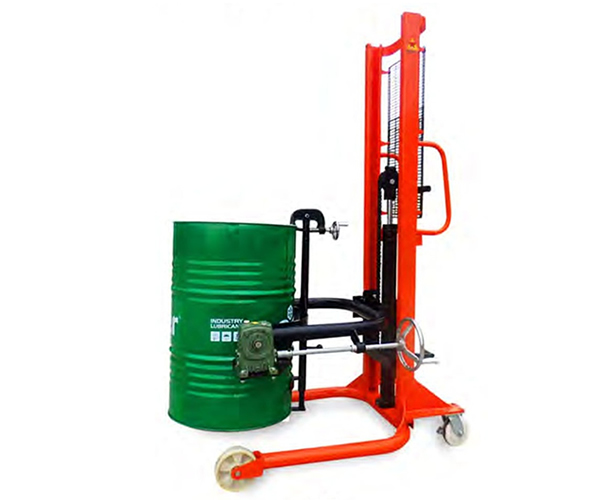 | DRUM HANDLING EQUIPMENT DRUM/BARREL STACKER-CUM-TILTER As the name indicates, most establishments have to handle drums/barrels of different sizes and materials on daily and/or regular basis. View product → |
Frequently asked questions
Which barrel characteristics affect drum stacker tilter positioning?
Check diameter, height, chime profile, head construction and surface condition. Plastic, thin-wall, open-head, tapered or dented barrels require compatibility checks before lifting.
What setup errors leave a barrel off-centre before lifting?
Common causes include incorrect gripper adjustment, poor barrel placement, damaged hooks, uneven contact and failing to align the drum axis with the rotation system.
How do wear, backlash and hydraulic drift change barrel position?
Worn pivots and hooks introduce play, backlash allows movement during rotation, and hydraulic drift or unequal cylinder movement shifts the barrel away from its intended position.
When should you stop adjusting the machine and call for service?
Stop when repeated setup corrections do not produce consistent alignment, the gripper slips, hydraulic movement is uneven, or you find damaged structural or gripping components.