

A barrel does not travel through a warehouse in one uninterrupted move: it is unloaded, identified, stored, retrieved, transferred to a process point, and eventually dispatched or emptied. By following the load from each hand-off to the next, you can define the operating sequence, prevent unstable lifts and turns, and avoid handling the same drum repeatedly.
Key takeaways
- Map every drum hand-off from unloading through dispatch before choosing equipment.
- Inspect the drum, rim and closures before selecting a clamp or cradle.
- Keep pedestrians clear during lifting, tilting, stacking and reversing.
- Record storage location, drum condition and ownership at every hand-off.
Map the drum’s route from receiving to dispatch
A drum’s route runs from vehicle unloading to inspection, identification, segregation, staging, storage, retrieval, dispensing or production, and finally dispatch or return-packaging disposal. The drum stacker titler warehouse process adds value when the container must be lifted, positioned, or rotated, not merely moved on a pallet.
- At receiving, check the drum, label, seal, batch details, leaks, and contents against the delivery record and SDS. Segregate flammable, corrosive, toxic, and incompatible materials before movement.
- Pick up the approved drum from the unloading or staging zone, keep it low during travel, and use marked aisles with clear visibility. If the load blocks the forward view, use a planned reverse route or spotter.
- Place the drum upright, horizontally, on a pallet, in a cradle, or at a defined rack position. Never treat the machine’s lift height as proof that a multi-tier stack is stable.
- Retrieve it for dispensing, decanting, or production, then return the empty drum to the waste or return-packaging area.
| Stage | Drum movement | Useful stacker-cum-tilter work |
|---|---|---|
| Receiving and staging | Unload and position for inspection | Lift from floor or pallet and move safely |
| Storage | Place upright or horizontal | Raise, align, and rotate to the approved orientation |
| Picking and production | Transfer to a dispensing or process point | Position the drum and tilt it for controlled access |
| Dispatch or return | Move full or empty drums to the loading area | Retrieve, orient, and place without double-handling |
This is how a drum stacker titler transfers barrels for through warehouse stages: it combines transport, lifting, positioning, and controlled rotation; a conventional pallet stacker does not provide that drum-rotation function.
Follow the drum tilter operating steps before every move
Run the drum tilter operating steps before every move, even when the drum is travelling only a short distance. Confirm the drum, attachment and destination match the planned handling task.
1. Inspect the drum for leaks, dents, loose bungs and damage to the chime or rim. Confirm its material, dimensions and filled mass.
2. Check the attachment’s rated capacity at the intended lift height and position. Do not rely on the base truck’s capacity plate; the clamp or cradle has its own limits.
3. Approach squarely and position the jaws or cradle at the manufacturer-specified engagement point. Close or seat the attachment, then confirm positive engagement.
4. Lift the drum only a short distance. Stop and check that it is fully supported, retained and stable before travelling.
5. Travel with the drum as low as practical, along a clear route, without sudden acceleration or braking. If it blocks forward visibility, use a defined reverse route or spotter; never carry it raised through a pedestrian aisle.
6. For rotation, stop on a level, suitable surface and secure the drum positively. Raise it to the required transfer height, rotate gradually, stop at the intended angle and verify stability.
7. Align the drum with the pallet, rack pocket, crib or floor-stack footprint. Lower it until the storage support carries the full load, then confirm the stack or drum is stable.
8. Open the clamp only after support is confirmed, withdraw clear, lower the empty attachment and complete a final stability check. Never use the tilter to force bungs, loosen stuck lids or pour through an unapproved opening.
Match the grip and movement to the drum’s condition
A drum’s material, size, mass and condition determine whether you can clamp, cradle, carry, tilt or stack it safely. Confirm the drum type, filled weight, dimensions, chime condition and leakage status before lifting; the base truck’s capacity plate does not prove that the drum attachment has the same rating at that lift height.
| Condition | Handling effect | Required control |
|---|---|---|
| Steel drum | Rigid chimes suit approved clamp jaws; dents can distort the gripping surface. | Clamp only sound rims and verify jaw engagement. |
| Plastic drum | Thin walls or moulded ribs can deform under concentrated force. | Use an attachment rated for that drum design, often a cradle or full-body support. |
| Large or heavy drum | Greater diameter, height and filled mass increase tipping force and reduce rated capacity. | Check the attachment rating at the actual position and lift height; never infer capacity from drum size alone. |
| Partly filled drum | Liquid shifts during acceleration, braking and rotation. | Travel slowly, keep the drum low and upright, and tilt in a controlled movement. |
| Leaking, bulged or damaged drum | A compromised chime can release the load; leakage creates a slip and contamination hazard. | Isolate it, contain the spill and follow the site’s damaged-container procedure instead of clamping it. |
In a drum barrel stacking workflow, lifting is not stacking: align the drum with the pallet, rack pocket, crib or floor footprint, lower it until fully supported, check stability, then release and withdraw. Lower the empty attachment afterward so it cannot strike a person or create a pinch point.
Define upright or horizontal storage, maximum tiers and permitted drum combinations; maximum lift height does not prove stack stability.
Create one hand-off plan for storage, production and dispatch
Use one named hand-off route and one owner at each transfer: receiving inspects and identifies the drum, storage assigns its location, production requests a specific drum, and dispatch receives only released stock. This drum barrel stacking workflow prevents a pallet from being unloaded, rehandled for storage, then moved again to production.
- Receiving checks the drum, label, seal and leak status at unloading. Quarantine damaged or leaking drums; do not send them into normal storage.
- The team records the drum number, contents, hazard class and destination, then assigns an upright or horizontal storage position. Keep incompatible contents in separate, marked locations.
- The trained operator collects the drum from the unloading zone with the stacker-cum-tilter, using the correct rim or cradle. Travel through marked aisles with the load low, not at rack height.
- Place the drum directly on its pallet, cradle, rack pocket or approved floor footprint. Lower until the support carries it, confirm stability, then release the clamp and withdraw.
- Storage marks the location as available, reserved or quarantined. Production’s request names the drum and process point, so the operator retrieves it once rather than creating a temporary staging pile.
- At dispensing or production, rotate the secured drum only after it is stable and the receiving equipment is ready. Return the empty drum directly to the waste or return-packaging area.
- Dispatch verifies the release status and moves the full or empty drum to the loading zone without routing it back through storage.
This drum stacker titler warehouse process saves handling only when every hand-off has a destination, record and safe support. Maximum lift height does not prove a stable stack.
Specify the machine and route for a Nagpur warehouse
1. Measure the route from vehicle unloading through inspection, staging, storage, picking, dispensing or production, and dispatch. Record aisle width, turning clearance, dock level changes, floor load rating, rack beam height, pallet condition, pedestrian crossings, emergency exits, and the narrowest doorway.
2. Specify the machine from the heaviest filled drum, not the empty shell. Verify drum diameter, height, material, chime condition, leakage status, and attachment position, then check rated capacity at the required lift height. The base truck’s capacity plate does not prove that the drum clamp or tilting attachment has the same rating.
3. Choose powered pedestrian equipment when the operator walks with the machine; choose a rider-operated industrial truck only when the traffic plan, operator training and inspection system support it. Confirm Indian and Maharashtra requirements with your safety and statutory-inspection personnel. Use OSHA powered-industrial-truck rules only as a comparison benchmark.
4. Test the route during Nagpur’s monsoon and hottest operating conditions. Check dock and yard water, wet or contaminated floors, dust, corrosion exposure, battery charging temperature, hydraulic response, braking and traction. Provide an indoor charging and maintenance area; standing water and oil can turn a short transfer into a spill or collision.
5. Before purchase, run a loaded trial through the tightest aisle and highest placement point. Confirm that the drum stays low during travel, remains within forward visibility, and rotates only while stopped, level and positively secured.
6. Ask Aguatech Engineers Pvt.ltd. to document the selected attachment’s capacity, drum compatibility, inspection points and route-trial results rather than accepting a generic catalogue rating. That record gives your warehouse drum handling in Nagpur a defensible basis for selection and training.
Related product
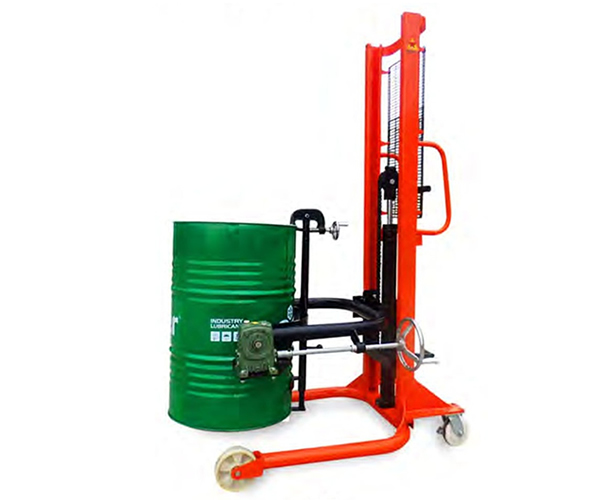 | DRUM HANDLING EQUIPMENT DRUM/BARREL STACKER-CUM-TILTER As the name indicates, most establishments have to handle drums/barrels of different sizes and materials on daily and/or regular basis. View product → |
Frequently asked questions
What stages should a drum follow through a warehouse?
Map the route from vehicle unloading to inspection, identification, segregation, staging, storage, retrieval, dispensing or production, and dispatch or return-packaging disposal.
What are the essential drum tilter operating steps before each move?
Confirm the drum identity and condition, inspect the grip area and closures, check the route and destination, secure the load, clear pedestrians, then lift, travel and place it under controlled speed.
How do you match the grip and movement to a drum’s condition?
Use a grip that suits the drum’s rim, shape and material. Do not clamp a dented, leaking or badly corroded drum until the responsible safety or operations team approves a different handling method.
How should storage, production and dispatch hand-offs be planned?
Assign one named hand-off point, record the drum identity and condition, define the next destination, and confirm who controls the equipment before each transfer.