

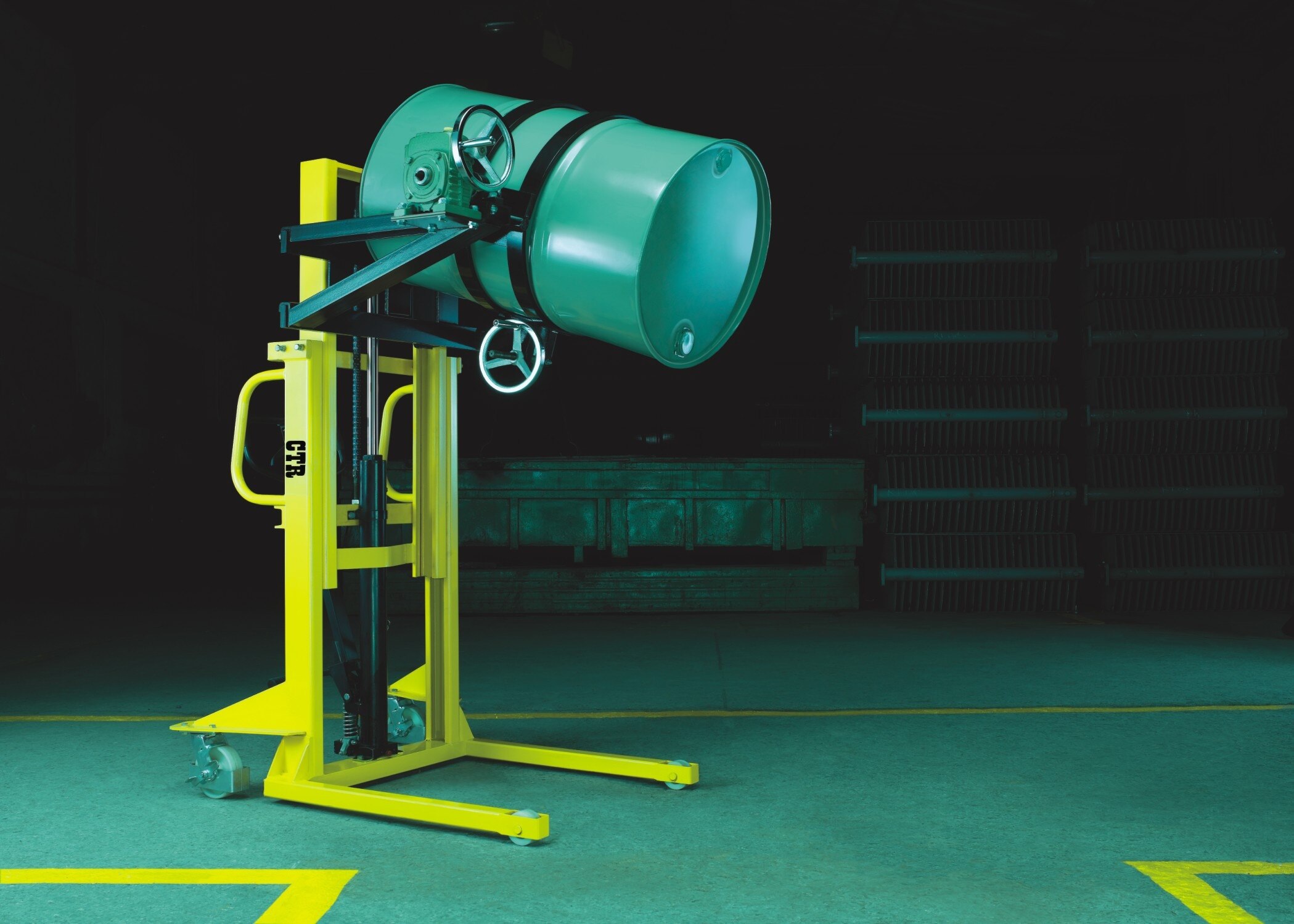
The right machine depends on more than a drum’s weight or a brochure’s maximum lift. Define the drum, work cycle, site constraints and control requirements first, then compare machines using rated capacity at the actual load centre, tilt position and working environment.
Key takeaways
- Confirm drum type, weight, dimensions and centre of gravity before selecting.
- Calculate usable tilter capacity at the actual load centre.
- Measure aisles, stacking height, floor condition and turning space.
- Compare tilt control, testing, service response and operating costs.
Match the machine to the drum-handling work cycle
A suitable drum stacker-cum-tilter must capture the correct drum, lift it with the required load centre, travel under control, rotate it to the working angle, position it, and release it without sudden movement.
Confirm the drum first: steel, HDPE or fibre construction; nominal volume; outside diameter; height; rim or bead shape; bung position; and filled mass. A clamp made for a standard steel rim can slip on a tapered HDPE drum or damaged bead.
- Capture: the clamp or gripper must engage the rim or body without crushing it, and include protection against unintended release when power is lost.
- Lift and travel: require a load chart for the actual attachment, lift height and load centre, plus controlled lowering and a parking brake or equivalent restraint.
- Tilt and place: check controlled rotation, hydraulic load-holding valves, mechanical locks or brakes, and enough reach to align the drum with a pallet, rack or filling point.
- Release: confirm the drum is stable before opening the gripper; never treat the base machine’s capacity as the attachment’s capacity.
| Option | Best suited to | Cannot replace |
|---|---|---|
| Drum stacker-cum-tilter | Lift, move, stack and rotate drums | General forklift duties without rated approval |
| Drum grab | Secure vertical transport | Controlled pouring or horizontal positioning |
| Drum shifter | Short-distance repositioning | High stacking or precise tilt |
| Forklift drum attachment | Existing forklift operations | Compact aisles without checking stability |
| Pallet stacker | Palletised loads | Safely gripping an individual drum |
Compare drum stacker tilter options in nagpur by cycle time, residual capacity, aisle performance and release control, not unit price alone. Choose another attachment when the job requires only shifting, pallet handling or pouring without stacking.
Specify the drum and calculate usable tilter capacity
Start with the heaviest filled drum, not its nominal volume. Record whether it is steel, HDPE or fibre; its capacity, outside diameter, height, rim or bead shape, bung position, damaged areas and gross filled mass.
A clamp designed for a straight-sided steel drum can slip on a tapered HDPE body or crush a weak fibre rim.
Ask the supplier to demonstrate capture and release on your actual drum. Check that the jaws engage the rim or body without covering the bung, that the grip remains secure during travel and rotation, and that power loss does not release the load.
Require a hydraulic load-holding valve, mechanical lock or brake; “hydraulic operation” alone proves nothing.
Calculate drum tilter capacity from the load chart, not the machine’s headline rating. Require figures for each lift height, tilt angle and forward load centre, with the actual drum attachment fitted. Use this screening check:
- Total lifted mass = filled drum mass + attachment mass.
- Load moment = each mass multiplied by its horizontal distance from the mast or rated pivot.
- Compare that moment with the chart value at your highest lift, farthest load centre and required tilt position.
Do not subtract attachment weight twice if the manufacturer’s chart already includes it. Reject a rating that covers 350 kg only at a short load centre when your tall drum sits farther forward or horizontally.
This is the central rule in any industrial drum stacker buying guide: usable drum tilter capacity is the chart rating under your exact conditions.
Check aisle, stacking and floor requirements before choosing
A 100 mm clearance on paper does not make a safe aisle. Measure the narrowest travel lane, turning space and obstruction when the drum is loaded, not when the machine is empty.
Your drum stacker cum tilter selection in Nagpur must also reflect the actual steel, HDPE or fibre drum, its filled mass and the clearance needed around its rim.
| Site measurement | What to record | Why it can disqualify a machine |
|---|---|---|
| Aisle and turning area | Narrowest aisle, end clearance, turning radius and rear swing | A compact powered stacker can swing into racks or people while turning |
| Lift and stacking envelope | Required placement height, drum height, mast height, tilted projection, beams, sprinklers, doors and truck bodies | A nominal lift height becomes unusable when the mast or tilted drum hits an overhead obstruction |
| Floor route | Joint width, threshold gaps, ramp gradient, dock-plate angle and floor levelness | A wheel can drop into a gap, or a manual unit can lose control of a loaded drum on a slope |
| Loading-bay access | Door width, dock height, approach space and trailer clearance | The machine may lift safely inside but fail to enter, exit or align at the bay |
Request a dimensioned drawing showing wheelbase, minimum turning radius, mast height, load-centre limits and maximum tilted envelope. Compare those figures with the tightest point, not the average aisle.
Run a site trial with a filled representative drum. Check that the machine can:
- Travel across joints and thresholds without drum movement.
- Turn without striking racks, walls or parked vehicles.
- Lift to the intended stack or rack position with overhead clearance.
- Place and release the drum while remaining level and stable.
Verify tilt control, stability, power and operating conditions
Do not approve a drum tilter until it demonstrates controlled lowering and rotation with the actual drum, load centre and lift height. A hydraulic system alone proves nothing: ask whether load-holding valves, mechanical locks or brakes stop a raised or tilted drum drifting, and whether the grip prevents unintended release after power loss.
1. Test rotation through the full operating angle. Check smooth stopping, a positive parking brake or equivalent restraint, and visibility of the drum during positioning.
Require a capacity chart showing the allowable load at each lift height, tilt angle and forward load centre; a 350 kg rating at a short load centre does not cover a tall, offset drum held horizontally.
2. Check stability with the filled steel, HDPE or fibre drum you will use. Confirm the rim, bead, taper and bung position suit the clamp, then test travel, braking and turning at maximum permitted lift. A compact low-cost unit can lose residual capacity and control at maximum height.
3. Match battery capacity to the shift: lifts, travel distance, rotations, charging access and recharge time. Ask for duty-cycle limits, battery life, charger requirements and performance during voltage drop, rather than accepting a nominal battery rating.
4. For solvents, paints or fuels, identify the Nagpur site’s hazardous-area classification before comparing drum stacker tilter options in Nagpur. Require matching electrical, earthing, static-control and component documents; closed drums do not make ordinary electrical equipment suitable, and ATEX marking alone does not confirm site suitability.
For outdoor use, verify protection against rain, dust, monsoon exposure, corrosion and storage temperature. Include service response and annual maintenance in the weighted comparison, not just purchase price.
Compare suppliers using service, testing and total operating cost
A low quotation is not a low operating cost if a failed clamp or charger stops dispatch. Before accepting any offer, require evidence that the quoted machine works with your drum, load centre, lift height and floor conditions.
| Comparison point | Require before purchase | Cost or safety consequence |
|---|---|---|
| Capacity | A nameplate or load chart covering the actual attachment, drum weight and lift height | The base truck rating can overstate usable capacity |
| Fit and clearance | A dimensioned drawing showing mast height, turning radius and maximum tilted envelope | Sprinklers, beams or doors can make nominal lift unusable |
| Safety functions | Demonstration of controlled lowering, rotation, parking brake and protection against power-loss release | Load-holding valves, mechanical locks or brakes prevent drift |
| Service | Inspection schedule, seal and hose intervals, battery and charger support, spare-part list and written response time | Delayed repairs increase downtime |
| Acceptance testing | Recorded load test, operator training and a test with your actual drum | A brochure cannot prove grip or stability |
Compare annual maintenance, battery replacement, charging energy, tyres, clamp components and technician travel—not only purchase price. Include hazardous-area classification, earthing, static-control and electrical documentation for solvents, paints or fuels; closed drums do not make ordinary equipment safe.
Your industrial drum stacker buying guide should score service response, residual capacity and duty cycle alongside price. Ask Aguatech Engineers Pvt.ltd. for the same evidence you request from every barrel stacker supplier in Nagpur, so the comparison measures support rather than sales claims.
Related product
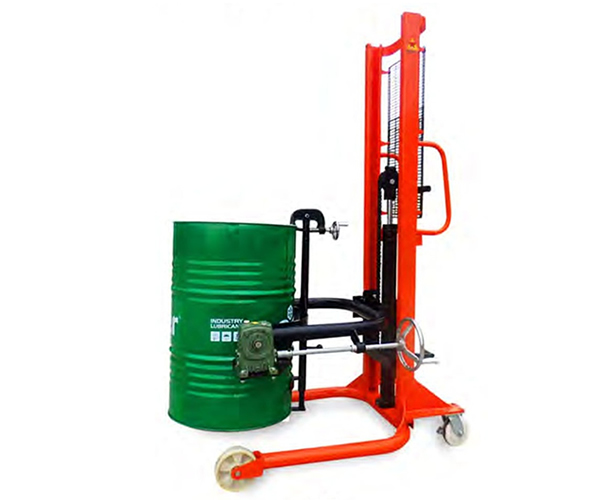 | DRUM HANDLING EQUIPMENT DRUM/BARREL STACKER-CUM-TILTER As the name indicates, most establishments have to handle drums/barrels of different sizes and materials on daily and/or regular basis. View product → |
Frequently asked questions
How do you match a drum stacker-cum-tilter to the work cycle?
Map each step from drum capture and lifting through travel, tilting, positioning and release. Choose controls and travel functions that prevent sudden movement during that cycle.
How do you calculate drum tilter capacity?
Use the drum’s filled weight, dimensions and load centre, then check the rated capacity at the required lift height and tilt position. Do not rely only on the drum’s nominal weight.
What site conditions must you check before buying a drum stacker?
Measure aisle width, turning clearance, stacking height, floor strength and levelness. Confirm that the machine can reach the intended rack or storage position without obstruction.
What should you compare among barrel stacker suppliers in Nagpur?
Compare tilt-control performance, stability, power requirements, operator safety features, inspection records, spare-parts access, service response and total operating cost.