

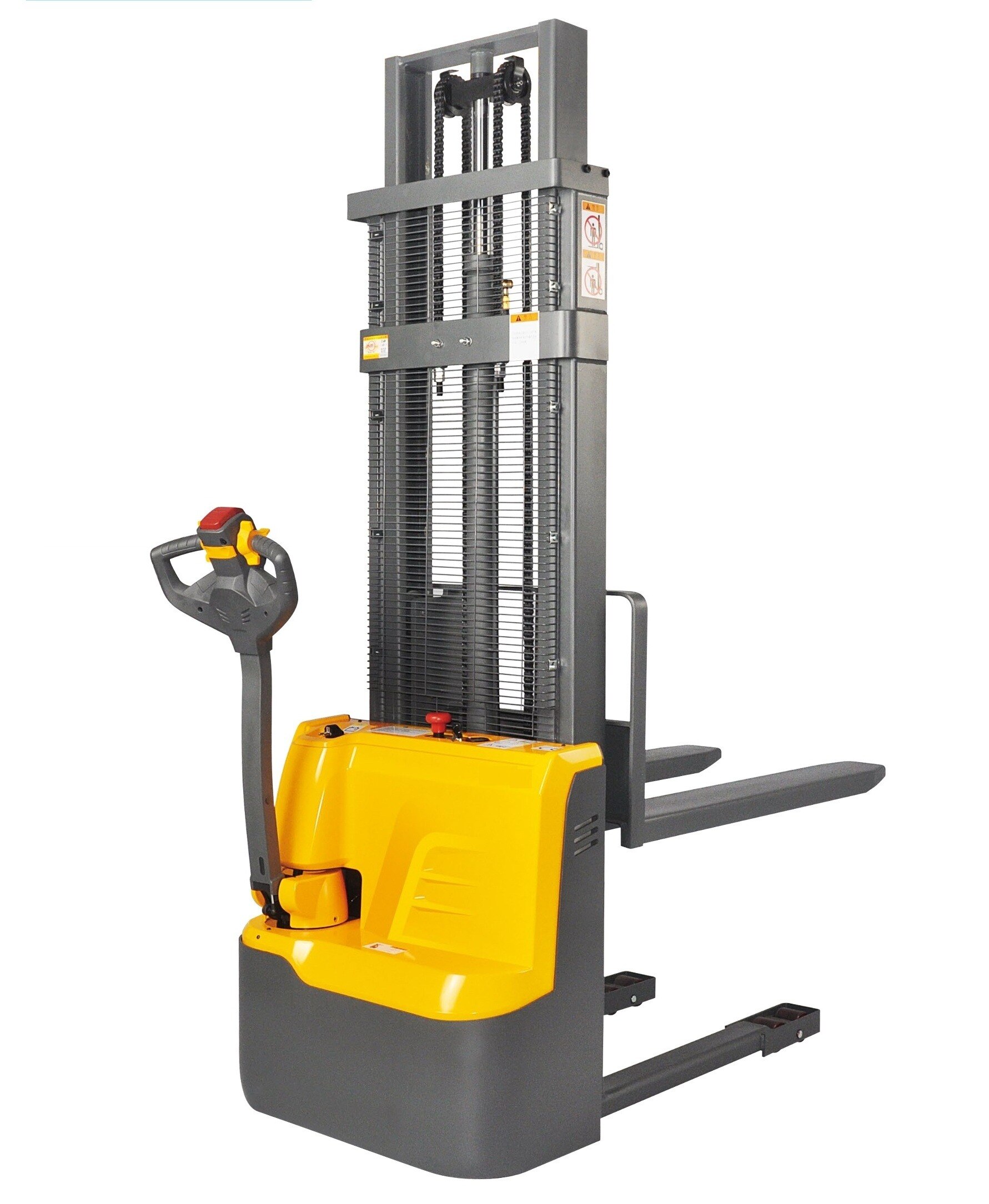
Choosing the wrong stacker can leave you short of capacity at height, unable to clear a doorway, or without enough battery for a full shift. Use the machine’s capacity plate, load geometry, site measurements, duty cycle, and safety controls to create a specification that fits your workplace before you compare quotations.
Key takeaways
- Rate capacity at your actual load centre, not the headline lifting capacity.
- Measure aisle width, doorway height, turning space and floor transitions before ordering.
- Match battery capacity and charging time to your shifts and daily operating hours.
- Request safety controls, Indian compliance documents and a complete written specification.
What “full electric” means when you compare stackers
A full electric stacker powers all three working functions: battery-electric travel, powered fork lifting, and powered lowering through controlled hydraulic operation. The operator selects direction and lift movement instead of supplying the force.
| Option | Travel | Lifting and lowering |
|---|---|---|
| Manual stacker | Operator pushes | Operator pumps; lowering is manually controlled |
| Semi-electric stacker | Manual or powered | Travel or lifting remains manual |
| Full electric stacker | Battery-electric | Powered lift and controlled hydraulic lowering |
“Full electric” does not mean unlimited runtime, zero maintenance, outdoor suitability, hazardous-area approval, or permission for untrained operators. Battery charging, inspections, brakes, wheels, forks, hydraulics, and operator training still determine safe use.
Record the exact truck configuration before comparing quotations:
- Walk-behind, platform, or rider
- Fork length, width, and dimensions
- Steering arrangement and operator position
- Battery chemistry and capacity
- Intended floor condition, gradients, load type, and duty cycle
The phrase full electric stacker for engineering workplaces is a commercial buying term, not a regulatory truck class. Use the manufacturer’s model classification, capacity plate, operating manual, and site risk assessment to define the equipment and training required.
The main purchasing test is direct: can the specified machine move your actual load through the actual route, for the required shifts, while retaining the required residual capacity?
Select capacity from the load centre, not the headline number
Measure the heaviest die, tooling pack, component pallet, fabricated part, raw-material pallet, or finished-goods load before choosing a full electric stacker. In engineering material handling, load geometry can matter as much as weight.
1. Record the load’s weight, length, width, height, centre of gravity, pallet entry direction, and whether it is eccentric or flexible. Long dies and asymmetric skids can move the effective centre of gravity forward or sideways, increasing forward-tipping risk.
2. Specify rated capacity together with load-centre distance, maximum lift height, mast configuration, and attachment. Request a capacity chart or plate stating allowable capacity at the intended height and load centre; reject a quotation that gives only a maximum figure.
Residual capacity falls as lift height rises or as the load centre moves beyond the plate value.
3. List every attachment: side-shifter, fork extensions, clamp, drum handler, or custom fixture. Each can reduce capacity, alter stability, and obstruct visibility. Require written manufacturer approval for capacity-affecting modifications, revised capacity marking where applicable, and a visibility review before use.
4. Ask the supplier to confirm fork length and fit for the load. Forks that are too short leave the centre unsupported; excessive projection can restrict aisles and shift the effective load centre forward.
Check the factory route before choosing lift height or truck size
Measure the route before selecting an electric stacker for factories. Record clear aisle width, turning radius with the chosen pallet, fork projection, rack-end clearance, and pedestrian crossings. Measure the lowest obstruction—doors, beams, lights, sprinklers, pipes, or mezzanine edges—and compare it with the collapsed mast height.
- Check doorway and trailer heights, dockboard transitions, ramp gradient, floor joints, pits, damaged concrete, wheel loads, and the smallest wheel’s ability to cross each defect.
- Ask for gradeability with the intended load on the actual surface; an unloaded figure is not enough.
- Specify operating temperature, dust, moisture, outdoor exposure, and any hazardous atmosphere.
Free lift raises the load without extending the mast. Specify it when a pallet must clear a low doorway or trailer roof while the mast remains below the obstruction.
Mast choice changes more than lift height:
| Arrangement | Compare before buying | Main trade-off |
|---|---|---|
| Duplex | Moderate storage levels, visibility, overhead clearance, residual capacity | Simpler access and maintenance |
| Triplex | Higher storage, free lift, collapsed height, visibility, residual capacity | More mast obstruction, stability demands, and maintenance access |
Separate pedestrian paths at blind corners. Include horn, speed limits, sight lines, and warning controls in the layout. This check matters for a full electric stacker for engineering workplaces because quiet travel can hide an approaching load.
Compare travel, lifting and braking performance under a full load
Compare empty and loaded results on the same floor, route, battery state, mast height and operating mode. Ask for these figures with the truck empty and loaded to its specified capacity:
| Measure | Empty test | Rated-load test |
|---|---|---|
| Rated lift and lowering speed | Record both speeds | Record both speeds |
| Travel speed and acceleration | Measure on the route | Measure with forks loaded |
| Braking distance | Test on level floor | Test with the rated load |
| Gradeability and turning radius | Record manufacturer’s values | Verify on site gradients |
| Noise level | Measure at the operator position | Measure during travel and lifting |
Check whether travel speed changes when the forks are raised, the battery is low, the mast is extended, or a creep or economy mode is selected. Test smooth creep movement at racks, inspection stations, machine tools, dock edges and staging lanes; harsh stopping can shift a die or fabricated part.
Confirm that tiller or platform controls preserve a clear view of fork tips and load corners. Compare regenerative braking, service braking, parking-brake engagement and rollback control on each site gradient.
For engineering material handling, use the longest load and hardest centre of gravity, not only a standard pallet. Include daily inspection, wheel and fork wear, hydraulic-leak checks and service access in time cost. Demand a complete route demonstration, not a showroom run.
Match battery, charger and shift pattern to the duty cycle
Choose the battery by duty cycle: shifts per day, travel distance, lift cycles, peak load, charging windows, ambient temperature, and available electrical supply. For a full electric stacker for engineering workplaces, ask for usable energy and expected runtime under your planned load cycle, not only nominal voltage and ampere-hours.
| Option | Operating fit | Requirements |
|---|---|---|
| Lead-acid | Planned single-shift use | Charging time, cooling time, watering, ventilation, spill response, and battery removal |
| Lithium-ion | Multiple shifts or short charging windows | Opportunity charging, compatible charger, battery-management alarms, thermal protection; higher initial cost |
Lead-acid systems need battery-change space, suitable lifting equipment, and a procedure for electrolyte spills. Lithium-ion buyers must confirm warranty coverage and replacement arrangements.
Locate chargers away from vehicle impact, wet processes, combustible storage, and pedestrian pinch points. Provide a marked charging bay with a parking-brake procedure and protected cables.
- Verify input voltage, phase, earthing, connector type, charger rating, and whether one charger supports the required number of batteries or trucks.
- Model each shift with charging downtime and low-temperature performance included.
An electric stacker for factories is not ready for continuous work because it has a plug; prove coverage against the actual route, load and schedule.
Verify safety controls, Indian compliance and the supplier’s specification
A pre-order checklist for a full electric stacker must test the machine, paperwork and workplace together. An electric stacker for factories is suitable only when its controls protect operators during the actual engineering material handling route.
1. Demonstrate the emergency stop, parking brake, dead-man control, horn, reverse alarm where the risk assessment requires it, speed reduction, steering-tiller design, travel interlocks, mast and lift interlocks, load backrest, fork guards, operator guarding, visibility, battery protection and protection against movement while charging.
2. Require the operator and service manuals, capacity plate, load charts, wiring diagram, charger documents, inspection schedule, spare-parts support and operator-training materials. Ask Aguatech Engineers Pvt.ltd., or any competing supplier, to state residual capacity at the requested height, battery duty-cycle assumptions, mast collapse height, grade rating, attachments, exclusions and acceptance-test criteria in the quotation.
3. Compare those documents and the site risk assessment with the Factories Act, 1948 and the Occupational Safety, Health and Working Conditions Code, 2020, as adopted and enforced by the relevant authority. Verify which law applies to your workplace; neither replaces equipment-specific instructions or training.
Make commissioning acceptance depend on a loaded test through the actual aisle, doorway, gradient, rack approach and pedestrian route. Choose the documented operating envelope, not the lowest headline price.
Frequently asked questions
What does full electric mean in a stacker?
A full electric stacker uses battery power for travel, fork lifting and controlled hydraulic lowering, so the operator does not manually push or pump the truck.
How do you select the right stacker capacity?
Use the load’s weight, dimensions and load centre together. Confirm the rated capacity at the lift height you need rather than relying on the headline figure.
What should you check on the factory route?
Measure aisle width, doorway and beam clearances, turning space, floor condition, ramps, dock edges and route obstructions before selecting truck dimensions or lift height.
How should battery and charger capacity match operations?
Compare battery capacity, charging time and charging access with travel distance, lifting frequency, operating hours and the number of shifts.
Which safety and compliance details belong in the supplier specification?
Request details for emergency stop, braking, horn, travel controls, overload protection, mast and guard design, battery protection, rated capacities and Indian compliance documentation.